





Introduction
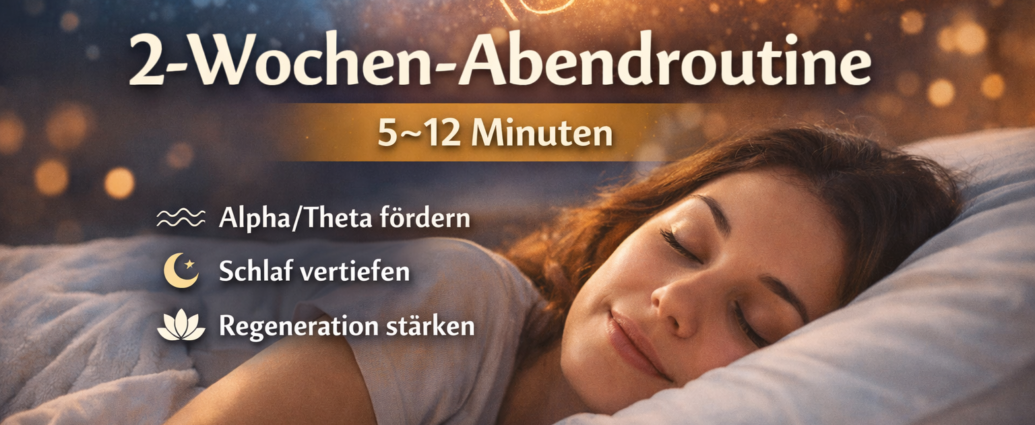
When the day has been full, it is often not the body that cannot „switch off“ - but the nervous system. This is exactly where this 2-week evening routine (5-12 minutes) It will help you to make targeted from activation (Beta) in Relaxation (Alpha) and into a Sleep-friendly sedation (theta proximity) change - without pressure, without complicated methods.
This routine is deliberately kept short so that it remains realistic. You don't need any devices, apps or previous experience - just a quiet space and a few minutes.
Note: This routine is a Self-help and relaxation routine. It does not replace a medical examination for sleep disorders, depression, anxiety disorders or physical complaints.
Why an evening routine can be so effective in the first place
Sleep is not a „button“ that you press - sleep is a Condition, which the body prepares. Two things are particularly important for this:
- Stimulus reduction (light, input, emotional activation)
- parasympathetic activation (Breathing, body awareness, safety signals to the brain)
The goal is not to „fall asleep immediately“, but rather:
„I make it easy for my nervous system to calm down.“
The rules of the game (to make it work)
- Shorter is better: 5-12 minutes is enough.
- Every evening - even if it's not perfect.
- No performance: When thoughts come, that's normal.
- Same order: This trains the brain to send a „now is sleep time“ signal.
Week 1: Stabilize & wind down (5-8 minutes)
Week 1 is all about strengthening the nervous system. to relieve. You train: „I am safe - I can let go.“
Step 1 (1 minute): „Light & input down“
- Screen off or at least night mode + brightness down
- Room as dimmed as possible
- If possible: 1-2 minutes quietly, without music, without messages
Mini-sentence (in the head): „Today is enough. Now the break begins.“
Step 2 (2 minutes): 4-6 breathing (parasympathetic anchor)
Breathe 4 seconds on, 6 seconds off.
Repeat this calmly for 8-10 breaths.
If this makes you feel „stressed“, take it instead:
3 seconds on - 5 seconds off.
Step 3 (2-3 minutes): Body scan „3 points“
Direct your attention to one after the other:
- Pine (leave loose)
- Chest (soften)
- Belly (let it sink as you exhale)
You don't have to „feel“ anything. It is enough that you direct your attention there.
Step 4 (1-2 minutes): „Park your thoughts“
Take a notebook (or piece of paper) and write:
- 3 Keywords, that occupy your thoughts
- next to it 1 mini-step for tomorrow (max. 1 sentence)
Example:
„Appointment - invoice - call → Call back tomorrow at 10:00.“
Then close the notebook. That's it.
Week 2: Deepen & support sleep pressure (8-12 minutes)
Week 2 builds on week 1 - only a little „deeper“: you promote more inner peace, less circling of thoughts and more physical heaviness.
Step 1 (2 minutes): Breathing + humming (optional, very effective)
Breathe in calmly - and as you breathe out you hum softly („mmmm“), approx. 6-8 exhalations.
Why it helps: Humming often creates a noticeable „sinking“ sensation in the chest/neck area and is experienced by many as calming.
If humming is not your thing: leave it out.
Step 2 (3 minutes): „Heaviness & warmth“ (autogenous style light)
Tell yourself inwardly - slowly and kindly:
- „My shoulders are getting heavy.“
- „My arms are getting warm.“
- „My stomach is getting quiet.“
- „My face is getting soft.“
You don't have to force anything. You just give signals.
Step 3 (2 minutes): Micro-relaxation over eyes
Many people underestimate how strongly the eyes activate the brain.
- Close your eyes.
- Imagine looking „behind your forehead“ into the darkness.
- Let the eyes become „wide“, not focused.
When thoughts come: kindly return to the darkness.
Step 4 (1-3 minutes): „3 sentences conclusion“
Finally, say three short sentences (inwardly or quietly):
- „I'm done for the day.“
- „My body is allowed to regenerate.“
- „Everything else will come tomorrow.“
Common stumbling blocks (and what you do then)
„I wake up even more during the routine.“
→ Then shorten to only 2 minutes of breathing + 1 set of finishes for 3 days. Then increase again.
„My thoughts don't stop.“
→ Normal. The goal is not „no thoughts“, but:
do not go along. A thought is like a car - you don't have to get in.
„I can't make it every night.“
→ Then do it as a „minimum“: 1 minute 4-6 breathing. That's what counts.
For whom this routine can be particularly helpful
- if you find it hard to switch off in the evening
- when you're „tired, but inwardly revved up“
- during periods of stress, emotional overload, too much input
- As an accompaniment to regeneration during physical exertion
Also in the context of serious illnesses (e.g. cancer) sleep and regeneration can play a major role in quality of life and stability - it is always important to draw clear boundaries: This routine is supportive, not a substitute.
Disclaimer
Frequency therapy bzw. Information medicine ist schulmedizinisch nicht anerkannt. Die Inhalte dienen der Information und ersetzen keine medizinische Diagnose oder Behandlung. Bei Beschwerden oder Verdacht auf Erkrankungen wenden Sie sich bitte an Ärztinnen/Ärzte oder andere medizinische Fachpersonen.


Comments are closed, but trackbacks and pingbacks are open.