



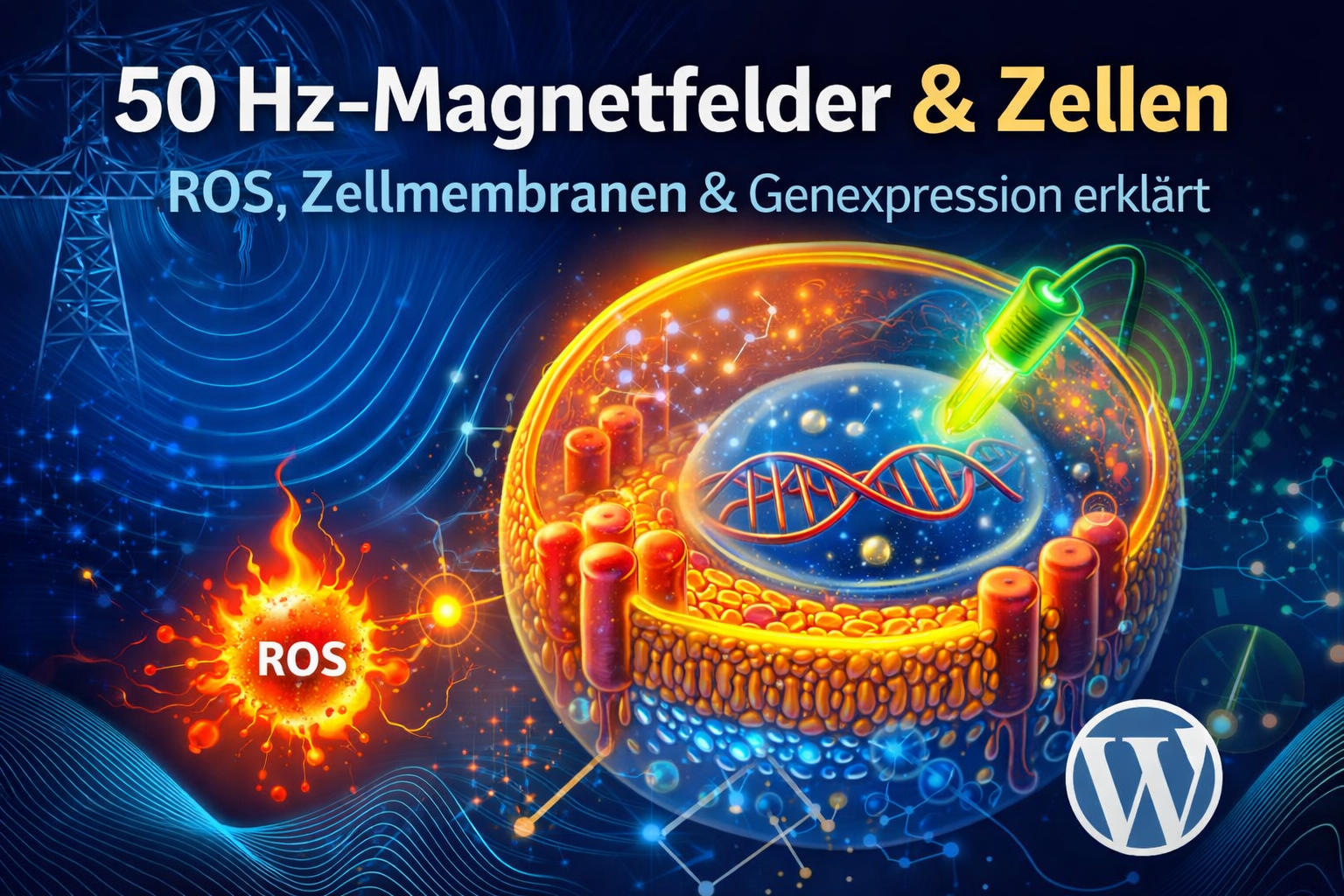
Many people immediately associate „50 Hz“ with power lines, household electricity and the question: Can this have a biological effect? The scientific discussion here is complex - and that is precisely why it is worth taking a closer look at the possible mechanisms soberly: What processes are even discussed in cells when extremely low-frequency magnetic fields (ELF-MF) are involved?
A review article from the field of electrical engineering/biophysics summarizes several hypotheses - including. reactive oxygen species (ROS), Cell membranes as „signal collectors“ and Changes in gene expression. Evaluation_of_how_low_frequency...
1) Biological effect ≠ disease (and why this distinction is important)
Research emphasizes that a biological effect initially only means: A cell or an organism reacts to a stimulus. This is not automatically synonymous with illness.
Especially with weak environmental factors, the Cause-effect relationship difficult because many influences act simultaneously in everyday life - and correlations can quickly be overestimated.
2) ROS & free radicals: Why they are at the center of the discussion
A frequently discussed approach: 50 Hz fields could influence processes that affect the ROS balance (oxidative balance).
ROS and free radicals are highly reactive. In chain reactions, they can damage macromolecules such as DNA; the text also mentions that this can result in Mutations can arise, which potentially can be malignant.
Important for the classification (also in the direction of cancer):
This is a Biochemical possibility (mechanism hypothesis), but not a statement along the lines of „50 Hz causes cancer“. Instead, the article emphasizes how difficult it is to establish clear cause-and-effect relationships in real environmental situations.
3) Cell membranes as an „antenna“: How is a weak signal supposed to „arrive“ at all?
One particularly exciting idea: due to the low energy of such fields, a signal „cumulative“ in order to be biologically detectable. For this biological membranes as a possible „collecting structure“ - figuratively like a kind of antenna that bundles signals and translates them into signal paths.
Why membranes?
- Wear membranes electrochemical potentials,
- contain receptors/proteins,
- and changes in membrane structure/protein activity could influence downstream substance transport, enzyme activity and signaling cascades.
4) Gene expression: Small stimuli - many responses?
The overview describes how even weak influences can cause changes in the Gene expression which makes the evaluation complicated.
As an example, a study is cited in which a 50 Hz field (1 mT) induced the expression of over 900 genes although some of these findings could not be confirmed using other methods.
Takeaway: Gene expression is a very sensitive system - changes do not automatically mean „damage“, but can provide indications, where biological reactions could take place.
5) How do you measure something like this? Fluorescence probes as a „live window“ into the cell
The article proposes to analyze effects on membranes and ROS with Fluorescence probes to make them more visible - because some of them in real time sehr subtile Veränderungen beobachten kann (z. B. Membrane potential, ROS-Niveaus, Ionen wie Ca²⁺).
Depending on the chemistry, fluorescent probes can react specifically to ROS and change their fluorescence properties.
6) Classification of frequency therapy (and why differentiation counts)
In the frequency therapy scene, people often talk about „oscillation“, „resonance“ and „biological signaling pathways“. Scientific purity is crucial here:
- Environmental ELF fields (50 Hz) are not the same as targeted therapeutic applications.
- Mechanisms such as Membrane potential, Signal transduction, ROS regulation are basically plausible biological „docking points“ - but the Dose, Field strength, Exposure duration, Cell type and Measurement methodology decide.
- Especially for sensitive topics such as Cancer diseases careful language is important: „discuss mechanisms“ ≠ „claim effectiveness“.
Wenn du Frequency therapy nutzt (oder darüber nachdenkst), ist ein guter Ansatz: Asking questions instead of making promises. For example:
- Which parameters are used (frequency range, intensity, duration)?
- Which target process is hypothetical addressed (stress regulation, sleep, well-being)?
- Which boundaries are communicated transparently?
7) Practical reader check: 5 questions you should always ask yourself when reading EMF articles
- Does the text talk about biological effects or via Disease risks?
- Become Measurement methods (e.g. fluorescence probes, gene expression analyses)?
- Are there any indications of Uncertainty/reproducibility? (Membrane experiments partly difficult to reproduce)
- Become Strength/unit (e.g. mT) and realistically classified?
- Is placed neatly between Hypothesis and Proof separated? (Primary receptor remains unclear)
Conclusion
Research on 50 Hz magnetic fields primarily discusses ROS-related effects, Cell membranes as a possible signal collection structure and Changes in gene expression - At the same time, central points (such as the „primary receptor“) remain open.
This is particularly important for frequency therapy as Biophysical framework interesting - not as a carte blanche for promises of a cure, especially not in the context of cancer.
Sources (short)
- Sztafrowski D., Wróblewski Z., Łukaszewicz M. (2011): Evaluation of how low frequency magnetic field 50 Hz affect living cells.
Disclaimer
Frequency therapy is not recognized by conventional medicine. The contents are for information purposes only and do not replace a medical diagnosis or treatment by a doctor or alternative practitioner. In case of complaints or suspicion of a serious illness (especially cancer), please always seek medical clarification.
Author: NLS Informationsmedizin GmbH, Herbert Eder