




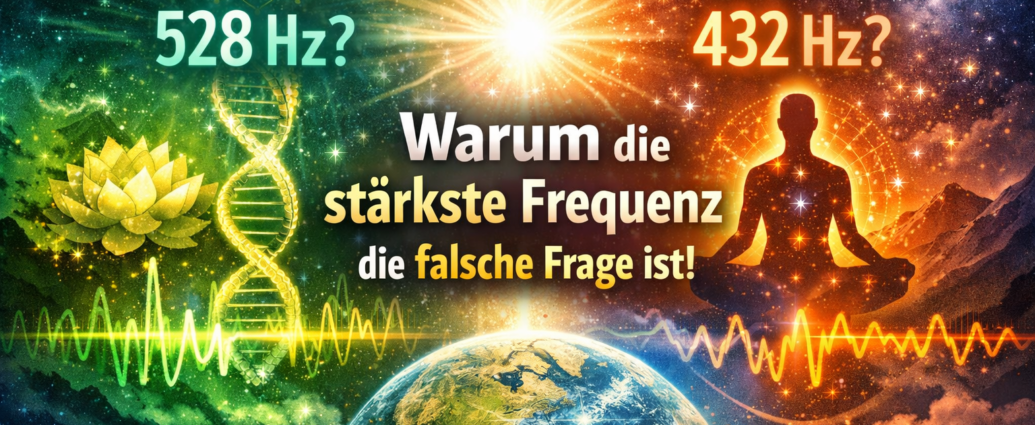
Many people today come across statements such as ‘528 Hz is the strongest frequency’ or ‘432 Hz heals the body’. These sentences sound simple. They give hope. And they spread quickly. But this is where the problem begins. The question of the strongest frequency falls short and is often misleading. Especially when it comes to health, regeneration or chronic complaints.
The Solfeggio frequencies Impact is often presented in a simplified way. Individual figures are singled out and associated with big promises. For people with chronic pain, Autoimmune diseases or high levels of stress can be disappointing. This is because the expected effect often fails to materialize. Not because frequencies are ineffective. But because the context is missing.
In the modern Frequency therapy is not about a single number. It's about the human being. About the nervous system. About the ability to regulate. And the question of what information the body can process at this moment. This is exactly where this article comes in.
You will learn why terms such as ‘strongest frequency’ make little sense from a therapeutic point of view. We take a look at the well-known 528 Hz effect. We classify 432 Hz. And we explain what happens in the Practice really counts. We combine empirical knowledge from therapy with current scientific models. Simply explained. Step by step.
This text is aimed at people who want to understand more deeply. To therapists. To alternative practitioners. And to sufferers who no longer want to fall for simple answers.
Why people look for the strongest frequency
The search for the strongest frequency is human. Those who suffer want quick help. Those in pain want a clear solution. A number. A method. A button you can press. In a complex world, simple answers have a calming effect. Psychologically, they reduce uncertainty and give a feeling of control.
Then there is the influence of social media. Short videos. Clear statements. ‘This frequency repairs your DNA’. Messages like this stick. They are easy to remember. But they leave out important connections. Algorithms reward simplification, not differentiation.
From a therapeutic point of view, this simplification is problematic. The body does not work in a linear fashion. It does not react according to the principle ‘more is better’. The autonomic nervous system in particular follows different rules. It reacts to safety, rhythm and appropriate stimuli. Studies show that overstimulation can intensify stress reactions.
A practical example: Two people hear the same frequency. One relaxes deeply. The other becomes restless or gets a headache. The frequency is identical. The effect is not. Previous experience, trauma background and daily form play a major role.
This is precisely where it becomes clear why the question about the strongest frequency is the wrong question. The right question is: Which frequency suits which condition. And in what dosage.
Even the well-known 528 Hz effect does not unfold automatically. It depends on the context. On the nervous system. On the stress. On the inner willingness to regulate.
528 Hz Effect: Classification instead of myth
The frequency 528 Hz is often referred to as the ‘healing frequency’. It is said to have effects on cell regeneration, DNA repair and emotional balance. These attributions have a symbolic core. In therapeutic practice, however, a sober classification is needed to avoid false expectations.
528 Hz is in the medium hearing range. Many people find this frequency pleasant. This alone can have an effect. Pleasant acoustic stimuli promote parasympathetic activity. Heart rate and muscle tone can be measurably reduced.
The 528 Hz effect is therefore not created magically. It is created through perception, processing and neuronal regulation. This explains why it works well for some people and is barely noticeable for others. Cultural conditioning also influences the perception of sound.
The type of application is also important. Pure sine tone. Music. Modulation. Duration. Volume. All of this significantly changes the effect. In practice, it has been shown that short applications with a clear intention are often more effective than hours of sound.
Overstimulation is a common mistake. People with chronic fatigue or autoimmune diseases are particularly sensitive. Here, even a frequency that is perceived as harmonious can be too much and exacerbate symptoms.
If you want to delve deeper into the long-term effects, you will find practical experience in the article Long-term effect of Solfeggio frequencies. There it becomes clear that impact takes time, adaptation and observation.
432 Hz and other frequencies in comparison
432 Hz is often referred to as ‘natural tuning’. Here, too, it is worth taking a closer look. Historically, there is no clear evidence that 432 Hz is universally more natural than other tunings. The current standard of 440 Hz is historically conditioned.
Nevertheless, many people report a pleasant effect. The reason lies less in the number itself, but in the listening experience. Music at 432 Hz is often perceived as softer. Less shrill. This can reduce stress and focus attention inwards.
In frequency therapy, we never look at frequencies in isolation. We look at patterns. Progressions. Resonance. A single frequency is like a single letter. Meaning is only created in context. Music, rhythm and pauses are crucial.
Higher solfeggio frequencies such as 639 Hz or 741 Hz are also often experienced as emotionally or cognitively activated. This can be helpful, but also overwhelming. Caution is advised, especially for people with anxiety disorders or sleep problems.
The following overview shows typical attributions and practical observations:
| Frequency | Frequent attribution | Therapeutic classification |
|---|---|---|
| 432 Hz | Harmony and grounding | Can have a calming effect, depending on the context |
| 528 Hz | Regeneration | Often pleasant, highly individual effect |
| 639 Hz | Relationship and heart | Emotionally activating, not suitable for everyone |
This table shows: Attribution is not the same as effect. What counts in practice is the body's reaction. Not the promise.
What frequencies really trigger in the nervous system
The nervous system is the key to understanding the Solfeggio frequencies effect. Each frequency is a stimulus. This stimulus is processed. It is processed differently depending on the state of the nervous system. Neurotransmitters, attention and expectation play a role here.
With chronic stress, the system is often on alert. New stimuli are quickly interpreted as a threat. Even harmonious sounds can then trigger anxiety. This explains paradoxical reactions in practice.
Preparation is therefore crucial in therapeutic work. Breath. Body awareness. Safety. Only then do frequencies unfold their potential. Studies on polyvagal theory underline the importance of safety.
The autonomic nervous system is particularly important. It controls regeneration, digestion, sleep and immune function. Frequencies can have a regulating effect here by offering rhythmic patterns.
More in-depth insights can be found in the article Solfeggio frequencies Effect on the nervous system. There it becomes clear why timing and dosage are crucial.
A common mistake in practice is to compare it with medication. Frequencies do not have a chemical effect. They have an informative effect. They give impulses. What the body makes of them is individual and cannot be forced.
Frequency therapy for chronic diseases
People with chronic illnesses are often looking for new approaches. Frequency therapy can have a supportive effect here. But it does not replace medical treatment. It supplements and accompanies existing concepts.
In autoimmune diseases, the focus is on regulation. Not activation. Excessive stimuli can worsen symptoms. This is why the question of the strongest frequency is particularly misplaced here.
In practice, a step-by-step approach has proven successful. Low intensity. Short duration. Clear observation. Adjustments are only made when the body reacts positively. This approach reduces relapses.
Many therapists combine frequencies with other methods. Breath work. Plant substances. Micronutrients. The result is an integrative approach that takes a holistic view of the person.
The emotional level is also important. Frequencies can trigger feelings. Old tensions. Memories. This is not a mistake. It is part of the process. Guidance and education are crucial here.
Scientific perspectives and current models
Frequency therapy is increasingly being studied scientifically. It is less about individual numbers. It is about oscillation, coherence and information transfer in biological systems.
Modern neurobiological models show that rhythmic stimuli can influence neuronal networks. Keyword entrainment. EEG studies show changes in alpha and theta waves.
The Epigenetics plays a role. Environmental stimuli influence gene expression. Frequencies are part of this environment. Their effect is subtle, but real and long-term.
It is important to draw clear boundaries. Not every claim is substantiated. Serious frequency therapy works transparently. It does not promise miracles. It invites self-observation and reflection.
Practical guide: How to use frequencies sensibly
Less is more for beginners. Start with short units. Five to ten minutes. In a quiet environment. Without distractions. Use headphones only moderately.
Pay attention to your reaction. Physically. Emotionally. Mentally. Make a note of changes. This creates clarity and prevents misinterpretations.
Do not use frequencies as continuous sound. The nervous system needs breaks. Integration happens in silence. Sleep quality is a good indicator.
Therapeutic support is advisable, especially in the case of pre-existing conditions. You can find training and sound information from experienced providers such as Herbert Eder under https://www.herbert-eder.com/.
A good introduction to common errors and dosing issues is the article Solfeggio frequencies Application.
Frequently asked questions from practice
Do I have to believe in frequencies for them to work? No. The effect does not depend on belief, but on processing in the nervous system. Expectation can reinforce effects, but is not a prerequisite.
Can I combine several frequencies? Yes, but with caution. Too many stimuli at the same time can be overwhelming. Sequences are often better than mixtures.
Is louder better? No. Loudness does not automatically increase the effect. Quiet is often more effective and safer.
How quickly do I feel something? Some immediately. Others after days or weeks. Patience, observation and adaptation are part of the work.
The right question leads to real impact
There is no such thing as the strongest frequency. There are only suitable or unsuitable stimuli. The art lies in listening. In observing. In adapting. This applies to both therapists and users.
The Solfeggio frequency effect unfolds where understanding meets experience. Where the focus is on the person, not the number or the promise.
When you start asking different questions, the effect also changes. Not ‘What is the strongest frequency’, but ‘What does my system need now’. This perspective opens the door to real change.
Next steps for your path with frequencies
If you really want to use frequencies, start with yourself. With your condition. Your everyday life. Your stress. Honest self-assessment is the first step.
Inform yourself thoroughly. Question simple promises. Seek support if necessary. Quality is reflected in differentiation.
Frequency therapy is a tool. Used correctly, it can support, regulate and open up new spaces. Not through strength, but through fit and awareness.
If you would like to delve deeper, you can find more information on https://www.herbert-eder.com/ numerous practical contents, training courses and insights from many years of therapeutic experience.
Comments are closed, but trackbacks and pingbacks are open.