





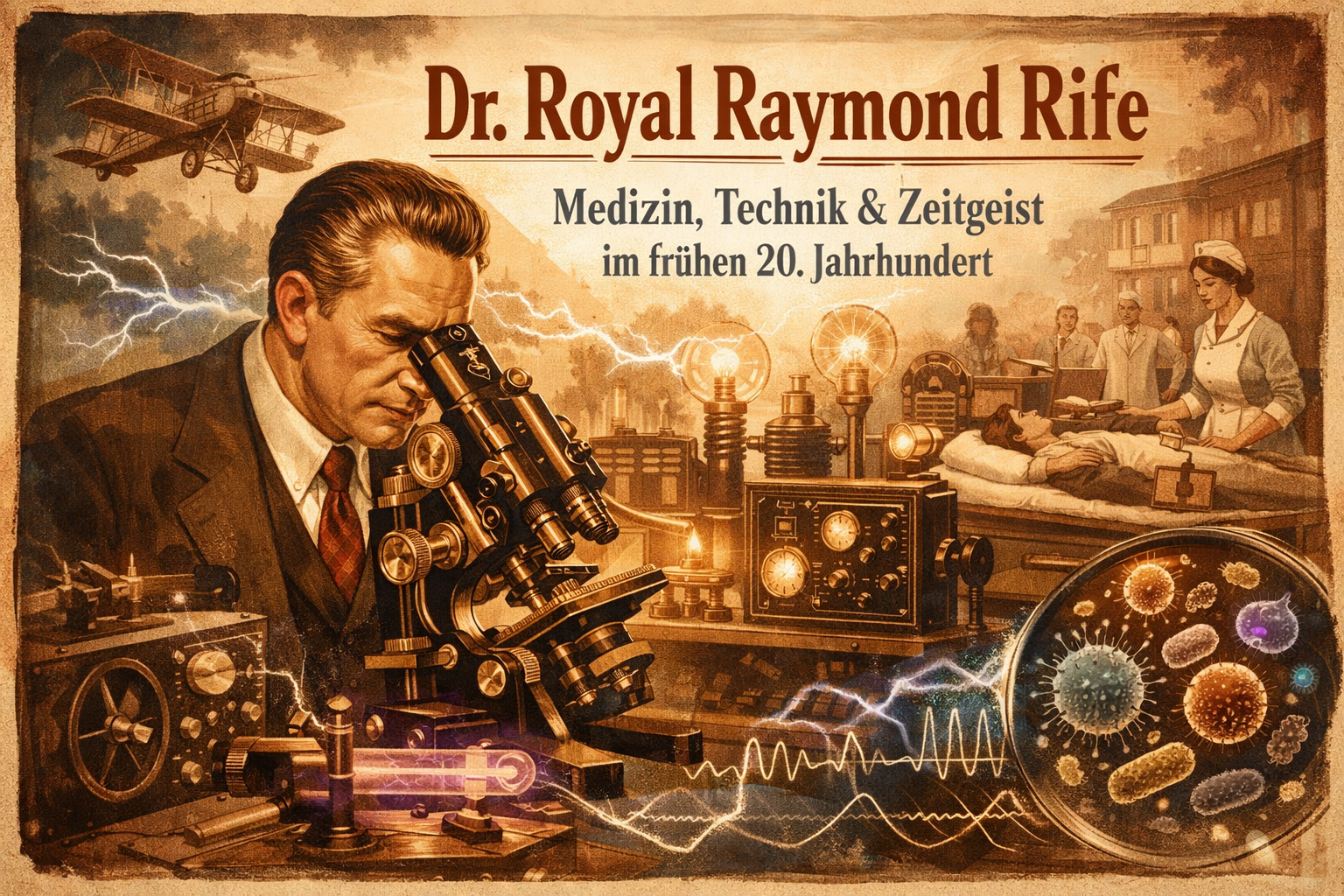
Historical context: Medicine, technology and zeitgeist in the early 20th century
The early 20th century was characterized by an exciting interplay of medical achievements, technical innovations and the zeitgeist of belief in progress. New therapeutic concepts and devices as well as the growing interest in electromagnetic phenomena had a major influence on medical procedures and social attitudes. It is important to consider these general conditions as a basis for understanding the following electrical healing methods of the time, which are then critically examined.
Medical paradigms and enthusiasm for electricity
The euphoria for electricity led to a variety of new therapeutic approaches, such as electrotherapy, diathermy and applications of electromagnetic fields. It was expected that electrical currents could trigger far-reaching biological effects, which led to the use of numerous new technologies in medicine (Allardyce, 2003). There was great public confidence and enthusiasm in the healing effects of electricity, and technical devices were used in medicine without sufficient scientific justification (Bracegirdle, 2003). In relation to Rife, for example, a Rife's Universal Microscope was used in his time without any critical empirical testing of its effects. While this approach is one of many possibilities with electricity that have been explored, many have been refuted due to lack of evidence (Whitney, 2014). Technological advances in the field of research were driven forward, particularly by inventors with an electrical engineering focus, such as Rife, but these later had to be withdrawn due to a lack of scientific evidence (Szasz, 2025).
The introduction of technology-based healing methods, such as electrotherapy in this case, clearly shows that not all innovations can withstand rigorous methodological testing. Electricity and electromagnetic fields were supposed to have a selective effect on pathogenic organisms, but at that time this could not be proven with the scientific methods used today in the form of reproducible and controlled studies (Szasz, 2025). Many devices and methods introduced at that time, such as Rife's Frequency therapy, are based on observations, assumptions and experiences of practitioners. The effect of the Universal Microscope, or treatment with low frequencies, has never been clinically proven, let alone clinically tested (Allardyce, 2003). Today, a distinction is made in oncology between the speculative approach and the evidence-based, effective applications of electrical healing treatments. The procedure of modulated electro-hyperthermia, whose safety, efficacy and efficiency have been proven in controlled studies, is used in modern therapy protocols (Szasz, 2025). The example of electrotherapy clearly shows that the technique itself, especially at the beginning, did not provide a sufficient basis for a generally accepted curative treatment. The effectiveness of the treatment was not tested, even though it was frequently used at the time (Bañobre-López et al., 2013).
Reproducibility, empirical testing and the existence of a biophysical model are the prerequisites for the establishment of electrotherapy as it occurs today in modern biomedicine (Szasz, 2025; Bañobre-López et al., 2013). Rife's use of the Universal Microscope shows how research is linked to the hope of curing diseases with new technological developments. The researcher discovered different color phenomena in pathological microorganisms, which made it possible to differentiate the pathogenic microorganisms through a 17,000-fold magnification in his self-built microscope and to derive the therapeutic frequencies on the basis of these (Bracegirdle, 2003). After an expert review, considerable deficiencies were discovered in the documentation and the statements regarding the resolution. Other experts were also unable to comprehend the visual information in Rife's work (Bracegirdle, 2003). Such criticism has often been leveled at emerging electrical healing methods (Allardyce, 2003). The search for new technological cures can develop in many directions. However, if the step of reproducibility is not achieved, some of these methods will be discarded. Every scientific research result requires standardized test procedures that can be repeated by other researchers. These should list all relevant parameters and possible causes and sources of error. The quality criteria must be adhered to in order to ensure the reproducibility of data and an inter-individual transfer of research results (Bracegirdle, 2003). This was also discussed by critical researchers, who pointed out that minimum methodological standards in the form of control groups, randomization and standardized measurement protocols are required in order to validate electrical and magnetic healing methods and thus take them seriously (Whitney, 2014). Rife therapy failed to meet these methodological and fact-checking requirements and thus contributed significantly to the mistrust of this and other methods. A control group and blind design and standardization of treatment and measurement must increase objectivity and contribute to reliable results in electrical and magnetic healing treatments (Allardyce, 2003).
In summary, the shortcomings of electrical healing methods and the criticism of them expressed by researchers show that methodological aspects must be taken into account if a healing treatment is to be accepted and applied in modern medicine (Whitney, 2014; Szasz, 2025). The Rife case is just one of many examples of the fact that, in addition to the will and hope for research into new technologies, methodological criteria are also crucial for differentiating between invention and innovation (Allardyce, 2003; Whitney, 2014).
Despite the methodological shortcomings of electrical healing treatments, interest in magnetic procedures still existed at this time and was taken up with later technical and therapeutic innovations. Developments in magnetic hyperthermia and the usability of magnetic nanoparticles for medical purposes can still be found in the application repertoire of magnetic forms of therapy today. Compared to Rife and his time, this modern technology makes it possible to cure cancer by making targeted use of magnetic materials (Bañobre-López et al., 2013). Modern cancer treatment is possible, for example, by inserting magnetic nanoparticles that can be heated by a magnetic field. These are specifically inserted into the Tumor injected. Magnetic nanoparticles are characterized by their high surface-to-volume ratios, which enable optimal usability. It is also possible to adapt and modify their surface in order to determine a precise destination in the body and thus reach individual cells, tissues and organs. The degree of penetration into cells can be influenced by controlling the size of nanoparticles. Magnetic hyperthermia can also be used to move individual nanoparticles by setting gradients in magnetic fields in order to target specific cell organelles. Research is also being carried out into the development of magnetic nanoparticles that can generate heat in the cells and destroy them. These scientifically based developments show a high degree of standardization, quantification and optimization, which makes them very different from the mostly anecdotal and unsystematic applications of the early days of electromagnetic and electrical healing treatment (Bañobre-López et al., 2013). In modulated electro-hyperthermia and other modern bioelectromagnetic procedures, these aspects are analyzed in detail through experimental and clinical testing (Szasz, 2025). A clear demarcation between controlled and standardized studies versus early unsystematic research allows for a detailed investigation of electromagnetic fields in terms of their effects and the possibility of side effects they have in biological systems.
In summary, it can be said that the numerous procedures were criticized at the beginning of electrical medicine. The unreliability of the results and the contradictory documentation were the result of a lack of methodological procedures and later formed an important step in the formulation of scientific standards in biomedicine.