




Abstract
An IEEE review paper describes how very weak Magnetic fields (nT-µT) could alter reactive oxygen species (ROS) via „radical pair“ mechanisms - with effects on cell growth, in some cases also in cancer cells. What is proven, what is open?
Introduction: Why „weak“ fields are exciting at all
Non-ionizing fields are everywhere - from power grids (50/60 Hz) and radio applications to devices such as smartphones and Wi-Fi. The classic safety assessment is strongly oriented towards short-term effects (minutes) like Heating or Nerve irritation. This is exactly where the discussion begins: Biological processes such as Cell cycles run over Hours to days - and could theoretically also be modulated by very low field strengths. Some_Effects_of_Weak_Magnetic_F...
The IEEE review paper available in PDF format („Some Effects of Weak Magnetic Fields on Biological Systems“, 2016) formulates a clear core idea: Weak magnetic fields could change the concentration of radicals - and thus (under certain conditions) influence cell growth, including cancer cell lines. Some_Effects_of_Weak_Magnetic_F...
1) Limit values & real environmental impact: What is officially valid?
The authors present important reference values, including:
- For cell phones: SAR limit 1.6 W/kg (over 1 g tissue) Some_Effects_of_Weak_Magnetic_F...
- ICNIRP orientation: at 50 Hz etc. Magnetic flux density limit 100 nT and in the area of 3 kHz-10 MHz: E = 83 V/m, B = 27 nT and Whole-body SAR = 0.08 W/kg Some_Effects_of_Weak_Magnetic_F...
At the same time, the authors emphasize: Typical environmental exposures usually do not exceed these guidelines, occupational exposures may come closer. Some_Effects_of_Weak_Magnetic_F...
Important: These limits are historically strongly influenced by „clear“ mechanisms (especially warming), while the discussed effects of work non-thermal are intended.
2) The central biological lever: ROS, radicals and long-term effects
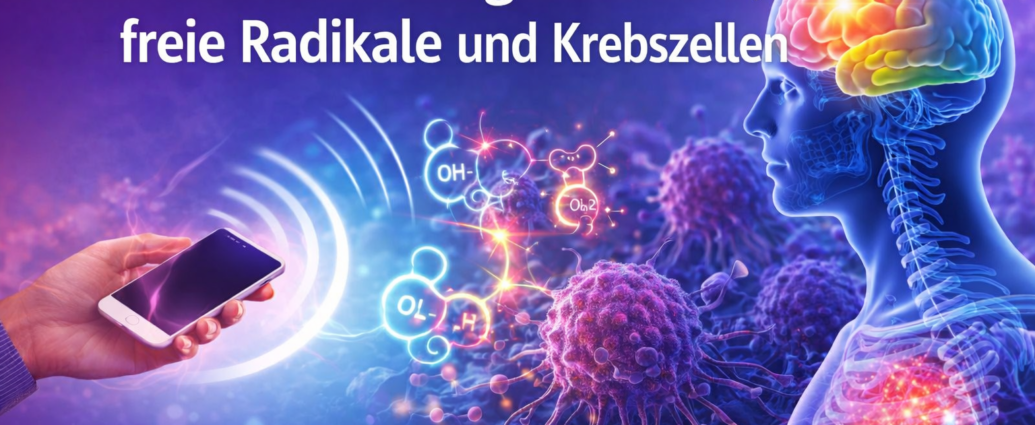
The article focuses on Radicals / reactive species such as superoxide (O₂--), NOx and hydrogen peroxide (H₂O₂). These molecules are not only „harmful“, but also Signal substances - At the same time, with a permanently increased concentration Biological damage promote. Some_Effects_of_Weak_Magnetic_F...
The authors explicitly link chronically elevated radical concentrations with diseases such as aging processes, cancer and Alzheimer's disease (as an association via oxidative stress). Some_Effects_of_Weak_Magnetic_F...
3) The hypothesis: „Radical Pair“ mechanism (spin chemistry)
The „star“ of the paper is the hypothesis that weak magnetic fields the recombination rate of radical pairs can change. This would shift the amount of radicals (e.g. O₂--) and molecules such as H₂O₂. Some_Effects_of_Weak_Magnetic_F...
Singlet vs. triplet - clearly explained
- Radicals can act as Couples are created.
- In the Singlet state they recombine relatively quickly (typical times between 10-⁶ and 10-¹⁰ s). Some_Effects_of_Weak_Magnetic_F...
- In the Triplet state recombination is „forbidden“ (due to spin) - the radicals live longer and can continue to react sooner. Some_Effects_of_Weak_Magnetic_F...
The idea: magnetic fields influence the Spin dynamics (transitions/precession), which modulates the singlet/triplet ratio - and thus the „lifetime“ and reaction possibilities.
Why frequency & resonance are important here
The authors argue that Resonances and Very narrow line widths (nuclear spin states with sometimes long lifetimes) could play a role - in other words, effects that Frequency- and amplitude-dependent are. Some_Effects_of_Weak_Magnetic_F...
This is the point at which „frequency“ enters the biological discourse - not in the sense of „a frequency heals“, however, but as a physical condition under which spin-chemical processes could theoretically react sensitively.
4) What do experiments show? (And what do they not?)
The authors are clear: there are Experiments with effects, but also many without effects - what they do with biological Feedback and repair mechanisms explain. Some_Effects_of_Weak_Magnetic_F...
4.1 Static fields & shielding of the earth's magnetic field
A particularly striking result in the overview:
- Reduction of the static magnetic field (SMF) under 18 nT reduced the growth of E. coli. Some_Effects_of_Weak_Magnetic_F...
- Reduction of the SMF to < 1 nT reduced the growth of HT1080 Fibrosarcoma cells to approx. 20-30%, while normal fibroblasts < 10% have been reduced. Some_Effects_of_Weak_Magnetic_F...
This is interesting from a cancer perspective because, at least in vitro, it indicates a Differential sensitivity between tumor and normal cells (but: cell culture is not an organism).
4.2 Low frequency (50/60 Hz): Effects can go up and down
In the case of low-frequency fields, examples are given in which free oxygen radicals were altered in lymphocytes in vitro (50 Hz). Some_Effects_of_Weak_Magnetic_F...
In addition, findings are described in which cell growth depending on the conditions rise or fall including peak shifts depending on static field and induced electric fields/currents. Some_Effects_of_Weak_Magnetic_F...
Takeaway: It is not „always positive“ or „always negative“, but strongly parameter-dependent.
4.3 RF range (MHz) at extremely low field strengths (nT): Proliferation and ROS
A particularly specific data set in the overview:
- In rat pulmonary artery smooth muscle cells: 45 nT SMF plus 7 MHz with 10 nT RMS showed up to 40% more proliferation on day 2 and 45% on day 3 (vs. SMF control). At the same time: O₂-- ↓45%, H₂O₂ ↑50%, SAR ~ 0.12 W/kg. Some_Effects_of_Weak_Magnetic_F...
And in contrast:
- With HT1080 Fibrosarcoma cellsCombination of 45 nT SMF and 5/10 MHz RF field (10 nT RMS) can increase the proliferation inhibit; Cell counts up to -30% on day 2; moreover H₂O₂ +55% after 10 MHz for 8 h. Some_Effects_of_Weak_Magnetic_F...
This is scientifically exciting - but also a warning signal against drawing simple conclusions: Same order of magnitude, different cells, different orientation/geometry, different time windows → different direction of response.
5) What does this mean for cancer, prevention and possible applications?
The study comes to a cautious but clear conclusion:
- There are Theoretical foundations and Experimental hints, that weak static, low-frequency and RF magnetic fields Radical concentrations can influence - and partly also Cell growth. Some_Effects_of_Weak_Magnetic_F...
- At the same time, effects not reliably reproducible in all settings, and biological systems compensate for many things. Some_Effects_of_Weak_Magnetic_F...
A sober cancer reality check
From an oncological point of view, these are No clinical therapy data, but first and foremost:
- Mechanistic plausibility arguments (spin chemistry / radical pairs)
- Cell and bacterial models (in vitro)
- Parameter-sensitive findings
Nevertheless, serious research questions can be derived from this:
- Under what conditions does ROS regulation switch from „signal“ to „chronic stress“? (cf. the dysregulation idea presented) Some_Effects_of_Weak_Magnetic_F...
- Which frequency/field parameters actually affect relevant biological transitions? Some_Effects_of_Weak_Magnetic_F...
- Are there cell types (including tumor cells) with particular susceptibility? Some_Effects_of_Weak_Magnetic_F...
6) Classification for „frequency therapy“ - serious and without overstretching
If you use the term „frequency“ therapeutically, it is crucial, Physical resonance models (as discussed here) does not automatically mean clinical effectiveness to be equated.
What this IEEE overview does allow, however, is a clean bridge:
- Biological systems use redox/ROS signals - and radical chemistry is fundamentally Magnetic field sensitive. Some_Effects_of_Weak_Magnetic_F...
- Effects are Frequency-, amplitude- and time-dependent (and often cell type specific). Some_Effects_of_Weak_Magnetic_F...
Practical conclusion for responsible communication:
„There are plausible mechanisms and laboratory findings that weak fields can modulate biological signaling pathways - but this does not automatically lead to a therapy against cancer. Clinical research is needed for that.“
7) What you should take away as a reader (short summary)
- Radical pair mechanisms provide a physical explanation of how very weak magnetic fields can theoretically modulate biochemical reaction pathways. Some_Effects_of_Weak_Magnetic_F...
- There are in-vitro instructions, that cell growth (including that of cancer cell lines) can be measurably altered under certain field/frequency combinations. Some_Effects_of_Weak_Magnetic_F...
- Effects can in both directions go and are context-dependent (cell type, orientation, duration, frequency). Some_Effects_of_Weak_Magnetic_F...
- For humans, these are No direct clinical conclusions, but a scientifically exciting track - especially in the field of ROS/redox and chronic stress models. Some_Effects_of_Weak_Magnetic_F...
FAQ
Can my WLAN or cell phone „make radicals“?
The work discusses mechanisms of how fields could influence radical reactions, but it does not show a direct, everyday causal chain „WLAN → disease“. Many effects depend strongly on parameters and exposure duration. Some_Effects_of_Weak_Magnetic_F...
Does this mean that weak fields can cure cancer?
No. Cell culture effects are being discussed - not clinical healing data. With cancer, every therapy claim needs clinical studies.
Why are results often contradictory?
The authors emphasize the role of feedback/repair mechanisms and the strong dependence on frequency, amplitude and time. Some_Effects_of_Weak_Magnetic_F...
Note / Disclaimer
The contents presented here are intended to Information and replace none medical advice, diagnosis or therapy. Statements on the possible effects of weak fields are based on theoretical models and laboratory findings (e.g. cell culture) and are not automatically transferable to clinical applications.
Author: NLS Information medicine Ltd, Herbert Eder