





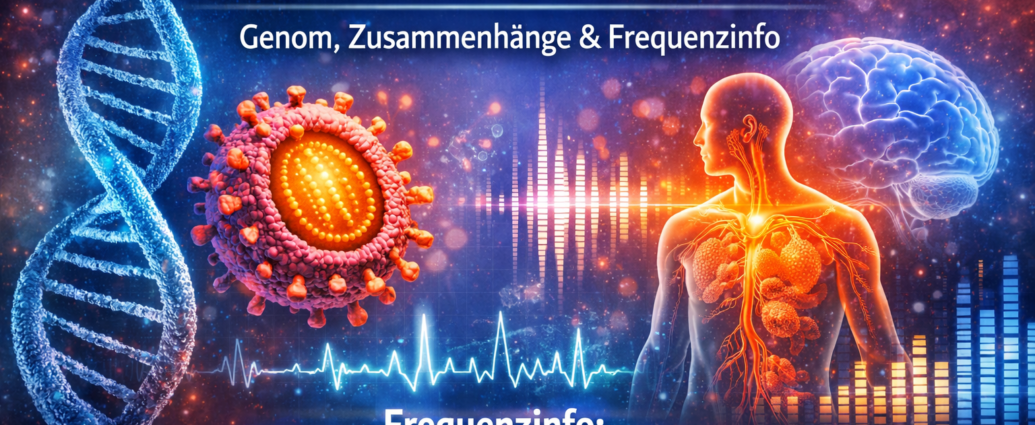
Genome, correlations and frequency information
Human endogenous Retroviruses, HERVs for short, are among the biological topics that lie at the interface of genetics, virology and regulatory medicine. The literature describes numerous silent regions in the human genome that contain a large number of endogenous retroviruses and retroviral sequences. These sequences are said to have entered the human genome in the course of evolution. It is precisely this fact that makes HERVs of particular scientific interest, because the focus here is not on a classic acute viral infection, but on the question of what role retroviral components can play within the human genome.
What are HERVs?
HERVs are human endogenous retroviruses, i.e. retroviral sequences that are anchored in the human genome. The literature describes that these components can be present in large numbers in the human genome. Unlike classic active viral infections, HERVs are not recognized as freely circulating infectious agents. Viruses but as genetic elements that have become part of the human genome.
This point in particular is crucial for the classification of conventional medicine. This is not about an ordinary infection process with acute contagion, but about retroviral traces and sequences that are permanently present in the genetic structure of humans. The focus is therefore less on classical infectiology and more on the connection between genetics, cell biology and regulation.
Why HERVs are described as defective
The literature describes that these endogenous retroviral sequences appear defective. They are called nonsense mutations or larger deletions, as a result of which they can no longer produce infectious virus particles. This is what clearly distinguishes HERVs from classic active retroviruses, which can continue to replicate in the organism.
This description is important because it shows that HERVs are not to be understood as ordinary infectious viruses. Rather, they are genetic relics or retroviral elements whose biological significance lies in their presence in the genome rather than in their acute infectivity.
HERVs and the human genome
A central aspect is the question of what significance such embedded retroviral sequences may have for the human genome. The literature emphasizes that the silent regions of DNA contain numerous such elements. This places HERVs in the context of genetic regulation, biological control processes and possible influences on cell functions.
This is precisely why the topic of HERVs is so exciting from a medical point of view. It combines virology with genetics and expands the classic concept of viruses. It is not just about pathogens from the outside, but also about retroviral components that are anchored inside the human genome.
Possible connections with autoimmune processes
The literature describes that HERVs are associated with certain Autoimmune diseases are associated with multiple sclerosis. Multiple sclerosis is mentioned in particular. This observation is significant from a conventional medical perspective because it indicates that HERVs may not just be silent genetic relics, but could play a role in certain regulatory or immunological contexts.
The question of triggering or contributing factors is particularly important in autoimmune processes. When endogenous retroviral sequences are mentioned in this context, this significantly broadens the perspective on disease development and biological regulation.
HERVs and multiple sclerosis
The link to multiple sclerosis is particularly emphasized in the literature. This means that HERV not only represents a molecular or genetic detail, but also a possible connection with chronic inflammatory and immunological processes of the nervous system. Even if such connections must be viewed in a differentiated manner from a conventional medical perspective, the potential scope of the topic is already evident here.
It is precisely this link that makes HERVs interesting from a broader biological perspective. It affects not only the immune system, but also neurological processes and questions of long-term regulation.
Possible link to HELLP syndrome and pre-eclampsia
The literature also mentions possible links between HERVs and HELLP syndrome and pre-eclampsia. This makes it clear that HERVs are also discussed in the area of pregnancy-related regulatory disorders. These observations suggest that endogenous retroviral sequences may be involved in complex biological processes that go far beyond classical virology.
It is precisely these possible connections that show that HERVs are not only discussed in a single medical field. Rather, they appear to be relevant where immune regulation, inflammation, vascular reactions and genetic influences intertwine.
Human Mammary Tumor Virus in the context of literature
The literature also mentions the Human Mammary Tumor virus or HMTV. It is described that corresponding DNA sequences were detected in a high proportion of breast cancer patients tested. It is also pointed out that proviral DNA should also appear in the normal blood cells of many of these patients.
This presentation places the topic in an oncological context. This not only brings the question of retroviral sequences in the genome to the fore, but also the relationship between viral DNA patterns, cell changes and tumor biology. From a conventional medical point of view, this is a sensitive and biologically highly complex field.
Retroviral sequences and tumor biology
The mention of retroviral DNA sequences in connection with tumor processes shows how broadly the literature covers the topic. It is not just about immune regulation or silent genetic elements, but also about the extent to which retroviral traces appear in oncological contexts. It is precisely this aspect that makes HERVs and related topics particularly challenging scientifically.
The importance of conventional medicine lies primarily in the precise classification of such findings. Not every detected sequence automatically implies a simple cause-and-effect relationship. Nevertheless, the literature shows that HERV-related topics play an ongoing role in biological and medical research.
Conventional medical classification of HERVs
From a conventional medical perspective, HERVs are primarily characterized by genome anchoring, defectiveness, possible regulatory significance and observed associations. HERVs are not understood as a classic infectious viral disease, but as endogenous retroviral elements with potential biological relevance.
This perspective is essential because it makes the difference to acute infectious diseases clear. HERVs are primarily a topic of molecular medicine, immunology, neurology, pregnancy pathology and oncology research.
Holistic view of the organism
From a holistic perspective, HERVs show particularly clearly that biological stresses and regulatory patterns do not always have to come from outside. When retroviral sequences are part of the human genome, the view of health and disease expands to an additional level. Then it is not only about external pathogens, but also about internal biological information patterns that may be related to regulation, inflammation and adaptability.
This is precisely why a complementary approach focuses not only on individual diagnoses, but also on system stability, immune imbalance, regenerative capacity and the individual response situation. In this way, the organism is understood as a dynamic system in which genetic, immunological and regulatory influences interact.
Complementary perspective on frequency therapy and frequencies
Around the Frequency therapy is often associated with terms such as oscillation, Resonance and regulation. Complementary understanding is about looking at biological topics not only in terms of substances, but also functionally and systemically. Particularly in the case of HERVs, which are at the interface of genome, immune regulation and complex biological relationships, such a perspective is seen as a broadening way of thinking.
The focus here is not on isolated individual values, but on the classification in a larger understanding of the biological reaction situation, system dynamics and inner order. In this context, frequency therapy and frequencies are seen as supplementary literature references within a complementary approach.
Frequency info
The following frequency ranges are mentioned in the literature for the Human Mammary Tumor Virus:
314-318, 350, 368, 383, 385, 387, 389-390, 393, 396, 406, 408, 427-430, 444, 450, 469, 475-477, 554, 568, 578 kHz
In the complementary context of frequency therapy and frequencies, these frequency data are understood as supplementary literature references. Within complementary approaches, they are placed in a larger context of resonance, system dynamics and individual reactions.
Conclusion
HERVs are endogenous retroviral sequences in the human genome and do not represent a classic infection topic, but rather a complex field between genetics, immunology, neurology and oncology. The literature describes possible connections with autoimmune processes such as multiple sclerosis, with pregnancy-related complications such as HELLP syndrome and pre-eclampsia as well as with retroviral DNA sequences in the context of Breast cancer. The conventional medical perspective is central because it differentiates these relationships and classifies them biologically.
In the complementary environment, the view of frequency therapy and frequencies can also be understood as a thematic extension. The frequency ranges mentioned in the literature are referred to as Frequency info into a larger context.

Comments are closed, but trackbacks and pingbacks are open.