





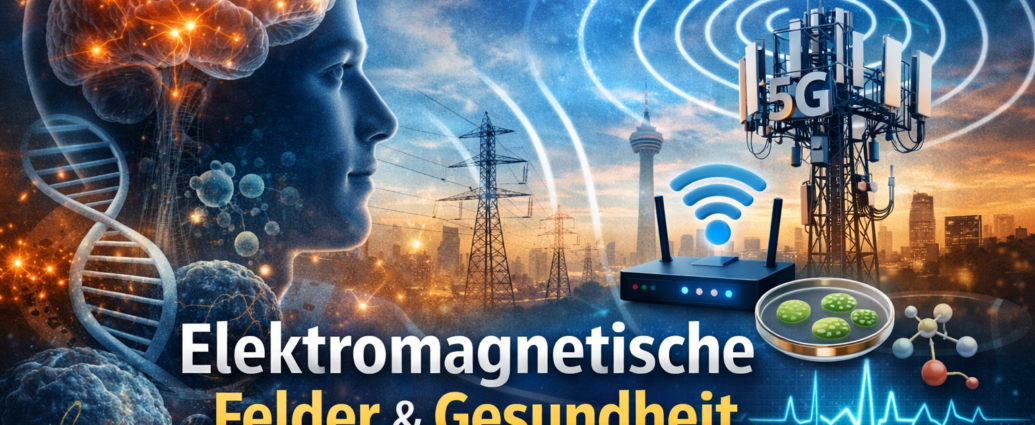
How relevant are non-ionizing electromagnetic fields for health? This article analyzes biological mechanisms, discussed health risks and the scientific controversy from an academic perspective.
Non-ionizing electromagnetic fields are an integral part of modern living environments. They arise in connection with power supply, mobile telephony, WLAN, wireless communication systems and numerous electronic applications. Precisely because these technologies are used almost everywhere, the scientific question of their biological and health effects is highly relevant.
In contrast to ionizing radiation, non-ionizing electromagnetic fields do not have enough energy to remove electrons directly from atoms or molecules. For a long time, this led to the conclusion that health effects were primarily relevant when there was measurable heating of tissue. This thermal understanding still characterizes a large part of international limit value systems today.
However, research has shown that the discussion is more complex. For years, the scientific literature has been describing possible biological effects that could lie below classic thermal thresholds. This shifts the debate from the pure question of warming to a more differentiated consideration of possible interactions between electromagnetic fields and biological systems.
For an academically oriented audience, a precise distinction is particularly important. Not every biological reaction automatically equates to a clinically relevant health risk. At the same time, the lack of absolute certainty does not mean that all concerns are unfounded. The scientific challenge lies precisely in making a clear distinction between observable effects, plausible mechanisms of action and reliable health conclusions.
What makes non-ionizing electromagnetic fields so scientifically interesting
Non-ionizing electromagnetic fields cover a broad frequency spectrum. This includes extremely low-frequency fields, such as those that occur in the electrical power supply environment, as well as high-frequency ranges that play a role in mobile telephony, WLAN and other wireless applications.
Biological systems are by no means insensitive to electricity. Cell membranes, Ion channels, The nervous system, signal transmission and metabolic regulation are based on finely tuned electrochemical processes. For this reason alone, it is plausible from a scientific point of view that electromagnetic exposure can trigger biological responses, at least under certain conditions.
The crucial question is therefore not just whether there are interactions, but what quality these interactions have. Are they temporary or permanent? Adaptive or harmful? Reproducible or only observable under special laboratory conditions? These are precisely the questions at the heart of modern EMF research.
Why the field of research is so controversial
The scientific controversy arises not only from differing results, but also from the fundamental complexity of the subject. Electromagnetic exposure is not a uniform phenomenon. Frequency, intensity, modulation, pulsation, duration and distance from the source can differ considerably. For this reason, many studies can only be directly compared to a limited extent.
In addition, different levels of research allow different conclusions to be drawn. Cell culture studies provide information on molecular processes, but do not allow any direct conclusions to be drawn about long-term effects in humans. Animal models can illustrate functional relationships, but are only transferable to a limited extent. Epidemiological studies, on the other hand, are particularly relevant for public health, but often suffer from uncertainties in determining exposure and from possible confounding factors.
This is precisely why the topic is so interesting for academics. It exemplifies how difficult risk assessment becomes when an environmental factor is omnipresent, biological systems react in a highly complex way and the evidence base is extensive, but not uniform in every respect.
Which biological mechanisms of action are being discussed
A central focus of research is the question of how electromagnetic fields could trigger biological effects in the first place. Several mechanisms are being discussed here.
Cell membranes and ion fluxes
Cells work with finely regulated electrical potentials. Cell membranes control the exchange of ions and form the basis for signal transmission, stimulus conduction and cellular communication. Researchers frequently discuss whether electromagnetic fields could influence transmembrane processes.
One focus is on calcium ions. Calcium is a central signaling molecule in biological systems and plays a key role in neuronal activity, enzyme regulation, muscle contraction and intracellular communication. Even small changes in the calcium balance can be functionally relevant.
Oxidative stress
Another frequently mentioned mechanism is oxidative stress. This involves an imbalance between reactive oxygen species and the cell's antioxidant protection systems. If electromagnetic exposure is associated with increased oxidative stress, this could represent a bridge between physical exposure and biological dysregulation.
Oxidative stress is a highly relevant concept in modern biomedicine because it is involved in numerous processes, including inflammation, ageing, mitochondrial stress and cell damage. It is therefore often discussed as a possible mediating mechanism in connection with electromagnetic fields.
Gene expression and cell stress reactions
Possible changes in gene expression and the cellular stress response are also discussed in the literature. Such observations are scientifically interesting, but must be interpreted in a differentiated manner. Altered gene expression does not automatically mean pathological damage. It can also be an expression of a temporary adaptation reaction.
Such findings only become relevant if they are reproducible, functionally plausible and associated with other biological or health endpoints.
Non-thermal models
Particular attention is paid to theories that seek to explain the biological effects of weak electromagnetic fields even without significant heating. These include resonance models, non-linear processes and coherence theory approaches. These concepts are theoretically sophisticated and biophysically interesting, but require particularly critical scientific scrutiny.
As far as academic classification is concerned, such models can provide valuable hypotheses, but cannot be equated with definitive proof. However, they show that research no longer regards the classic thermal paradigm as the only sufficient interpretative framework.
Which health issues take center stage
The literature on electromagnetic fields and health covers various topics that have been studied to varying degrees.
Neurological and cognitive effects
Influences on the nervous system are examined particularly frequently. These include sleep quality, attention, memory performance, EEG changes and subjective complaints such as tiredness, headaches or concentration problems. Such endpoints are scientifically relevant, but methodologically difficult because they can be strongly influenced by psychological and situational factors.
Reproductive health
Another focus is on possible effects on fertility and reproductive biology. Among other things, changes in sperm quality, sperm motility and other reproductive parameters are being discussed. This field has received a great deal of attention because reproductive processes are considered to be particularly biologically sensitive.
Blood-brain barrier and regulatory systems
Some research work is concerned with the question of whether electromagnetic fields could influence regulatory protection systems, in particular the blood-brain barrier. Such questions are of particular interest because they mediate between molecular observation and possible systemic effects.
Oncological risks
The best known and at the same time most sensitive discussion concerns possible links between electromagnetic exposure and cancer. The focus is primarily on tumors of the nervous system, but also on other oncological issues. Scientific restraint is particularly important here. Epidemiological abnormalities can be relevant, but should not automatically be understood as causal evidence.
Particularly in the area of chronic exposure, the long-term question remains scientifically significant because broad population groups are affected and technological usage patterns change faster than long-term observational data are generated.
Why thermal limit values alone may not be enough
A central topic of the scientific debate is the question of whether existing limit values are sufficient. Many international standards have historically been strongly oriented towards thermal criteria. Protection is essentially understood as protection against excessive warming.
The criticism of this is that biological effects could possibly also occur below these thresholds. If this is the case, a purely thermally based protection model would be conceptually too narrow. This does not automatically mean that existing threshold values are worthless. However, it does mean that the underlying understanding of safety may not take into account all biologically relevant forms of reaction.
This point is particularly central to academic discussions because it marks the interface between science, regulation and public health.
The precautionary principle as a scientifically sound approach
The precautionary principle is particularly important in controversial fields of research. This is not a rejection of evidence, but a rational response to uncertainty. If exposures are widespread, chronic and partly involuntary, it can be useful to take precautionary considerations, even if not every question has been conclusively answered.
Scientifically correct precaution is not alarmism, but an expression of responsible risk assessment. Such an approach is particularly understandable for technologies that are widely used in society.
Scientific classification of the study under discussion
The paper on which this article is based is an overview article that brings together biological mechanisms of action, health issues and regulatory aspects in connection with non-ionizing electromagnetic fields. The article argues clearly in the direction of precaution and emphasizes in particular non-thermal effects and possible risks of chronic exposure.
It is important for academics to read this work as a scientifically positioned overview, not as a conclusive overall judgment on the entire field of research. Its strength lies in the systematic combination of biological, epidemiological and regulatory arguments. Its limitation lies in the fact that overviews with a clear line of argument do not automatically give equal weight to all opposing positions.
This is precisely why the work is valuable: it forces us to carefully reflect on existing limit value models, biological impact assumptions and long-term issues, instead of simplifying the topic prematurely.
Significance for science and society
The discussion about electromagnetic fields is more than just a specialized topic of individual disciplines. It touches on fundamental questions of modern knowledge societies: How do we deal with technologies whose benefits are high but whose long-term biological consequences are only incompletely understood? How do we define safety in a field in which subtly measurable biological reactions do not automatically equate to clinical harm? And how do we communicate scientific uncertainty responsibly?
This is precisely why this field of research is a prime example of interdisciplinary science. Biophysics, cell biology, neuroscience, reproductive medicine, epidemiology and regulation meet directly here. This makes the topic both scientifically challenging and socially relevant.
Conclusion
Non-ionizing electromagnetic fields and their potential impact on health remain a serious research topic. The scientific debate is no longer just about warming effects, but also about possible non-thermal effects on cellular processes, oxidative mechanisms, neuronal regulation, reproductive health and potential long-term risks.
A serious classification must achieve two things at the same time: methodological sobriety and openness to biological evidence that cannot be fully explained by the classic heat model. Neither a blanket all-clear nor premature certainty can do justice to the current state of the debate.
It is precisely this differentiation that is crucial for an academic audience. Non-ionizing electromagnetic fields are not a marginal topic, but an exemplary field for how modern science deals with complexity, uncertainty and social responsibility.
Source of the work discussed in this article
Vasile, M., Caligiuri, L. M., Lamonaca, F., Nastro, A., & Beiu, T. (2014). Nonionizing Electromagnetic Radiation (EMF) and Their Influence on the Health of Living Organisms. Academy of Romanian Scientists Annals - Series on Biological Sciences, 3(2), 5-18.


Comments are closed, but trackbacks and pingbacks are open.