





Basics, diagnostics and complementary frequency information
Author: NLS Information medicine Ltd, Herbert Eder
Introduction
Adenocarcinomas are among the most common forms of malignant tumors in humans. In conventional medicine, they are described as malignant neoplasms that arise from glandular tissue or epithelial cells with secretory properties. Precisely because glandular and epithelial structures are found in many organs of the body, adenocarcinomas can develop in very different regions. These include the breast, intestine, lungs, prostate, stomach, pancreas, vagina and cervix.
The decisive factor for medical classification is that adenocarcinomas can vary greatly in their biological aggressiveness, their differentiation, their growth rate and their tendency to metastasize. Some tumors still clearly resemble their original tissue, while others already show strong dedifferentiation and a significantly more aggressive cell biology.
Even within the Frequency therapy the topic of adenocarcinoma is of great interest. While conventional medicine focuses on histology, imaging, tumor stage and treatment planning, information medicine also looks at complementary resonance patterns and frequency ranges. In the following WordPress article, the focus is initially on the basics of conventional medicine. Only at the end follows the Frequency info with the complementary resonance frequencies described in the literature.
What is an adenocarcinoma?
An adenocarcinoma is a malignant tumor Tumor, which develops from glandular tissue or from epithelial cells with gland-like properties. Epithelia are among the most important types of tissue in the body. They cover surfaces, line cavities and organs and form numerous glandular structures. As such tissues are found throughout the entire organism, adenocarcinoma can develop in many organ areas.
The decisive factor for the designation as adenocarcinoma is that the tumor cells have secretory or glandular characteristics. They do not necessarily have to be part of a classically structured gland. It is sufficient that they show functional or structural glandular characteristics.
In pathology, a distinction is also made between benign and malignant glandular neoplasms. If glandular tissue is altered but benign, it is referred to as a Adenoma. An adenoma usually grows locally, typically does not invade other tissue and only very rarely spreads. The Adenocarcinoma on the other hand, has a malignant behavior, can infiltrate neighboring tissue and can also metastasize as it progresses.
In which organs do adenocarcinomas occur particularly frequently?
Since glandular and epithelial tissues are found throughout the body, adenocarcinomas can develop in numerous organs. They are particularly common in the following regions:
- Chest
- Large intestine
- Lung
- Prostate
- Stomach
- Pancreas
- Vagina
- Cervix
This distribution makes it clear that adenocarcinoma is not a single organ disease, but a tumor form that can occur in different tissue milieus. Therefore, the specific clinical significance always depends heavily on the organ of origin, the tumor stage and the biological manifestation.
Benign adenomas and malignant adenocarcinomas
To understand tumor development, it is important to differentiate between Adenoma and Adenocarcinoma particularly important.
Adenoma
An adenoma is a benign glandular neoplasm. It usually remains localized, often grows more slowly and shows no typical invasive behaviour in neighbouring tissue. However, some adenomas can be functionally active or lead to considerable local problems as they progress.
Adenocarcinoma
An adenocarcinoma is the malignant form of a glandular tumor. These tumors can infiltrate neighbouring tissue, break through biological barriers and, if they develop over a longer period of time, metastasize. This is precisely why early detection is so medically important.
The transitions between benign changes, precursors and malignant development can vary depending on the organ. In many cases, a degenerative situation develops over a longer period of time, while the actual progression to manifest malignant disease can then occur much more quickly.
Differentiation and cell image in adenocarcinomas
The degree of differentiation plays an important role in pathology. Well-differentiated adenocarcinomas often still closely resemble the original glandular tissue. Poorly differentiated forms, on the other hand, show significantly less resemblance to the original tissue and often behave more aggressively.
Well-differentiated adenocarcinomas
- Stronger similarity with normal glandular tissue
- Often more orderly structure
- Slower development in some cases
Poorly differentiated adenocarcinomas
- Loss of normal tissue structure
- Significantly more atypical cell images
- Often more aggressive growth
- Often more invasive
The degree of differentiation is therefore an important factor for prognosis, progression and treatment planning.
Conventional medical view of tumor formation and development
The development of an adenocarcinoma is a multi-stage process. At the center are changes in cell regulation, cell division and genetic control. Normal body cells are subject to precise mechanisms that control growth, maturation and death. If these control mechanisms are disrupted, cells can slip out of normal regulation.
A key role is played here:
- genetic changes
- epigenetic dysregulation
- Chronic irritant situations
- Inflammatory processes
- Local environmental changes
- Influences on cell division and cell differentiation
As degeneration progresses, cell clusters develop that behave increasingly autonomously. Such cells no longer react appropriately to the organism's normal growth inhibitors. This can initially lead to precursors and later to invasive tumor forms.
The role of the immune system
The immune system also plays an important role in tumor development. It not only recognizes classic pathogens, but can also detect altered or degenerated cells under certain conditions. Nevertheless, tumor cells often manage to evade immune surveillance, at least in part.
From a conventional medical point of view, this is achieved, among other things, by
- Altered antigen presentation
- Disruption of the immune response
- Local immunosuppression in the tumor environment
- Adaptation and camouflage of degenerated cells
- Formation of growth-promoting signaling substances
The tumor microenvironment, i.e. the immediate biological environment of the tumor, is of great importance for growth and spread. It influences inflammation, the formation of new blood vessels, local immune activity and Cell communication.
Typical symptoms of adenocarcinomas
The symptoms of an adenocarcinoma depend primarily on the organ affected, the size of the tumor, its spread and its growth pattern. As adenocarcinomas can occur in many organs, there is no standardized list of symptoms. Often, symptoms only occur when the tumor has already reached a certain size or has impaired local functions.
Possible indications could be
- unclear pain
- Weight loss
- Weakness
- Power reduction
- Bleeding
- Organ dysfunction
- Feeling of pressure
- Changes in the Digestion
- Cough or breathing difficulties
- Conspicuous palpation findings
This is precisely why differentiated diagnostics are crucial.
Diagnostics for adenocarcinomas
The conventional medical diagnosis of adenocarcinoma is based on clinical examination, imaging and histological examination.
Physical examination
The clinical examination remains the first step. Depending on the organ affected, important information on the localization and extent of the disease can be obtained.
Imaging procedures
Several imaging methods are mentioned in the literature, including:
Individual procedures are used depending on the organ and the issue at hand. They are used to detect tumor masses, assess the extent and infiltration and detect possible secondary foci.
Biopsy and histology
The histological examination is crucial for the final diagnosis. Only histological analysis can determine with certainty whether an adenoma, adenocarcinoma or another type of tumor is present.
Conventional medical treatment of adenocarcinomas
Treatment depends on the type of tumor, organ involvement, stage, degree of differentiation and general condition of the patient. The following forms of therapy are mentioned in the literature:
Operation
If possible, surgical removal of the tumor is a key treatment measure. The aim is to resect the affected tissue as completely as possible.
Radiotherapy
Depending on the type and stage of the tumor, radiotherapy can be used either in addition to surgery or as an independent therapy component.
Chemotherapy
In more advanced or systemically relevant tumor situations, chemotherapy may be part of the treatment concept.
In conventional medicine Practice these procedures are often combined and individually adapted to the respective clinical picture.
Why adenocarcinomas are particularly interesting for frequency therapy
Adenocarcinomas are particularly interesting for frequency therapy because they occur in a wide variety of organs and can therefore affect very different tissue milieus. At the same time, as glandular-epithelial tumors, they show characteristic biological patterns that are also considered on a complementary resonance level within information medicine.
Frequency therapy expands the purely structural view to include the question of whether functional stress, regulatory disorders and tumor processes are also reflected in characteristic frequency fields. This complementary approach is particularly exciting in the case of adenocarcinomas, because glandular tissue, derailed cell regulation and organ-related characteristics are combined.
Frequency info - complementary resonance frequencies for adenocarcinomas
In the literature Adenocarcinomas following Complementary resonant frequencies called:
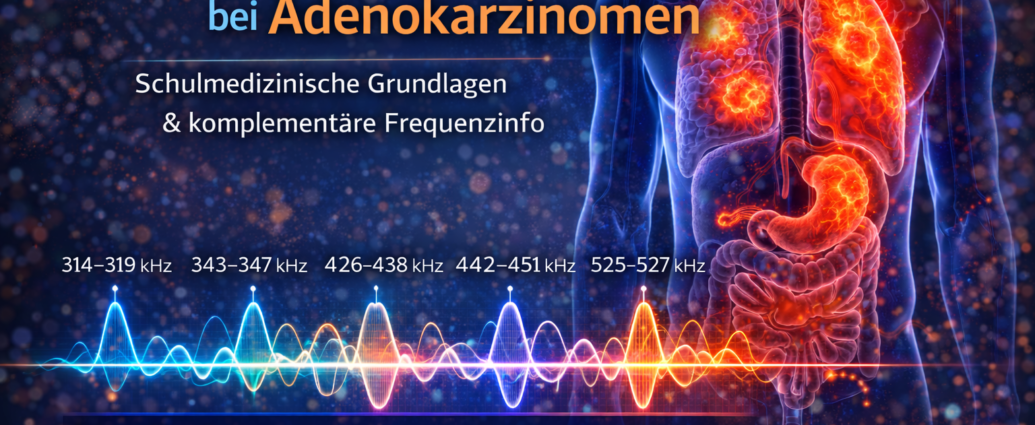
314-319, 343-347, 426-438, 442-451, 525-527, 543-545 kHz
These resonance ranges can be divided into several conspicuous frequency fields.
Lower resonance range
- 314-319 kHz
Medium resonance field
- 343-347 kHz
Central upper resonance field
- 426-438 kHz
- 442-451 kHz
Higher resonance ranges
- 525-527 kHz
- 543-545 kHz
Particularly striking is the concentration between 426 and 451 kHz. This area appears as the central resonance field of the adenocarcinoma within the complementary frequency analysis.
Frequency info - complementary resonance frequencies for adenomas
In the literature Adenomas following Complementary resonant frequencies called:
438-442 kHz
This information is also interesting for frequency therapy because it is in close proximity to a resonance area of the adenocarcinoma. Within information medicine, this proximity can be seen as an indication of a functional or tissue-related relationship between the resonance patterns.
Frequency info compact
Adenocarcinoma - complementary resonance frequencies:
314-319, 343-347, 426-438, 442-451, 525-527, 543-545 kHz
Adenoma - complementary resonance frequencies:
438-442 kHz
Complementary classification of the resonance ranges
The following resonance chambers are particularly striking for frequency therapy:
- 314 to 319 kHz
- 343 to 347 kHz
- 426 to 451 kHz
- 525 to 527 kHz
- 543 to 545 kHz
The area between 426 and 451 kHz is the most prominent focus. At the same time, it is noteworthy that the adenoma with 438 to 442 kHz lies in precisely this environment. Within information medicine, this is considered to be of complementary importance because the resonance patterns of benign and malignant glandular tissue changes converge here.
It is precisely these condensations that make the topic particularly interesting for frequency therapy. Not only individual values, but entire resonance spaces are understood as complementary expressions of a specific tissue pattern.
Importance of frequency therapy in a complementary context
Within frequency therapy, an adenocarcinoma is not only understood as a structural mass, but also as an expression of altered information and regulation patterns. The complementary frequency information serves as an additional view of possible resonance fields of the altered tissue.
Frequency therapy offers an extended approach, particularly in the case of glandular-epithelial tumors, which can develop in many organs of the body. It asks whether biological derailment, regulation, tissue pressure and functional stress can be mapped on a frequency level. This provides an in-depth complementary perspective on adenocarcinomas and adenomas.
Conclusion
Adenocarcinomas are malignant tumors of glandular or secretory epithelial cells and can develop in numerous organs. Conventional medicine focuses on the degree of differentiation, organ reference, diagnostics, histology and a stage-appropriate treatment concept consisting of surgery, radiotherapy and chemotherapy.
The topic also opens up a complementary perspective for frequency therapy. The resonance frequencies for adenocarcinoma and adenoma described in the literature form a structured frequency information that can be considered as a complementary aspect within information medicine. Particularly striking is the range between 426 and 451 kHz, which appears as the central resonance field of the adenocarcinoma.


Comments are closed, but trackbacks and pingbacks are open.