





Conventional medical basics, symptoms, treatment and frequency information
Carcinoid syndrome is a clinical symptom that can occur in connection with neuroendocrine tumors. These tumors often develop in the gastrointestinal tract, less frequently also in the lungs or in other organ areas. They are characterized by the fact that they can release biologically active messenger substances that have hormone-like effects in the body. This results in a complex symptom picture, which can range from reddening of the skin to diarrhea and heart problems.
To understand carcinoid syndrome, the conventional medical perspective is important first. Only then can the complementary view within the framework of the Frequency therapy classify. The focus is on the organic correlations, the typical symptoms, the diagnostic pathways and the therapeutic options. This is followed by the Frequency info with the frequency ranges mentioned in the literature in a complementary relationship.
What is a carcinoid?
A carcinoid is a neuroendocrine Tumor, which usually originates from specialized cells of the hormone-active system. These cells are mainly found in the digestive tract, particularly in the small intestine, appendix, stomach or rectum. Such tumors can also develop in the lungs.
Typical of these tumors is their ability to produce various biologically active substances. These can include serotonin, histamine, bradykinin, prostaglandins and other hormone-like substances. As long as these substances are sufficiently broken down by the body, many tumors remain inconspicuous for a long time. However, if larger quantities are released or the metabolic load is too high, carcinoid syndrome can develop.
How carcinoid syndrome develops
Carcinoid syndrome develops when the messenger substances released by the tumor enter the circulation in such high quantities that their effect becomes clinically noticeable. Serotonin, which is associated with several symptoms, is particularly important here. Histamine and bradykinin also play a role in typical reactions such as hot flushes and vascular changes.
Carcinoid syndrome often occurs when secondary tumors are already present in the liver. In this situation, the substances produced by the tumor can enter the bloodstream to a greater extent. This explains why many neuroendocrine tumors do not initially cause any noticeable symptoms, but the syndrome can become much more visible in more advanced stages.
Where carcinoid tumors are particularly common
Carcinoid tumors can develop in various organs. Depending on their origin, their behavior, symptoms and risk of spreading differ.
Small intestine and appendix
In the small intestine, neuroendocrine tumors are among the more common primary tumors in this area. They also occur in the appendix. Small tumors in the appendix often behave more favorably, while tumors outside this area can often show more aggressive behavior.
Stomach
Carcinoids of the stomach are rarer. They can occur in connection with chronic changes in the gastric mucosa. Several tumors at the same time are more frequently observed in certain mucosal changes or hormonal disorders.
Lung
Pulmonary carcinoids can also produce hormone-active substances. Depending on their location and size, they cause respiratory symptoms, coughing or hormone-related general symptoms.
Rectum
Carcinoid tumors in the rectum often remain asymptomatic for a long time and are often discovered by chance during endoscopic examinations.
Typical changes in the tumor tissue
Histologically, carcinoid tumors are neuroendocrine neoplasms with independent biological behavior. They can start as small nodules under the mucous membrane and grow larger as they progress. If they grow into the surrounding tissue, connective tissue reactions can occur. This can lead to distortions, constrictions or functional disorders, particularly in the abdominal cavity.
Larger tumors can protrude into the intestinal lumen like polyps and occasionally ulcerate, causing bleeding or pain. As they progress, they can spread to lymph nodes, the liver or other organs.
What complaints can occur
Many neuroendocrine tumors initially go unnoticed. It is only with increasing activity or spread that symptoms develop. Carcinoid syndrome is particularly common due to recurring seizure-like symptoms.
Hot flushes and reddening of the skin
Sudden flushing episodes are very typical, usually on the face and neck. The skin can become very flushed and later pale or bluish.
Diarrhea and abdominal cramps
The effect of the released messenger substances can cause recurring diarrhea, cramp-like abdominal pain and a general feeling of discomfort in the abdomen.
Nausea and vomiting
These complaints can also occur as part of hormonal activity.
Weight loss
Chronic digestive problems and a long-term tumor disease can lead to weight loss.
Cardiovascular complaints
Fluctuations in blood pressure, palpitations or circulatory reactions may occur in connection with the vasoactive substances.
Respiratory reactions
Bronchial constrictions with shortness of breath or tightness can also be part of the symptoms.
General symptoms
Feelings of anxiety, trembling, weakness, increased tearing or salivation are also described.
Carcinoid syndrome and cardiac involvement
An important aspect of conventional medicine is the possible involvement of the heart. Prolonged exposure to certain messenger substances can lead to connective tissue changes in the heart valves and endocardium. The right heart valves are often particularly affected. As a result, relevant heart problems can develop over the course of the disease, which have a significant impact on the general condition.
This is precisely why early detection of carcinoid syndrome is important. Not only the tumor itself, but also its systemic effects must be kept in mind.
Diagnostics from a conventional medical perspective
The diagnosis is based on symptoms, laboratory values, imaging and tissue examinations. Because the symptoms are often unspecific at first, targeted clarification is crucial.
Blood and urine tests
If suspected, serotonin metabolites and other markers are determined. The increased excretion of certain degradation products in the urine can also be diagnostically important.
Imaging procedures
Various methods are used for localization and spread diagnostics, depending on the issue at hand. These include cross-sectional imaging and special examinations to visualize neuroendocrine tumors.
Endoscopic examinations
Tumors in the gastrointestinal tract can be discovered or further clarified by means of endoscopy.
Tissue sample
The histological examination remains of central importance for a reliable assessment.
Treatment options
Conventional medical therapy depends on the location, size, hormone activity and spread of the tumor. The aim is to reduce the tumor mass, control symptoms and avoid complications.
Operation
If the tumor is operable, the focus is on surgical removal. This applies in particular to localized findings.
Medication to control symptoms
Various medications are used to control the hormone-related symptoms. The aim is to reduce diarrhea, flushing episodes and circulatory reactions.
Systemic therapies
Depending on the type of tumor and its progression, further forms of treatment may be necessary, for example in advanced or metastatic cases.
Long-term follow-up
Carcinoid tumors often require prolonged observation. Follow-up checks are important in order to detect activity, growth and organ damage in good time.
Stomach, intestine, lungs and liver in the overall context
Carcinoid syndrome does not just affect a single tumor focus. Rather, it is an expression of systemic stress in which metabolism, hormone signals and organ functions interact closely. The digestive tract, liver, cardiovascular system and autonomic regulation are interrelated.
This is precisely why holistic thinking often considers not only the local tumor situation, but also the overall picture of the organism. This includes digestion, the mucosal environment, metabolic stress, exhaustion, circulatory regulation and general vitality.
Frequency therapy in a complementary context
In the complementary field, frequency therapy is seen as a supplementary approach. The aim is to support the organism on an energetic and informational level. The focus is not on the isolated consideration of an individual symptom, but on the interaction of different functional levels.
In the case of complex symptoms such as carcinoid syndrome, the complementary focus is often on the autonomic nervous system, digestive organs, the body's regulatory capacity and individual stress patterns. The resonance areas mentioned in the literature are also not considered schematically in this context, but as part of a more comprehensive complementary concept.
Holistic support for carcinoid syndrome
In the context of frequency therapy, carcinoid syndrome is often classified not only locally but also comprehensively. Various levels can be taken into account:
Digestion and mucous membrane
Since many of these tumors develop in the gastrointestinal tract, the functional support of the digestive system plays an important role.
Liver and metabolism
Because the liver is involved in the breakdown of biologically active substances, it is often included in the overall picture in complementary thinking.
Vegetative regulation
Flushing, circulatory reactions, restlessness and palpitations indicate a strong involvement of vegetative processes.
General load situation
Chronic illnesses are often accompanied by exhaustion, weight loss and a reduced regulatory capacity. This can also be incorporated into a complementary concept.
Frequency info
According to the literature, the following resonance areas are mentioned particularly frequently in carcinoid syndrome:
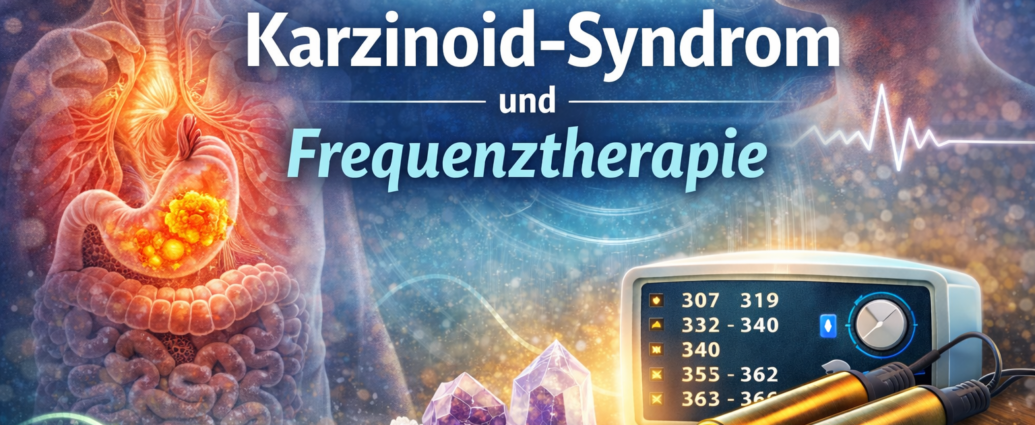
307 kHz
319 kHz
332 kHz
340 kHz
353-362 kHz
365 kHz
371-383 kHz
426-438 kHz
442-454 kHz
471-488 kHz
493-495 kHz
513 kHz
518-529 kHz
534 kHz
544 kHz
These frequency ranges are viewed in a complementary way and placed in a holistic context within frequency therapy. In practical support, they are linked to the individual symptoms, the general regulation, the stress on the digestive system and the overall energetic situation of the organism.
Carcinoid syndrome and frequency therapy considered together
Anyone dealing with carcinoid syndrome should first understand the basics of conventional medicine: neuroendocrine tumors, hormone-active messenger substances, possible liver involvement, cardiac stress, diagnostics and targeted forms of therapy. This medical view forms the basis for any well-founded discussion of the topic.
In addition to this, frequency therapy can be classified as complementary if the aim is to support the organism holistically. The focus here is on regulation, digestion, vegetative balance and individual stress patterns. The frequency ranges mentioned in the literature are understood in this context as frequency information and integrated into a more comprehensive complementary concept.
Conclusion
Carcinoid syndrome is a complex set of symptoms associated with neuroendocrine tumors that can affect many organ systems. Typical symptoms are hormone-related symptoms such as hot flushes, diarrhea, abdominal cramps, circulatory reactions and, in some cases, cardiac involvement. Conventional medical diagnosis and treatment form the central basis.
In the complementary field, frequency therapy can be used as a supplementary approach to support the organism in its ability to regulate itself. The frequency ranges described in the literature are integrated into a holistic concept as frequency information.

Comments are closed, but trackbacks and pingbacks are open.