





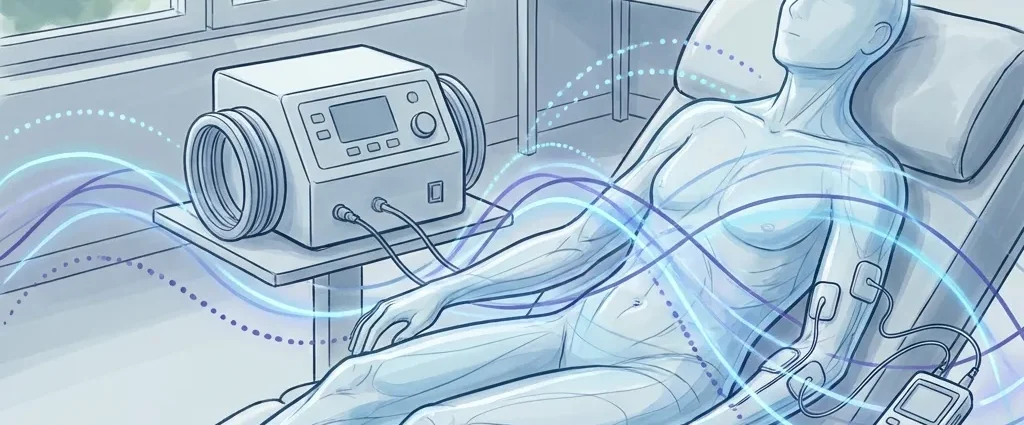
Many people today are interested in Frequency therapy. The range of therapy devices is growing. TENS, PEMF and various forms of frequency therapy promise pain relief, regeneration and a better quality of life. But what really works? And what are the real biological differences?
Especially in cases of chronic pain, Autoimmune diseases When dealing with fatigue or exhaustion, many people seek gentle alternatives. Conventional medical approaches often reach their limits in these cases. At the same time, there are many promises, little clarity, and even more opinions. This creates uncertainty. Alternative practitioners and therapists, in particular, are faced with the question of which method is appropriate and how it should be used correctly.
This article brings order to the topic. You will learn how TENS, PEMF and frequency therapy affect the body in an understandable and well-founded way. We look at the biological points of attack. We compare neurophysiological and cell biological effects. We talk openly about the study situation, limitations and practical benefits. We remain down-to-earth and clear.
The focus is on real impact, not marketing. You get guidance for everyday life. Regardless of whether you are affected yourself, work as a therapist or want to continue your education. The aim is for you to know, after reading, which method suits which goal and what you should look out for in therapy equipment.
Three paths, one goal: understanding pain, regulation and healing
TENS, PEMF and frequency therapy pursue a similar goal. They want to influence processes in the body. However, the way to achieve this is fundamentally different. This is precisely where the crucial differences arise.
TENS works with electric current. This is applied directly to the skin via electrodes. The target is the peripheral nerves. PEMF uses pulsating electromagnetic fields. These penetrate tissue and act directly on cells. Frequency therapy in the narrower sense usually uses very weak signals that target regulatory systems.
What is often overlooked: These three approaches address completely different levels of biology. While TENS superimposes short-term signals in the nervous system, PEMF intervenes in the biophysical processes of the cell. Frequency therapy, on the other hand, addresses higher-level control circuits such as the autonomic nervous system or neuroendocrine axes. These differences explain why some patients experience rapid pain relief, while others only experience subtle changes after weeks.
In the Practice A lack of understanding often leads to unrealistic expectations. People buy a TENS unit even though they have chronic inflammation. Or they expect frequency therapy to eliminate acute pain, even though its primary effect is regulatory. Studies show that the success of a treatment depends heavily on whether the method is appropriate for the underlying condition.
These differences can be clearly contrasted:
| Procedure | Physical stimulus | Biological point of attack | Effective level |
|---|---|---|---|
| TENS | Electric current | Peripheral nerves | Neurophysiological |
| PEMF | Electromagnetic field | Cell membrane, mitochondria | Cell biology |
| Frequency therapy | Low-energy signals | Regulatory systems | Systemic |
This table already shows the core. TENS works quickly, but symptomatically. PEMF goes deeper. Frequency therapy attempts to bring order to the system. In practice, it is important not to mix these levels, but to combine them in a targeted manner when it makes sense.
TENS: When nerves are modulated
Transcutaneous electrical nerve stimulation, or TENS for short, has been well researched. It has been used for decades. The aim is to reduce pain via the nervous system.
TENS addresses different nerve fibers depending on the frequency. High frequencies between 70 and 100 Hertz activate A-beta fibers. They block pain signals in the spinal cord. This mechanism is known as gate control. Low frequencies between 2 and 4 Hertz promote the release of the body's own endorphins.
Intensity also plays an important role. Studies show that clearly perceptible but not painful stimulation is more effective than subliminal stimulation. The placement of the electrodes also determines success. Incorrectly placed electrodes often lead to a lack of effects and frustration among users.
These effects are well documented:
| TENS type | Frequency | Biological effect |
|---|---|---|
| High-frequency TENS | 70, 100 Hz | Gate control mechanism |
| Low-frequency TENS | 2, 4 Hz | Endorphin release |
| Endorphin peak | 0.5, 5 Hz | μ-Opioid receptors |
Large reviews show that TENS works better than placebo. At the same time, the study situation is heterogeneous. Meta-analyses report effect strengths between low and moderate. There is evidence of benefit for back pain, osteoarthritis and postoperative pain in particular.
However, the results of the clinical studies published in recent years regarding the effect of TENS in the pain therapy setting are extremely controversial.
In practice, this means that TENS can relieve pain, often within minutes. However, it does not change any cell processes. It does not promote regeneration. It is useful for acute or functional pain. It is often not sufficient for chronic inflammation or autoimmune diseases and should not be regarded as the sole solution.
PEMF and frequency therapy: cell biology instead of symptom treatment
PEMF stands for pulsed electromagnetic fields. This method does not primarily affect nerves, but cells. This is where the big difference lies.
Electromagnetic fields affect voltage-gated ion channels. Calcium, in particular, plays a central role. These channels regulate inflammatory processes, energy production, and Cell communication controlled. Even slight changes in calcium signaling can have far-reaching effects on healing and pain perception.
Current studies show clear effects. In randomized, double-blind studies, the pressure pain threshold after PEMF increased by up to 139 %. Even after seven days, the effect was still measurable. The p-value was 0,045 and was thus significant. Such results are remarkable for non-invasive procedures.
| Parameters | Result |
|---|---|
| Pressure pain threshold | +83, 139 % |
| Effect after 10 minutes | +138 % |
| Long-term effect | +107 % after 7 days |
High-energy PEMF applications are likely to be effective in the treatment of tendinopathies.
PEMF influences mitochondrial ATP production. It modulates inflammatory pathways such as NF-κB. It supports osteogenesis and tissue repair. Accelerated bone healing has also been shown in animal models, which is why PEMF is also used in orthopaedics.
An in-depth overview of biological mechanisms of action can also be found in the article Frequency therapy effect: What frequencies do in the body.
In addition, a look at Breast cancer and frequency therapy is recommended in order to understand how frequency therapy can also have a supportive effect in complex clinical pictures.
Frequency therapy: regulation as a goal
Frequency therapy is a collective term. It encompasses many devices and concepts. What they all have in common is that they work with very weak signals. These are intended to trigger regulatory processes.
The models behind them are based on Resonance, biophotons, and autonomic control loops. The goal is not direct stimulation, but self-regulation. The autonomic nervous system plays a central role in this process, particularly the balance between the sympathetic and parasympathetic nervous systems.
An important aspect is individuality. Frequency therapy often works with concepts similar to biofeedback. The body should absorb the appropriate information without being overwhelmed. This explains why some patients react very sensitively, while others hardly feel anything.
Honesty is key. For many of these approaches, there is no robust clinical evidence in the form of large randomized trials. That does not mean they are ineffective. It means that they complementary should be used, ideally as part of a comprehensive treatment plan.
In practice, many users report better sleep quality, emotional stability and stress reduction. This can be particularly valuable for sensitive patients, such as those with burnout or long-term COVID. However, it is not sufficient as the sole therapy for serious illnesses.
Particularly in the case of complex processes, it is Autoimmune diseases Frequency therapy: balance instead of suppression meaningful.
Which therapy devices are suitable for which goal?
There is a large selection of therapy devices. Marketing promises are often loud. The effect is not always the same. It is therefore worth taking a clear look at the target and level.
TENS can be helpful for acute pain. It is cheap, simple and fast. PEMF is superior for regeneration, anti-inflammation and chronic processes. Frequency therapy is suitable for support, regulation and sensitive phases.
A common mistake is to buy multifunctional devices without a clear concept. Devices that can „do everything“ are often not really strong in any discipline. Studies and practical experience show that specialized systems deliver better results.
A decision-making framework can help:
| Goal | Suitable procedure |
|---|---|
| Acute pain | TENS |
| Chronic inflammation | PEMF |
| Regulation, stress | Frequency therapy |
The combination often makes sense for therapists. It is important to clearly prioritize and document the effects. You can also find out more at Herbert Eder, which offers practical training and sound insights.
Security, boundaries and responsibility
As effective as these methods may be, they are not toys. Contraindications must be taken into account. These include pregnancy, implants, or active cancer.
The dosage is also crucial. Too strong or too frequent applications can have the opposite effect, especially on highly sensitive people. A gradual approach is therefore advisable.
You can find an honest discussion of risks in the article Understanding frequency therapy side effects correctly. It is also worth taking a look at Frequency therapy contraindications - when restraint is wise, to act responsibly.
Especially with children, the highly sensitive or seriously ill, less is more. Observation, documentation and adaptation are mandatory. Responsibility also means recognizing limits and involving conventional medical support if necessary.
Trends 2025 and beyond
The market is developing rapidly. PEMF devices are becoming more mobile. Protocols are being personalized. Use in long-COVID and autoimmune diseases is increasing.
Digital interfaces, app-based control and AI-supported adjustment of frequencies are on the rise. Initial studies are investigating personalized field parameters based on HRV or inflammation markers.
At the same time, the need for education is growing. Not every frequency makes sense. Not every device delivers what it promises. Quality, field strength and application are decisive. In 2025, clarity will be more important than innovation at any price. After all, understanding biological principles remains crucial.
The heart of the matter
TENS modulates nerves. PEMF modulates cells. Frequency therapy supports regulation. This simple distinction brings clarity.
When selecting therapy devices, always ask yourself: What level do I want to work on? Symptom, cell or system? The answer determines success or disappointment.
The next step is to deepen your knowledge and apply it consciously. With clarity, responsibility and an open view of the whole, a real therapeutic effect is created.
You can also expand your knowledge with the Learn frequency therapy - your path from beginner to professional expand.

Comments are closed, but trackbacks and pingbacks are open.