





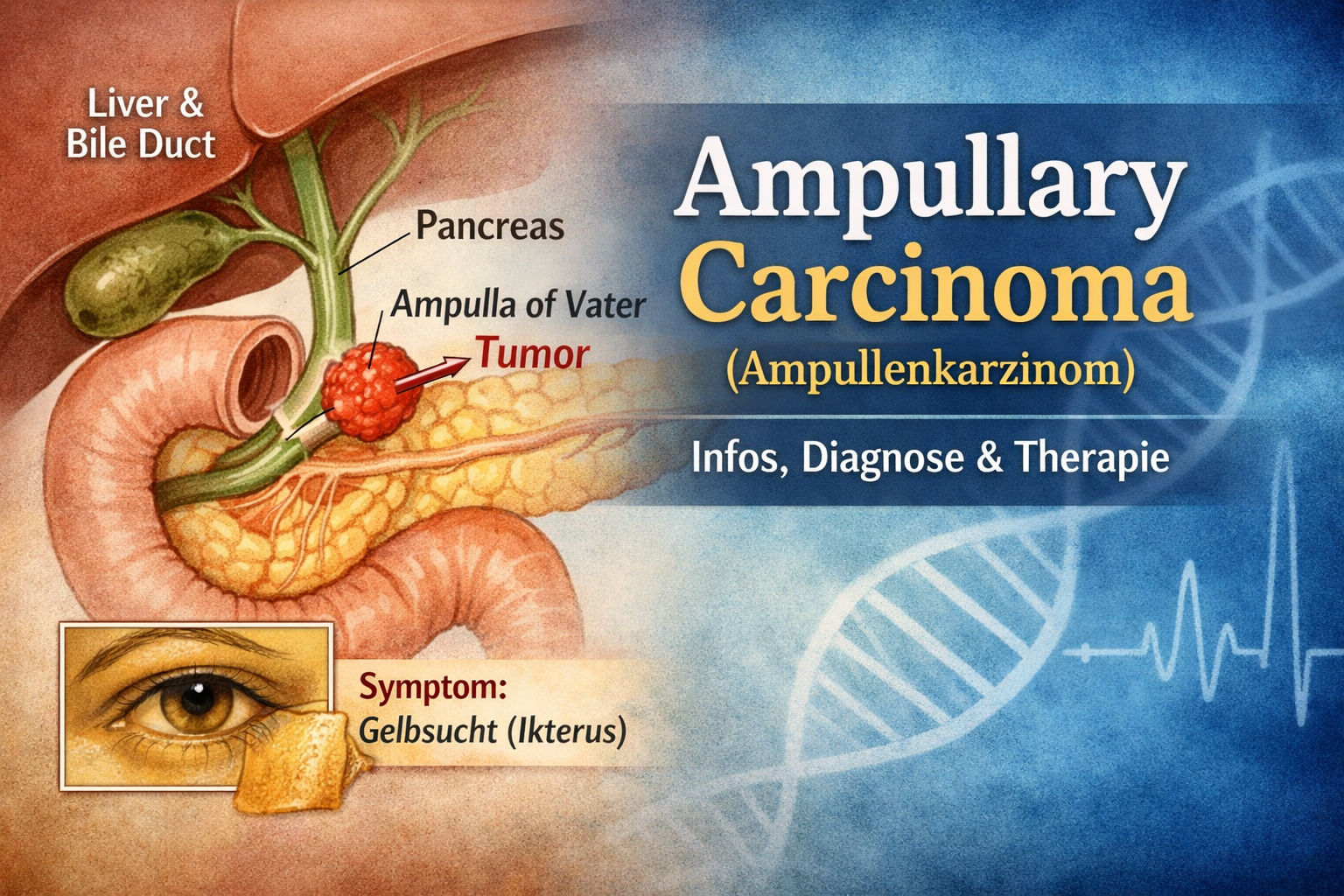
The Ampullary Carcinoma (German: Ampullary carcinoma) is a rare malignant tumor in the area of the Papilla Vateri (Ampulla of Vater) - i.e. where Bile duct and Pancreatic duct into the duodenum. Due to this location, the tumor often leads to a blockage of bile flow at an early stage, which is why the disease is sometimes more severe than pancreatic cancer. is noticed earlier.
What exactly is the ampoule (Papilla Vateri)?
The ampulla is a small anatomical „switch point“ in the upper small intestine where digestive juices from the intestine are released. Liver/bile and Pancreas into the intestine. A tumor in this area can block the outflow - with typical consequences such as Jaundice.
Frequency and classification
Ampullary carcinomas are among the periampullary tumors and are altogether rare. The prognosis can vary depending on Tumor stage and histological subtype (e.g. intestinal vs. pancreatobiliary type) vary significantly.
Causes and risk factors
There are usually no clear individual causes. In practice, the following are discussed or frequently seen:
- Genetic syndromes (e.g. familial adenomatous polyposis/FAP) for ampullary tumors in the broader sense
- Chronic inflammatory and congestion processes in the biliary/pancreatic system (depending on the patient situation)
- General cancer risk factors (age, smoking, metabolic problems) - depending on the individual constellation
Important: These are risk indications, not diagnoses.
Typical symptoms (warning signs)
The most common and clinically most important symptom is:
- Jaundice (icterus): yellow skin/sclera, dark urine, light-colored stool, itching
Other possible complaints:
- Upper abdominal pain or feeling of pressure
- Nausea, loss of appetite, weight loss
- Fever/inflammatory signs in the case of cholangitis
- Pancreatitis-like symptoms in some cases
Diagnostics: How is ampullary carcinoma diagnosed?
Depending on the initial findings, combinations of the following procedures are typically used:
- Imaging (CT/MRT/MRCP) for expansion and metastasis detection
- Endoscopy (duodenoscopy) with targeted examination of the papilla
- Endosonography (EUS) for local assessment and staging; frequently mentioned in guidelines/recommendations
- ERCP Diagnostic/therapeutic if necessary (stent for bile outflow obstruction)
- Biopsy for histological confirmation
Staging - why it is so important
Treatment planning depends heavily on whether the tumor:
- locally limited and operable is,
- Lymph nodes are affected,
- Distant metastases are available,
- which Subtype histologically present (prognostically relevant).
Standard therapy: Surgery (if possible)
With curative objectives, the Surgical removal usually the central measure. This is often a Pancreaticoduodenectomy (Whipple operation), depending on the extent and stage.
In very early, strictly selected situations, endoscopic/limited procedures can play a role - but this is highly case-specific and belongs in an experienced center.
Chemotherapy and radiotherapy: (neo-)adjuvant and palliative concepts
As ampullary carcinomas are rare, schemes are partly based on pancreatic/biliary concepts - taking subtype and risk factors into account.
- Adjuvant therapy (after surgery) is often considered depending on the findings
- Neoadjuvant therapy (before surgery) may occur in selected cases
- With metastatic/recurrent diseaseSystemic therapies according to oncological standards
Important: The specific choice (e.g. 5-FU-based or gemcitabine-based regimen) is individual and belongs in the tumor conference.
Aftercare and control
After curative therapy, regular check-ups are common, typically with:
- Clinical course, weight, diet
- Laboratory (liver values, possibly tumor markers depending on the concept)
- Imaging at fixed intervals
- Management of consequences of surgery (digestion, enzymes, diabetes risk)
Forecast
The prognosis is very variable and depends in particular on:
- Stage (T/N/M)
- R0 resection (tumor-free surgery)
- Lymph node infestation
- Degree of differentiation
- Histological subtype (clinically relevant)
Many centers report that ampullary carcinomas compared to classic pancreatic carcinoma often better starting conditions because they often show symptoms earlier (e.g. jaundice) - but this never replaces individual assessment.
Frequency therapy section
There are currently no established international frequency programs or frequency lists specifically for ampullary carcinoma.
If complementary procedures are used in practice, the exclusively accompanying with a clear priority on diagnostics, surgery/oncology, side effect management and aftercare.
Conclusion
Ampullary carcinoma is rare, but due to its particular location, it is often reported via Jaundice conspicuous relatively early on. The Operation is - if possible - the most important curative step; in addition systemic therapies depending on the risk and stage. Treatment in an experienced center and the decision in the interdisciplinary tumor conference are crucial.
Disclaimer (important note)
Frequency therapy is not recognized by conventional medicine and replaces none medical diagnosis or treatment by doctors, oncologists, therapists or alternative practitioners. If cancer is suspected or confirmed, a guideline-oriented clarification and therapy is mandatory.
Author: NLS Informationsmedizin GmbH Herbert Eder