


1) Brief overview
A Angiosarcoma is a Rare, usually aggressive soft tissue tumor, which comes from Blood or lymph vessel-lining cells develops. It can occur practically anywhere in the body, but often on the skin (mainly head/neck, partly chest area) and often grows rapidly.
2) What is angiosarcoma - and where does it often occur?
Angiosarcomas belong to the group of Sarcomas (tumors of the connective/supportive tissue). Typical symptoms include
- Cutaneous angiosarcoma (skin): often brownish-purple, „bruise-like“, can become larger and bleed easily.
- Angiosarcomas of the breast (also possible after pre-treatment)
- Deep soft tissues/organs (rare, but possible)
Important: Because the vascular lining occurs everywhere, the localization is very variable.
3) Possible risk factors
Possible connections/triggers are described in the literature (depending on localization):
- Previous radiation exposure (e.g. after radiotherapy)
- Chronic lymphoedema (long-standing lymph congestion situation)
- Other factors are possible depending on the source/organ; in individual cases the cause is often not clear.
(For rare tumors, the data is often limited - individual clarification at the sarcoma center is crucial).
4) Symptoms - what to look out for?
Depending on the location of the tumor, the following may occur
- Skin change like a hematoma, that does not go away, gets bigger or bleeds
- Lump/swelling, pressure pain
- In case of deep location/organ infestation: non-specific complaints (pain, functional impairment, etc.)
5) Diagnosis & staging
Typical procedure:
- Clinical examination (skin/soft tissue, lymph nodes)
- Imaging (e.g. ultrasound, MRI/CT - depending on localization)
- Biopsy with histological and immunohistochemical confirmation
- Staging (spread diagnostics) - particularly important for aggressive tumors
Precisely because of its rarity, a clarification in a Sarcoma/Tumor Center meaningful.
6) Conventional medical therapy options (state of oncology)
The treatment depends heavily on Localization, size, resectability and metastasis from. The usual pillars are:
- Operation (if possible, with the aim of complete removal)
- Radiotherapy (often supplementary, depending on the situation)
- Systemic therapies (e.g. chemotherapy; in selected cases targeted or immuno-oncological approaches - depending on tumor biology/guidelines/study situation)
- Clinical studies can be particularly relevant for rare tumors.
7) Frequency therapy - classification in the context of angiosarcoma
Many of those affected seek Accompanying, complementary approaches, to support regeneration, sleep, stress regulation and subjective well-being. In practice, frequency therapy is partly accompanying used - but the Evidence for tumor therapeutic efficacy in conventional medicine not recognized (see disclaimer at the end).
8) Frequency programs according to lists (EDTFL / CAFL)
8.1 EDTFL (ETDFL) - suitable programs for „Sarcoma“
In the ETDFL 2024A (ETDFL 2023/2024 Edition) can be found no separate entry „Angiosarcoma“ in the search logic, but several Sarcoma programs, which are used as an obvious assignment.
Note on units: ETDFL frequencies are used in many issues. in kHz (depending on the device). If your device Hz expected: kHz × 1000 = Hz.
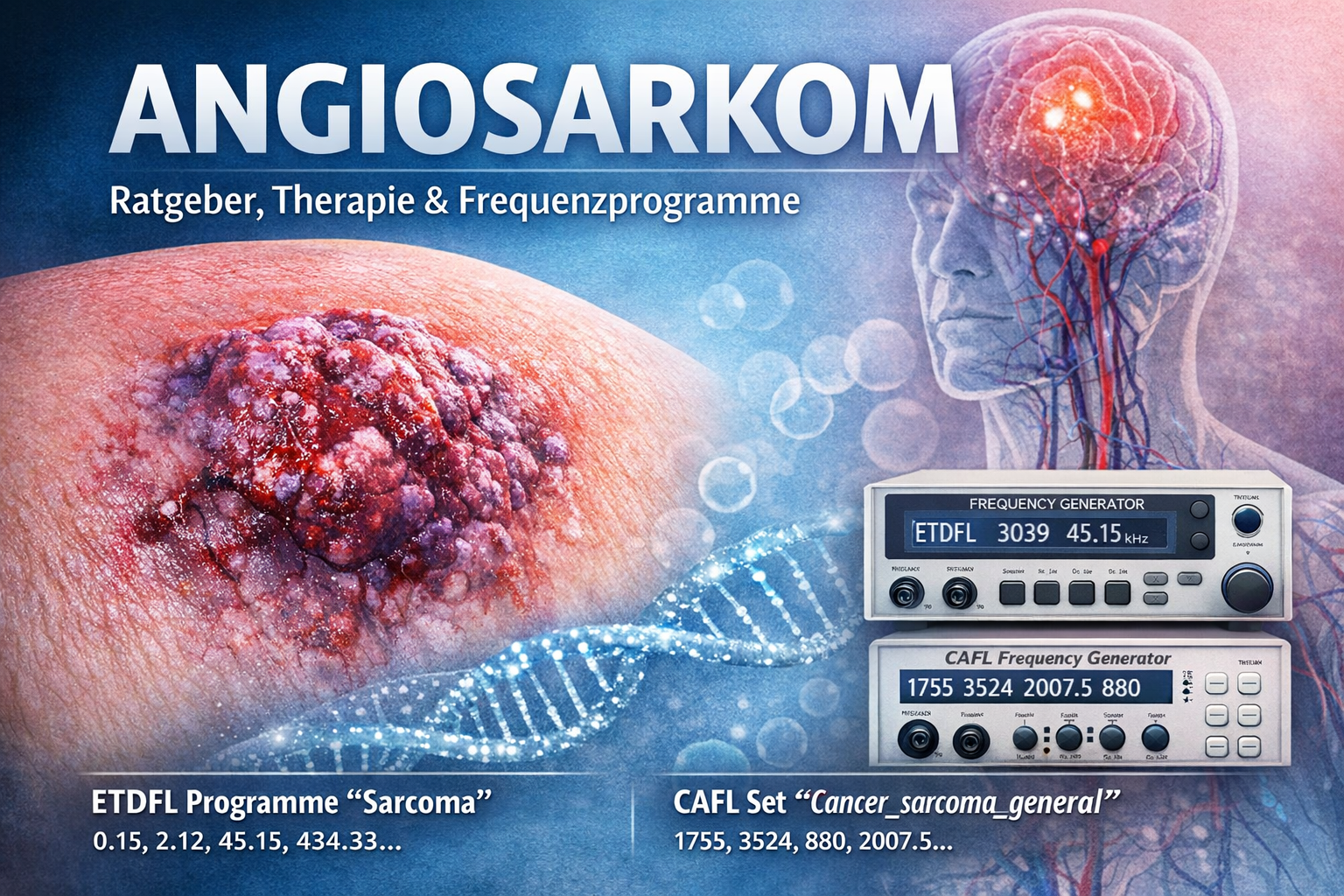
ETDFL - Sarcoma (Program #3039)
- 3039: Sarcoma: 0.15, 2.12, 20, 45.15, 47.5, 96.5, 125, 375.75, 434.33, 563.19
ETDFL - Sarcoma, General (Program #3043)
- 3043: Sarcoma, General: 0.14, 0.22, 0.72, 2.58, 47.5, 96.5, 125, 375.75, 434.33, 563.19
ETDFL - Cancer: Sarcoma General (Resonant Light Alternate Sets)
- 547: Cancer: Sarcoma General - Alternate Set 1: 0.13, 0.57, 0.75, 12.27, 68.29, 135.25, 272.72, 434.53, 733.91, 836.42
- 548: Cancer: Sarcoma General - Alternate Set 2: 0.1, 0.55, 0.73, 0.87, 67.2, 172.85, 230, 434.2, 535.23, 608.21
Practical tip (neutral): If no specific angiosarcoma set exists, the following is often used „Sarcoma“ + „Sarcoma General“ and the reaction documented (tolerance/exposure).
8.2 CAFL - Classification „Angiosarcoma“
In the used CAFL-PDF (v2007-05-16) can be found no separate entry „Angiosarcoma“, but there is:
- a Comprehensive basic set „Cancer (Basic comprehensive set)“ (as a general cancer spectrum)
- and „Cancer_sarcoma_general (BY)“ as a sarcoma-related set
CAFL - Cancer (Basic comprehensive set)
- (Extract/set as listed): 10000, 11780, 21275, 17034, 11430, 10025, 6766, 6064, 5000, 3713, 3176, 3040, 2950, 2876, 2790, 2720, 2452, 2189, 2182, 2128, 2127, 2084, 2048, 2008, 1604, 1552, 1489, 880, 854, 800, 784, 776, 766, 728, 690, 683, 676, 666, 524, 464, 333, 120, 20
CAFL - Cancer_sarcoma_general (BY)
- Cancer_sarcoma_general (BY): 1755, 3524, 2007.5, 2005, 2015.9, 2083.8, 728, 880, 802, 785
9) Keywords (comma-separated)
Angiosarcoma, angiosarcoma, sarcoma, soft tissue tumor, vascular tumor, skin angiosarcoma, diagnosis, therapy, surgery, radiotherapy, chemotherapy, ETDFL, EDTFL, CAFL, frequency programs, frequency therapy
10) Author
NLS Informationsmedizin GmbH, Herbert Eder
11) Hashtags
#Angiosarcoma #Angiosarcoma #Sarcoma #Cancer #Oncology #Frequency therapy #ETDFL #CAFL #HerbertEder #NLSInformation medicine
Medical disclaimer
The frequency programs/lists mentioned here (e.g. ETDFL/CAFL) originate from the field of complementary or alternative medical applications and are not recognized by conventional medicine. They replace none medical diagnosis or treatment. If angiosarcoma is suspected or diagnosed, care should be provided by Specialists (ideally in a sarcoma center) is strongly recommended.