




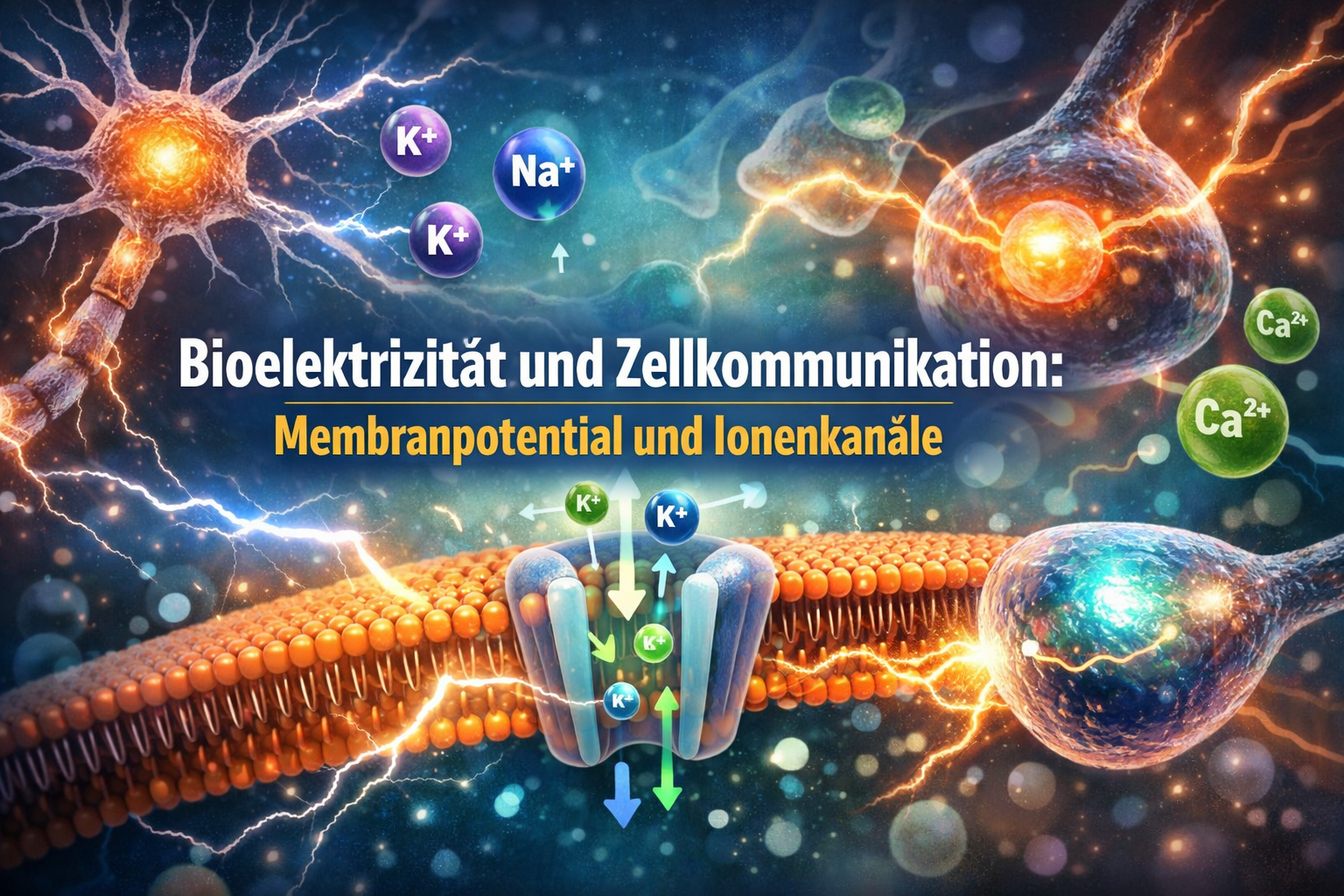
Bioelectricity and cellular communication are based on the electrochemical membrane potential, which is created by the asymmetry of the selective-permeable distribution of ions such as sodium, potassium, calcium and chloride as well as the function of specific ion channels (Brasovan et al., 2025). Ion channels have a regulatory effect on ion transport and influence the electrical potential of the cell membrane. The potential difference generated in this way enables the transmission of electrical signals in cell networks. Nerve conduction, muscle contraction and signal transduction are some of the physiological processes that benefit from this cellular function.
Damage to the cell membrane potential due to toxic, pathological or age-related influences has an effect on ion transport, which in turn has a negative impact on ATP production and gene expression (Brasovan et al., 2025). This underlines the fact that the integrity of the cell membrane potential is an important prerequisite for the functionality of every cell and that pathological processes are promoted in many diseases by its dysregulation and the resulting regulatory deficits.
Different frequencies of electromagnetic fields and thus bioelectric information influence the selectivity and permeability of ion channels, as they contain the information of endogenous, endogenous electromagnetic fields and can thus stimulate dysfunctional cells (Brasovan et al., 2025). However, since frequencies always have a different effect on biological cells and the results can vary greatly, the application must be adapted and standardized for each individual.
Furthermore, it has been recognized that a specific frequency influences the cell membrane potential. Various experiments show that absorbed electromagnetic frequencies have the potential to modulate epigenetic activity and induce or suppress the expression of certain genes (Ebrahimi et al., 2015). This potential generated in vivo can activate metabolic processes in cells and force cell regeneration. Frequency-modulated biological intervention approaches are also conceivable, as electromagnetic frequencies can be transported into cells and tissues in a targeted manner in order to support individual metabolic and reparative processes. Further basic research will be necessary in this regard.
There are frequency medicine procedures that were developed with the intention of regulating the cell membrane potential via a specific fine adjustment and restoring the „healthy“ functional level of the cells (Brasovan et al., 2025). It was also recognized that certain frequency ranges have an effect on ion channels. In Szász's research, it was observed that in a frequency range between 0.1 and 10 MHz, the activity of the sodium-potassium pump, a central element of the membrane potential, reaches its maximum (Szász, 2021). The endogenous oscillation frequencies of all cells are located in this range.
The use of specific electromagnetic frequencies with the aim of manipulating ion channels and selectively influencing cell properties was already extensively investigated in the 1950s. An improvement in cell membrane boundaries in pathological processes has been demonstrated in the β-dispersion range (10 kHz to several 100 MHz) (Szász, 2021). Selective control can be used to influence cell processes that are relevant for the development or regression of various clinical pictures, so that biochemical interventions can be replaced. However, it is not possible to specifically specify the frequency and strength at which significant cell stimulation occurs, as these differ depending on the biological reaction.
In interdisciplinary experiments, specific frequencies that correspond to the body's own frequencies have been shown to influence the electric field on cell membranes. This led to increased conductivity and normalization of the signalling processes (Brasovan et al., 2025). These findings suggest that only specific frequencies can achieve an optimal influence on the regulatory processes of cells and thus their signal transduction.
In addition, there are so-called window effects, which pose a challenge in the practice of frequency medicine applications, as qualitative changes in response to biological systems can be triggered by slight changes in frequency or field strength (Szász, 2021). This requires individualization, which complicates the research potential, but represents an essential step towards targeted treatment systems. It shows that frequency therapy is a systemic process and no universal treatment of every individual is possible, as the respective reaction of the therapy is always individual and dependent on the organism. Future research is needed to determine which biological parameters form the basis for an individualized frequency application.
The fact that ion channels play a key role in frequency therapy proves that we are moving away from the traditional biochemical direction of therapies. Electromagnetic signaling has been established as a fundamental regulator of biological processes, as well as physiological and pathological processes. A well-known phenomenon of electromagnetic field effects is that birds lose their sense of direction in the vicinity of radio towers (Lakhovsky & Hatonn, 1970). This suggests that the nerve cells are susceptible to electromagnetic signals.
Structured water also plays a decisive role in its function as a communication conductor and antenna amplifier of information. Most living organisms contain a very high proportion of water (approx. 70-80 %). Recent studies have shown that a proper molecular structure of water enables a strong exchange of charged ions, which form the basis of electromagnetic fields (Brasovan et al., 2025).
Resonance effects, which in bioelectrics represent the basic connection between cells, also affect the function of ion channels and cell connections. In 1925, Lakhovsky established that cells are able to absorb and stimulate electromagnetic information, as each cell is an electromagnetic oscillator (Lakhovsky & Hatonn, 1970). Modern medicine also shows that cellular signal transduction in the body takes place via electromagnetic resonance. External electromagnetic fields have a resonant effect on membranes, which leads to the stimulation of endogenous frequencies. This regulates communication between cells in a whole range of functions in the human organism, e.g. healing and repair processes.
Future studies can also elucidate the mode of action of frequency-modulated treatment at the molecular level. The technique of EPL (Expressed Protein Ligation), in which synthetic probes can be implanted into specific domains of proteins (Muralidharan & Muir, 2006), can be considered here. This technique allows the functional analysis of proteins as well as the possibility to study structural phenomena such as phosphorylation, conformational changes or aggregation, which alter the activity of proteins under frequency-medical intervention. In addition, the spectroscopic analysis of molecular mechanisms of frequency medicine interventions, which allow the selective manipulation of biological systems, could be improved by the implementation of probes.
Many frequency procedures are aimed directly at modifying gene expression, as various studies show that electromagnetic frequencies can achieve biophysical stimulation of nerve cells, which in turn leads to the stimulation of cell metabolism, but also to a change in gene expression (Ebrahimi et al., 2015). In addition, chromatin changes are caused, which in turn can influence the readability of epigenetic information in the organism.
In general, this new method of influencing the electrical potential of cells through the application of frequency-modulated electromagnetic signals should be seen as an expansion of knowledge about the possibilities of regulating physiological processes in the human organism, which can be used for therapies in the future.