




1 Introduction: Why biophotonics is crucial for the medicine of the future
Biophotonics is one of the most exciting fields of research of our time. It investigates the ultra-weak light emission that emanates from living cells - the so-called Biophotons. These light particles, which are DNA and mitochondria appear to play a fundamental role in cell communication and energy transfer.
The connection between Biophotonics and reflexology offers a new, scientifically sound look at ancient healing traditions. While reflexology has been working with concepts such as „energy flows“ and „meridians“ for centuries, modern research shows that these energy channels could have a biological basis - in the form of the Primary Vascular System (PVS).
2. the aim of the research - the connection of energy channels and biophotons
The study „Biophotonics and Reflexology: Conceptualization of the Role of Biophotonic Signaling“ by Nevoit et al. (2024) pursues this goal, develop a biological theory, which explains how reflexology works on a cellular and electromagnetic level.
The central question here is: How are biophysical signals transmitted between organs, and what role do biophotons play in this process?
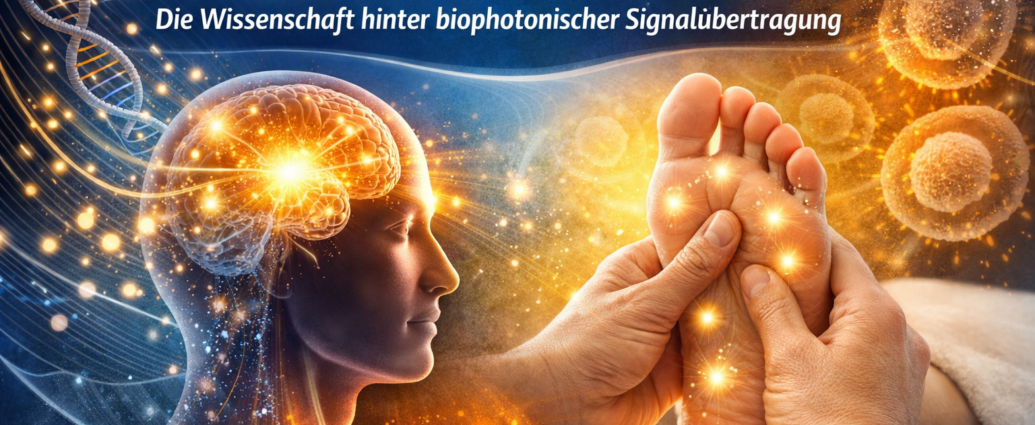
The researchers propose that biophotons are transmitted via the primary vascular system - a network that exists parallel to blood and lymphatic vessels - as a Optical signal carriers and thus enable reflex connections between organs.
3. basics of biophotonics: light, life and communication
3.1 What are biophotons?
Biophotons are Light quanta (photons), which are emitted by cells in the visible and near UV spectrum. They are produced by biochemical reactions in the DNA and the mitochondria, especially in cellular respiration.
About 75 % of all biophotons originate from DNA-molecules. This ultra-fine radiation transmits information at the speed of light - a mechanism that may explain the precise synchronization of biological processes throughout the body.
3.2 How biophotons connect cells with each other
Every cell generates an electromagnetic field. Biophotons ensure that this field remains coherent and enables communication between cells. This electromagnetic resonance could explain how signals work over long distances without nerve transmission - for example in acupuncture or reflexology.
4 The role of primary vascular systems (PVS) - the „missing link“
4.1 Anatomy and structure of the primary vascular systems
The PVS, also known as the „Bong-Han system“, was described back in the 1960s by Korean researcher Kim Bong-Han. It consists of its own network of microscopic vessels and nodes, that occur throughout the body - on organ surfaces, in blood vessels, in the nervous system and in the Skin.
These channels transport „primo fluid“, which DNA, RNA and stem cell precursors - a possible proof of the Renewability and reparability of the body on an energetic level.
4.2 PVS as an electromagnetic information channel
Scientific experiments indicate that the PVS works like a Optical fiber system works:
It transmits biophotonic signals at the speed of light, shielded by collagen structures. This allows biological impulses - e.g. through acupuncture - have an immediate systemic effect, which explains the direct connection between reflex zones and internal organs.
5. reflexology and meridians in the light of biophotonics
Classical reflexology assumes that energy channels (meridians) connect different areas of the body.
Thanks to modern biophotonics, we can now understand, that these channels are real biophysical structures in the form of the PVS and the myofascial chains.
5.1 Scientific explanations for traditional energy pathways
Researchers have found that many traditional meridians correspond anatomically to muscle chains or connective tissue structures. These transmit electromagnetic signals in a similar way to electrical conductors.
5.2 Myofascial chains as biological conductors
The Myers„ “Anatomy Trains" - the muscular chains in the body - appear to lie parallel to the meridians. As a result, they can serve as natural pathways for biophotonic signals and explain reflex effects between organs.
6. energy conversion in the body: from ATP to coherent energy
6.1 The biophysical significance of mitochondria
Mitochondria are not only „power plants of the cells“, but also Light sources. They generate photons during cellular respiration. This energy is converted into coherent electromagnetic oscillations via biopolymers - the basis of the biophotonic communication.
6.2 Muscle tissue as a source of electromagnetic energy
Muscle cells contain a particularly large number of mitochondria. This makes them the main source of biophotonic energy. This energy is released via fascial structures and the PVS in the body and is the basis for the reflex effect during movement, massage or acupuncture.
7. importance for healing methods: Acupuncture, bioresonance and phototherapy
The discovery of biophotonic signal transfer opens up completely new perspectives for the Explanation and further development of complementary therapies.
Especially Acupuncture, Reflex zone therapy and Bioresonance benefit from these findings.
7.1 Acupuncture and biophotonic effects
When an acupuncture needle is inserted into a biologically active point, a local electromagnetic pulse is generated.
This impulse activates the primary vascular system (PVS), which transmits biophotonic signals to the connected organs at the speed of light.
This also explains the immediate systemic effects, which are observed in many patients - such as pain relief or relaxation.
7.2 Bioresonance therapy and electromagnetic resonance
Bioresonance devices work with low-frequency electromagnetic waves, which are intended to modulate the body's own vibrations.
The findings of biophotonics provide a scientific basis here: biophotons function as electromagnetic carriers of biological information, This means that external signals can actually trigger resonance effects at the cellular level.
7.3 Phototherapy and light medicine
Modern biophotonics also investigates how Targeted light frequencies activate healing processes.
Since biophotons are the natural language of cells, future treatments could be based on this principle, To „inform“ cells specifically with light frequencies“, to stimulate healing processes - an approach that was already used in the Bioelectronic medicine is being tested.
8. the bridge between modern and traditional medicine
The connection between Biophotonics and reflexology marks a historic turning point in medicine.
For the first time, the energetic principles of traditional healing arts with the biophysical laws of modern science harmonize.
Traditional medicine - especially from China, India and Korea - has been describing energy flows that run through the body for thousands of years.
Biophotonics now offers the missing scientific explanation:
This energy is electromagnetic nature, carried by biophotons, which are transmitted via the PVS and fascial structures.
This creates a common language for naturopathy and high-tech medicine - a step that is in the interests of the Gujarat Declaration of the WHO (2023) was demanded in order to scientifically substantiate traditional medicine.
9. future research perspectives of biophotonics
The study by Nevoit et al. (2024) opens up many new fields of research:
- Medical imaging: Development of technologies for the visualization of biophotonic currents in the human body.
- Diagnostics: Analysis of biophoton emission as an indicator of cell health or disease.
- Regenerative medicine: Use of biophotonic signals to control stem cells in the PVS.
- Neuroenergetics: Investigating the role of biophotons in neuronal communication and consciousness.
- Sports and preventive medicine: Understanding how movement activates biophotonic energy and increases well-being.
This future direction could lead to a completely new discipline - the „Bioelectromagnetic medicine“, the light, Frequencies and energy as diagnostic and therapeutic tools.
10 Conclusion: Biophotons as the key to understanding life
Biophotonics is much more than a technical field of research - it is a Revolution in biological thinking.
The discovery that cells communicate through light shows that Life itself is an electromagnetic phenomenon is.
In conjunction with reflexology, this knowledge provides a scientific basis for ancient healing traditions.
The Primary vessel system as an anatomical carrier of biophotonic currents explains for the first time how energetic stimuli - for example through acupuncture or massage - can Systemic healing reactions can be triggered.
This makes it clear:
Biophotons are the language of life - they connect mind, body and energy at the level of physics.
11. frequently asked questions (FAQs)
11.1 What is biophotonics simply explained?
Biophotonics is the science of light in biological systems. It investigates how living cells emit weak light signals (biophotons) and use them for communication, regulation and healing.
11.2 How does biophotonic signal transmission work?
During metabolic processes, cells generate photons that carry information about their state. These photons propagate through water, biopolymers and the primary vascular system - similar to a light signal in glass fibers.
11.3 What role does biophotonics play in reflexology?
It provides a scientific explanation of how stimuli at certain points (e.g. sole of the foot, ear, hands) affect organs via energetic channels.
The PVS transmits these signals at the speed of light - the biophotonic mechanism of the reflex connection.
11.4 Is biophotonics scientifically recognized?
The existence of biophotons has been scientifically proven. However, their biological function is still being researched. More and more studies, such as the one by Nevoit et al. (2024), confirm their central role in cell communication and energy transfer.
11.5 Can biophotons influence diseases?
Yes - disturbed or weak biophoton emissions are associated with diseases, stress or cell damage. By activating the biophotonic balance (e.g. via light therapy or exercise), the body can support its own healing.
11.6 What applications already exist in medicine?
- Photobiomodulation (PBM): Light therapy for tissue regeneration.
- Biofeedback & bioresonance: Use of electromagnetic Frequencies to harmonize body signals.
- Diagnostic photonics: Measurement of ultra-fine light emission for the early detection of diseases.
Closing words
The fusion of Biophotonics and reflexology symbolizes the beginning of a new era of medicine - a medicine that not only takes into account the chemical, but also the energetic-informational character of life recognizes.
This approach means that healing is no longer understood as a biochemical process, but as a Electromagnetic communication in the entire organism - a harmonious interplay of light, energy and consciousness.