




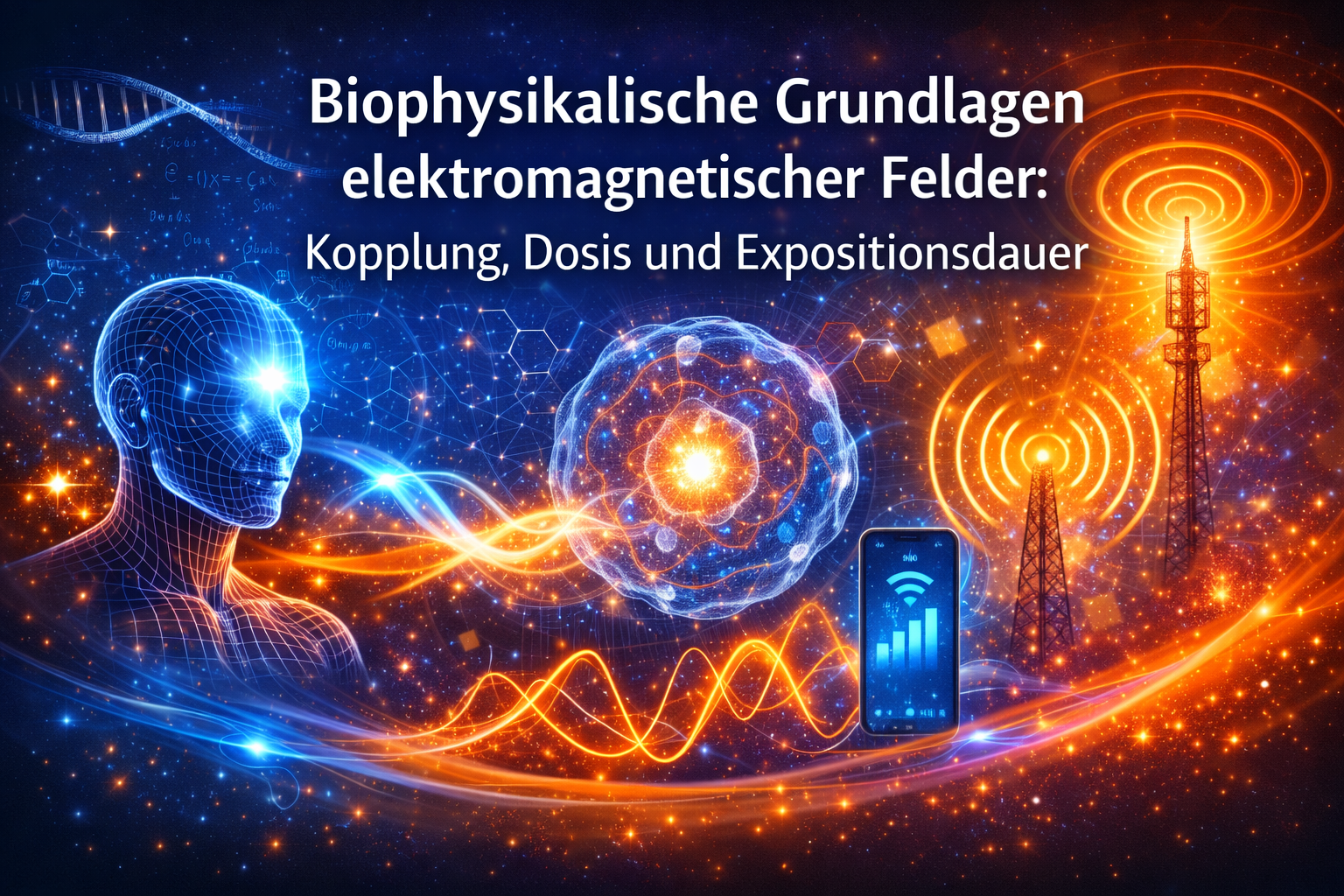
The biophysical principles of electromagnetic fields play an important role in frequency therapy in terms of coupling to biological tissue, dose design and exposure duration. The coupling of electromagnetic fields to biological tissue is influenced by biological parameters such as conductivity or the dielectric properties of cell membranes. These parameters are highly variable and depend on tissue types, but also on the frequency range. Depending on the frequency, different sensitivity points on the cell membrane have been described. Specifically, the membrane and electrolyte interface of the β-dispersion react very sensitively to the effects of electromagnetic fields in the range from 10 Hz to the MHz range. The reaction, i.e. cellular communication activation through frequency treatment, can be targeted. In the MHz range, for example, exposure to the frequencies 0.1-10 MHz has shown that the activity of the sodium-potassium pump shows the best efficiency and can be treated by applying the appropriate frequency and thus regulating the membrane potential (Szász, 2021). According to recent data, the highly ordered water clusters are able to effectively transmit the electromagnetic signals received by cells to neighboring cells and amplify them (Brasovan et al., 2025). The problem is that the frequency and parameters must be precisely tuned.
The effect of electromagnetic fields is dose-dependent and must be precisely matched to the biological windows with the corresponding current density and electrical voltage ranges. The smallest differences in parameters such as 0.03-0.06 V/m in the field strength or 4-5 μA/cm² in the current density show serious effects in the DNA concentration, but also in the activation of various biological functions in the cell (Szász, 2021). There is an effective range of effectiveness of electromagnetic fields on biological tissues and cells, so that the frequencies to be dosed work effectively in this region. Frequency therapy only works in a narrow bandwidth; a slight increase or decrease in the dose may have no effect or cause undesirable biological reactions. Dose efficiency is crucial to the effectiveness of treatment and standardization of protocols is required. It is important to be able to precisely maintain the parameters in order to generate an effect on biological tissues and prevent the occurrence of adverse reactions. The Multiwave Oscillator, for example, works with a wide action window, and only with a very precise dose were demonstrable results achieved in a clinical study (Valone, 2003). It is assumed that the reason for contradictory research results in this area of application of frequency therapy is the lack of standardization (Szász, 2021).
It is essential for the biological response to the effects of electromagnetic fields how long the exposure to the frequencies takes place. In practice, it is evident that shorter but repeated applications are generally more effective than a single exposure. In clinical and experimental studies, for example, applications with pulsating electromagnetic fields such as BEMER showed that two daily short-term applications of eight minutes each with a precise dosage and fixed intervals generated an improvement in microcirculation and pain relief (Palmer et al., 2023). In addition, a study on manual therapy in combination with electromagnetic frequency stimulation (Multiwaves) in pain relief in patients with rheumatoid arthritis concluded that a multimodal approach is more successful than the individual application of the two treatments (Chung et al., 2013). However, it is very important that the duration of the applications matches the temporal dimension of the affected mechanisms, as short-term, high-frequency applications tend to target acute signaling pathways (secondary messengers, cytoplasmic enzymes), while long-term functions such as gene expression require a much longer exposure duration. Therefore, further clinical studies with good documentation of treatment intervals are needed to establish a standardized, reproducible protocol for the optimal duration of electromagnetic field application (Palmer et al., 2023; Szász, 2021).
With non-thermal effects of electromagnetic fields, regulation of biological processes is specifically triggered without heating the tissue. Pulsed electromagnetic fields and other devices such as high-frequency Tesla systems are also used to perform certain cell functions non-thermally, such as restoring the transmembrane potential or improving electron transport through electroporation (Valone, 2003). The electromagnetic fields cause signal transmission without thermal stimulation and initiate biological processes at the cellular level. This procedure should contribute efficiently to the initiation of targeted cellular signaling pathways and gene regulation. It is assumed that in the long-term perspective of the therapeutic success of electromagnetic fields, their non-thermal effects are of great importance for the effectiveness in frequency therapy, and further experimental and clinical studies are necessary to prove the principle of action (Szász, 2021; Valone, 2003).
On the occasion of a study on pulsed electromagnetic fields for cartilage regeneration in the knee joint, it is pointed out that the correct application of the dose and the exact setting of the exposure time play an important role in the results of frequency therapy. The study investigated pulsed electromagnetic fields and the associated mechanical stimulation for cartilage regeneration in the knee in vivo. It showed a statistically significant benefit in terms of chondrocyte differentiation with a 30-minute treatment with pulsed electromagnetic fields compared to a 30-minute, single treatment with mechanical stimulation (Aaron et al., 2006). It has been proven that the regeneration of cartilage tissue is accelerated with precisely dosed electromagnetic fields and stimulation. Among other things, this stimulation has been shown to influence the amount of transforming growth factor β (TGF-β). TGF-β is a substance that stimulates cartilage cells, the chondrocytes, to generate the regeneration-promoting cell product. Pulsed electromagnetic fields can therefore be used specifically to initiate this signaling pathway in the knee and accelerate cartilage regeneration. The study shows that the use of frequency therapy can replace the empirical experience of therapists and thus provide a protocolized treatment method for clinical applications (Aaron et al., 2006). The correct application of the frequency and the dosed treatment can be precisely adapted to the different patients and thus a suitable therapy plan can be created for them. The protocol with precise dose information would be ideal for drawing up individual treatment plans. In studies, attention should therefore also be paid to the collection of clinically and biophysically measurable data (Aaron et al., 2006).
The biophysical principles for the application of electromagnetic fields, for efficacy, exposure duration and dose can be used to standardize clinical practice.