




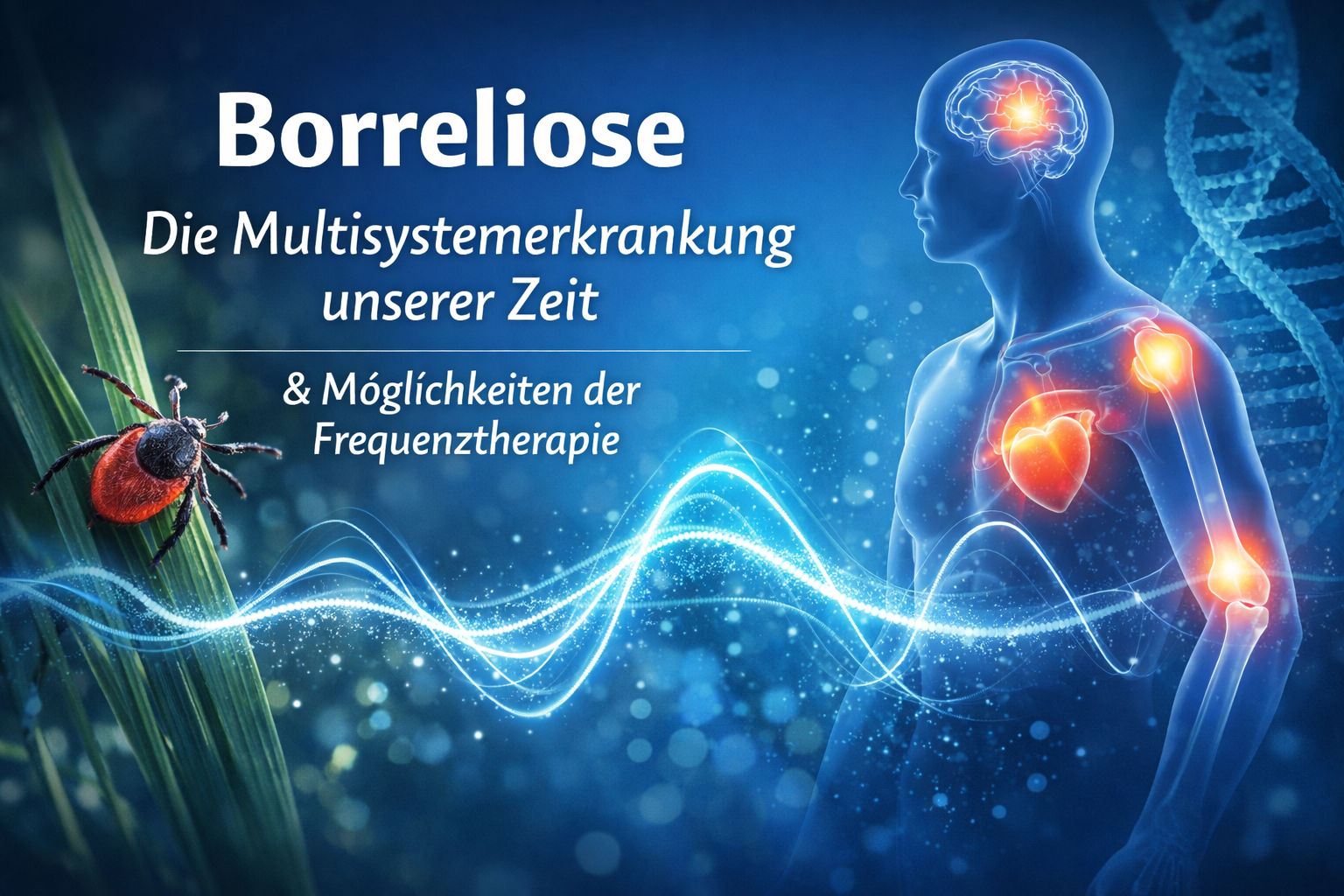
Lyme disease is a mystery for many people: the tick bite is long forgotten, blood values are inconsistent, symptoms wander through the entire system - and at the end of the day there is often a feeling of „nobody can tell me what I have“. This is precisely why Lyme disease is often described by sufferers as a Multisystemic disease of our time It can affect the nerves, joints, skin, heart, psyche and immune system - and it does not manifest itself in the same way in everyone.
In this article, we take a look, Why Lyme disease is so complex, which typical and atypical symptoms can occur, such as common Diagnostics and conventional medical therapy approaches look - and which Möglichkeiten komplementäre Verfahren wie die Frequency therapy can offer as an accompaniment.
Note: This article does not replace a medical diagnosis or treatment. If Lyme disease is suspected or symptoms persist, please always seek medical advice (infectiology, neurology, rheumatology).
1) What is Lyme disease anyway?
Lyme disease„ is usually understood to mean Lyme borreliosis, an infection caused by bacteria from the group of Borrelia burgdorferi sensu lato. They are usually transmitted through tick bites. In Europe, several Borrelia species can be involved - which is one of the reasons why the symptoms and course of the disease are so variable.
Important: Not every tick is infected, and Not every bite leads to Lyme disease. At the same time, it is precisely the „quiet“ progressions that can become problematic because they are not recognized at an early stage.
2) Why Lyme disease is experienced as a multi-system disease
Borrelia is not just „an infection like any other“. Many sufferers report:
- Changing complaints (knee today, neck tomorrow, dizziness the day after tomorrow)
- Waveforms (phases of improvement, then relapse)
- Systemic exhaustion (fatigue, stress intolerance)
- neurovegetative dysregulation (sleep, circulation, stress system)
- Inflammatory and immune reactions, which are very individual
The „multisystemic“ arises from an interplay of:
- Infection / pathogen persistence (in some cases)
- Immune response and inflammation
- Nervous system involvement (neuroinflammation/neuroirritation)
- Co-factors such as co-infections, gut/barrier, stress axes, micronutrient status, lack of sleep, etc.
3) Symptoms: typical - and often overlooked
Early phase (days to weeks)
- Migratory rash (erythema migrans)classic ring-shaped, but does not always have to be „bulls-eye“
- Flu-like: fever, headache and aching limbs, severe fatigue
- Lymph node swelling
Important: migratory flushing is a strong clinical sign - Here you should not wait for laboratory results, but to take medical action quickly.
Later phase (weeks to months)
- Joint problems (often knee, but not only)
- Muscle and tendon pain
- Nerve complaintsTingling, burning, numbness, „electrical“ pain
- Head pressure, migraine-like complaints
- Dizziness, tinnitus
- Concentration disorders, „brain fog“
Late phase / chronic courses (months to years)
- Persistent exhaustion (fatigue)
- neurocognitive complaints
- vegetative dysregulation (pulse, perspiration, sleep, temperature)
- Mood swings, anxiety/depression (often secondary to stress)
- Cardiac involvement in individual cases (rhythm/conduction disorders)
4) Diagnostics: why it is often difficult
Lyme disease diagnosis is challenging because:
- Antibody tests show Immune response, not automatically „active infection“
- In the early phase, antibodies can still negative be
- Laboratory values must with clinic, course and exposure (tick risk) should be considered together
- Symptoms can be non-specific and overlap with other diseases (e.g. autoimmune processes, viruses, long Covid, hormonal disorders, dysautonomia)
Typical conventional medical clarification (simplified):
- Medical history (ticks, skin signs, time course)
- Serology (ELISA/immunoassay + confirmation)
- Depending on the symptoms: cerebrospinal fluid (if neuroborreliosis is suspected), ECG, imaging, rheumatism parameters, differential diagnosis
5) Conventional medical therapy: the central pillar
The standard therapy in the acute phase is Antibiotic treatment according to medical guidelines, adapted to the stage and manifestation. This can work very well for clear early Lyme disease. In later, complex cases, management is often more individualized and includes additional measures:
- Pain and inflammation management
- Neurorehabilitation / Physio / Movement therapy
- Sleep and stress regulation
- Micronutrient medicine (after diagnostics)
- Intestinal/immune system support
- Accompanying psychotherapy/coaching for high stress levels
And yes, there is also the discussion about Persistent complaints after therapy („post-treatment“ syndrome). For those affected, this is less a concept than a reality: „I've been treated, but I'm not healthy.“ This often requires a multimodal approach.
6) Where frequency therapy makes sense
Frequency therapy is used in the complementary field to Regulation, Load tolerance and systemic balance support. With Lyme disease, the important question is not „either/or“, but:
How can the environment be improved, inflammation modulated, the nervous system calmed and the body brought back into regeneration - in parallel with medical clarification and therapy?
Typical objectives (complementary thinking):
- Support of the autonomic nervous system (vagus/stress axis)
- Promotion of relaxation, sleep and regeneration
- Accompanying support for pain, muscle tone, „nerve irritation“
- Support of microcirculation and tissue regulation (depending on the approach)
- Accompanying „detox“ concepts (critical and individual, do not overdo it!)
Important: Frequency therapy is No substitute for antibiotics in acute Lyme disease, but for many sufferers it can be a Stabilizing accompanying measure especially when the system is „overloaded“.
7) Frequency therapy for Lyme disease - a practical approach: 4 pillars
Pillar 1: Down-regulate the nervous system (the basis)
Many Lyme disease sufferers are in permanent stress mode: sleep is shallow, stimulus filter is disturbed, noises/light are too much, palpitations, restlessness, „crash“ after stress.
Here, frequency therapy (depending on the procedure) can aim to from the alarm state to get.
Accompanying measures:
- Breathing training (coherent breathing)
- Gentle exercise (walks instead of HIIT)
- Sleep hygiene + light management
- Magnesium/glycine (only as a general idea - clarify individually)
Pillar 2: Accompanying inflammation & pain axes
Pain in Lyme disease is often not just „mechanical“, but neuro-inflammatory. Frequency therapy is often experienced here as a supportive measure in order to:
- Modulate the sensation of pain
- Release muscle tension
- Improve recovery after exercise
Additional modules (complementary):
- Omega-3, vitamin D, check inflammation markers
- Heat/cold depending on compatibility
- Manual therapies (dose carefully)
Pillar 3: Support the immune system & environment
The body needs resources: energy, micronutrients, intestinal barrier, liver/detoxification capacity. Frequency therapy is often embedded in concepts that address the „milieu“:
- Intestine (fiber, probiotics specifically, clarify SIBO/histamine if necessary)
- Micronutrients (B12, folate, ferritin, zinc, selenium - according to laboratory)
- Liquid/electrolytes
- Liver and bile flow (nutrition, bitter substances - individual)
Pillar 4: Long-term development instead of „war against the pathogen“
More pressure„ is not always better, especially in the longer term. Many sufferers react to strong interventions with Herxheimer-like reactions or system overload. A smart approach is often required:
- dose
- regulate
- stabilize
- Gradually increase
Frequency therapy can be used here as gentle, repeatable regulator with a focus on resilience and resilience.
8) Example of an accompanying weekly plan (gentle & realistic)
No therapy instructions - just an orientation model on how to introduce structure.
3-5× per week
- Frequency therapy session (start short, then increase)
- 20-40 minutes walk (or 2× 10-15 minutes)
daily
- Coherent breathing 5-10 minutes
- High-protein breakfast or lunch (stability for the nervous system)
- Light in the morning (10-20 minutes of daylight)
- In the evening: screen down, warm light, sleep ritual
1× per week
- Check-in: What has improved? What has triggered?
- Adapt load („pacing“ instead of pushing)
9) Lyme disease & cancer - why the comparison often comes up (and how to keep it clean)
In practice, some people with chronic Lyme disease report a „physical state of emergency“, which can feel as threatening as with severe diagnoses because:
- Massive drop in energy/performance
- the nervous system is permanently stressed
- everyday life suddenly no longer works
The important thing is: Lyme disease is not cancer - but for those affected it can similarly existential be. And as with many chronic illnesses, the earlier it is recognized and adequately treated, the better.
10) When you should definitely seek medical advice
Please do not „treat away“, but seek medical clarification if:
- Wandering redness or fresh tick bite + symptoms
- Severe headache + stiff neck, neurological deficits
- Heart stumbling, fainting, new arrhythmias
- Symptoms of paralysis (e.g. facial nerve palsy)
- Persistent severe joint swelling
11) Conclusion: Lyme disease requires systems thinking
Lyme disease is often not „one problem“, but a whole bundle of infection, inflammation, nerve stress and lack of resources. This is precisely why many people experience it as a multi-system illness.
Conventional medical clarification and therapy are the basis - especially in the early phase. Frequency therapy can also help to stabilize the system: Calm the nervous system, promote regeneration, accompany pain and bring the body back into balance.
If you recognize yourself in this picture: Go step by step. Not all at once. And above all: you are not „complicated“ - your system is just trying to deal with a complex load.
Meta data for WordPress (optional)
SEO title: Lyme disease: multisystemic disease - symptoms, diagnosis & frequency therapy
Permalink: borreliosis-multisystemic disease-frequency therapy
Meta description (max. ~160 characters): Lyme disease can affect many systems. Find out about symptoms, diagnosis and how frequency therapy can provide support.
Keywords: Lyme disease, Lyme borreliosis, tick bite, erysipelas, neuroborreliosis, fatigue, frequency therapy, complementary medicine
Disclaimer
Frequency therapy is not recognized by conventional medicine and its effectiveness is not scientifically proven. It cannot replace a diagnosis or therapy by trained doctors or alternative practitioners. If you have symptoms or suspect Lyme disease, please contact a healthcare professional.
NLS Information medicine GmbH hat hier ein sehr seriöses Zapper-Produkt herausgebracht: BioZapper Borrelien Edition.
Here is the link:
BioZapper - Borr Edition: More programs, top quality
Contents of the device:
The individual programs and their meaning are listed below:
- The number represents the respective program number in the zapper
- This is followed by the respective basic program or the corresponding symptom
- You will then find the name of the source: - Rife: Dr. Royal Raymond Rife - Clark: Dr. Hulda Clark - Beck: Dr. Robert Beck
- Finally, the application time in minutes
Basic programs Borrelia:
- Borrelia, early stages (Rife), 12 minutes
- Borrelia garinii (Rife), 4 minutes
- Borrelia afzeii (Rife), 4 minutes
- Borrelia basic program 1 (Rife), 32 minutes
- Borrelia basic program 2 (Rife), 12 minutes
- Borrelia basic program 3 (Rife), 16 minutes
- Borrelia basic program 4 (Rife), 20 minutes
- Borrelia basic program 5 (Rife), 16 minutes
immune system, blood purification and Detox:
- Beck blood tapper (Beck)
- Immune system stimulation (Rife), 40 minutes
- Detox and detoxification (Rife), 24 minutes
- Liver support (Rife), 12 minutes
General symptoms with Lyme disease:
- Flu-like symptoms (Rife), 36 minutes
- Muscle pain (Rife), 28 minutes
- Fatigue, tiredness (Rife), 20 minutes
- Cold extremities (Rife), 12 minutes
Head and neck area:
- Visual disturbances (Rife), 16 minutes
- Neck pain (Rife), 8 minutes
- Neck stiffness (Rife), 4 minutes
- Tinnitus (Rife), 16 minutes
- Facial paralysis (Rife), 24 minutes
- Concentration disorders (Rife), 8 minutes
- Meningitis, meningitis (Rife), 20 minutes
- Herpes inflammation (Rife), 28 minutes
Upper body and chest area:
- Pain in cervical vertebrae, thoracic vertebrae (Clark), 10 minutes
- Rib pain (Rife), 20 minutes
- Cardiac arrhythmia (Rife), 8 minutes
- Balance disorders (Rife), 12 minutes
Gastrointestinal area:
- Digestive disorders (Rife), 16 minutes
- Flatulence (Rife), 12 minutes
- Heartburn (Rife), 16 minutes
- Diarrhea (Rife), 8 minutes
- Nausea (Rife), 16 minutes
- Loss of appetite (Rife), 16 minutes
- Inflammation due to Helicobacter pylori (Rife), 8 minutes
Hormonal fluctuations without organic findings:
- Fluctuating Blood pressure (Rife), 4 minutes
- Hypothyroidism (Rife), 16 minutes
- Hyperthyroidism Rife), 4 minutes
- Hormone disorders (Rife), 8 minutes
- Testosterone men (Rife), 4 minutes
- Testosterone women (Rife), 4 minutes
- Menstrual disorder (Rife), 8 minutes
- Menstrual failure (Rife), 20 minutes
Psychological symptoms:
- Restlessness (Rife), 4 minutes
Genital area:
Skin texture:
- Psoriasis (Rife), 20 minutes
- Nail fungus (Rife), 8 minutes
- Erythema migrans (Rife), 16 minutes
- Itching (Rife), 24 minutes
Musculoskeletal system:
Carpal tunnel syndrome (Rife), 16 minutes