





Author: NLS Informationsmedizin GmbH, Herbert Eder
Abstract
In frequency therapy, certain frequency ranges have been used for many years, which are assigned to individual tumor types, tissue changes and oncological stress patterns. These complementary tumor frequencies are understood as possible resonance ranges within information medicine. The following article provides an overview of their significance and contains a comprehensive list of different tumor frequencies.
Introduction
Frequency therapy deals with the question of whether biological systems react to vibration, resonance and frequency-related information. Within this approach, it is assumed that various tissue changes and tumor forms can also exhibit characteristic resonance ranges.
Especially in the area of Cancer many therapists, users and patients are interested in such correlations. Complementary tumor frequencies are understood as possible indications of biophysical patterns that can be taken into account within frequency therapy and information medicine.
The following overview summarizes a comprehensive list of such frequency ranges and shows for which tumor types certain resonance windows are mentioned.
What are complementary tumor frequencies?
Complementary tumor frequencies are frequency values or frequency ranges that are assigned to specific tumor types, tumor precursors or related tissue changes. In frequency therapy, these ranges are used to better classify resonance patterns and to view energetic relationships in a more differentiated way.
This is not just about individual numerical values, but often about entire frequency windows. It is particularly striking that some areas recur in several tumor types. This makes this list particularly interesting from the perspective of information medicine.
Why are these frequency ranges relevant within frequency therapy?
Within frequency therapy, it is assumed that different stress patterns of the organism can occur at different vibration levels. Tumor frequencies are therefore seen as part of a larger regulation and resonance model.
Especially with Cancer diseases there is great interest in such resonance patterns. Many users are concerned with the question of whether the organism can also be supported on an energetic or information-related level. Frequency therapy places these considerations in a complementary context and understands the human being not only materially, but also biophysically and vibrationally.
Recurring frequency ranges
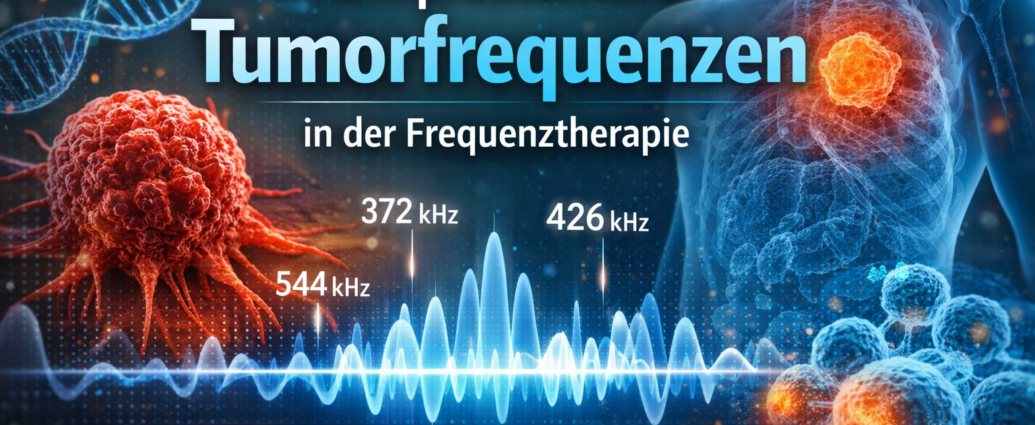
Certain frequency windows appear particularly frequently in the list. These include above all
- 340-354 kHz
- 372-382 kHz
- 402-412 kHz
- 426-439 kHz
- 470-479 kHz
- 510-545 kHz
- 550-567 kHz
These recurring areas are interesting because they occur in different types of tumors. In frequency therapy, this can be understood as an indication of common resonance patterns or superordinate stress fields.
Complete list of complementary tumor frequencies
A
Adenoma: 442 kHz
Adenocarcinoma: 313, 368, 402-410, 426-438, 533, 552-558, 568 kHz
Astrocytoma: 343, 354, 436, 438, 450, 453 kHz
B
Basal cell (skin) carcinoma: 314, 389, 522-524, 540-542, 553-557, 583 kHz
Bladder tumor: 342-347, 402-412, 438-448, 524, 545 kHz
Breast tumor: 314-321, 343-346, 374, 397, 402-413, 427-436, 484, 502, 524, 540-543, 552-557, 578 kHz
Bronchial and lung tumor: 294-297, 372-376, 402-409, 426-439, 524, 538-540, 548 kHz
C
Carcinomas: 343-345, 400-410, 426-444, 458-469 kHz
Cervical polip: 294, 351, 379-384, 380, 443, 564 kHz
Cervical carcinoma: 392, 402-410, 412, 426-438, 443-448, 459-464, 476, 500 kHz
Cervical adenoma: 440-448 kHz
Cholesteatoma: 316, 404-408, 462 kHz
Cholesteatoma of the mastoid region: 316, 324, 406, 463 kHz
Chondrosarcoma: 513-521, 524-534 kHz
Colon carcinoma: 312-314, 335-346, 356, 392-393, 426-438, 524, 557 kHz
D
Droglioma: 436 kHz
E
Endometrial tumor: 426-436 kHz
Eosophagus tumor: 372, 426-439 kHz
Ewing's sarcoma: 318, 348-353, 370-372, 395-406, 450, 512-519, 523-527, 530-534 kHz
F
Feline (cat) leukemia: 338, 380-392, 422-434, 461-469, 510, 528 kHz
Fibroadenoma mammae: 354 kHz
Fibroma: 340, 353, 372, 395-397, 476, 513, 544 kHz
Fibrosarcoma: 342, 445-447 kHz
G
Gastric adenocarcinoma: 343-348, 426-438 kHz
Glioblastoma: 372, 402-409, 418-429, 437-439, 444, 459 kHz
Glioma: 438-448, 470-476, 554-556 kHz
H
Hairy cell leukemia: 318, 320, 399, 477, 493, 496-500 kHz
Hodgkin's lymphoma: 389-390, 564 kHz
Hypernephroma: 300, 324, 389-392, 402-409, 426-444, 448, 459-469, 540, 564 kHz
K
Kaposi's sarcoma: 331, 426, 508 kHz
L
Laryngeal polip: 391, 412 kHz
Laryngeal tumor: 370-376, 536, 580 kHz
Leucoplakia: 340-342, 353, 476, 513, 544 kHz
Leukemia B cell tumor: 486-487 kHz
Leukemia feline: 424-436, 461, 469 kHz
Leukemia lymphatic: 402-409, 426-432, 488 kHz
Leukemia myeloid: 418-422, 426-429, 432, 450 kHz
Leukemia T cell: 311, 330, 370-374, 420, 432-433, 452, 496, 536 kHz
Leukemia B cell: 307, 317-319, 329, 399, 435, 486-487, 523-525, 561-563, 574 kHz
Leukemia: 340, 353, 372, 402, 450, 513, 544, 567 kHz
Lipoma: 309-312, 360-363 kHz
Liposarcoma: 450, 488-496, 514, 520-527, 531-536, 550, 560-576 kHz
Liver carcioma: 324, 336, 343-347, 352-354, 372-382, 390-402, 420-427, 456, 475-479, 490, 510-514, 532, 538, 541, 561 kHz, and the frequencies of the hepatitis viruses
Lymphosarcoma: 486, 492 kHz
M
Melanoma: 294-300, 322-328, 396, 442-448, 451-456, 465-470, 480-489, 490-496, 501-507, 533-545, 554-563 kHz
Meningioma: 390, 546-548 kHz
Multiple myeloma: 372, 486 kHz
Myoma: 425-428, 460-464, 516 kHz
Myosarcoma: 404-408, 514 kHz
N
Nasopharyngeal tumor: 372-382, 408-410 kHz
O
Ovarian tumor: 390-394, 402-410 kHz
P
Pharyngeal tumor: 407-411, 436-439, 538-542 kHz
Plasmacytoma: 486 kHz
Nasal polyp: 367-369, 550-554 kHz
Polyps in different tissues: 296-312, 318-319, 332-340, 348, 352-354, 366-368, 372, 409, 452-453, 459-464, 476-479, 513, 534, 544, 550-556 kHz
Precancerous state polyposis: 296-312, 318-319, 332, 340-348, 352-353, 367, 372, 452-453, 459-464, 476-479, 544, 554-555 kHz
Precancerous state: fibroid cysts in breast: 340, 353, 372, 396-400, 402, 410, 450, 544 kHz
Prostate adenoma: 292, 352, 382, 402-410, 452, 479-480 kHz
Prostate, other tumors: 310, 343-345, 353, 362, 372, 392, 402-410, 426-437, 470, 479-480, 506-513, 542-547 kHz
R
Rhabdomyosarcoma: 372, 401-411, 450, 459-464, 511-524, 533, 535-544, 558-559, 567 kHz
S
Salivary gland tumor: 372-383, 402-410, 426-439, 518-519, 526-538 kHz
Sarcoma: 470-476, 501, 510-515, 542-545 kHz
Skin cancers: 330, 332, 378-382, 544-545 kHz
Stomach carcinoma: 343-346, 372, 402-412, 418-422, 426-448, 458-466 kHz
T
Testis tumor: 344, 372, 390-394, 402-408 kHz
Thyroid carcinoma: 372, 402-412 kHz
U
Urinary tract tumor: 344-346, 372, 402-412 kHz
Uterine tumor: 426-437, 520 kHz
V
Vaginal carcinoma: 426-444 kHz
W
Wart, condyloma acuminatum: 462-478 kHz
Wart, plantar: 404-407, 468-477 kHz
Wart, verruca acuminata or filiformis, or peruviana: 329, 352, 392-396, 402-410, 448, 485-491, 502-510 kHz
Classification of the list
The list shows how broad the spectrum of complementary tumor frequencies is within frequency therapy. It includes not only classic tumor forms, but also polyps, precursors, sarcomas, leukemias, skin changes and other contaminated tissue areas.
It is striking that numerous frequency ranges overlap. It is precisely these overlaps that make the list particularly interesting for information medicine. They indicate that different clinical pictures may lie in common resonance fields or show similar biophysical reaction patterns.
Especially in connection with Cancer this approach is important for many users because it draws attention to functional relationships, regulatory patterns and resonance phenomena.
Significance for practical frequency therapy
In practical work, such frequency lists are not usually considered in isolation. Instead, they are incorporated into a more comprehensive understanding of the organism. This often includes considerations of:
- Regulatory capability
- energetic load
- Organ reference
- Tissue environment
- Stress load
- Sleep quality
- Metabolism
- General stability
Frequency therapy attempts to take these levels into account as part of a complementary approach. Tumor frequencies are understood as a possible orientation within a larger resonance model.
Conclusion
Complementary tumor frequencies play an important role in frequency therapy and information medicine. This list shows how diverse the assignment of resonance ranges to different tumor types and tissue changes is.
Especially in the area of Cancer the observation of such frequency patterns provides many therapists and users with additional access to the subject of regulation, resonance and energetic stress. The list therefore provides an interesting basis for anyone who would like to take a closer look at frequency therapy and oncological resonance patterns.
FAQ on complementary tumor frequencies
What are tumor frequencies?
Tumor frequencies are specific frequency values or frequency ranges that are assigned to individual tumor types, precursors or tissue changes within frequency therapy.
In which range are most tumor frequencies?
Many of the frequencies mentioned lie between around 300 and 580 kHz. Ranges around 340-354 kHz, 372-382 kHz, 402-412 kHz and 426-439 kHz are particularly common.
Why do some frequency ranges overlap?
Because different types of tumors may have similar resonance patterns or biophysical similarities. It is precisely these overlaps that are of particular interest within information medicine.
What role do tumor frequencies play in frequency therapy?
They are used by many users as a guide to better classify resonance patterns and to view stress in a complementary way.
Why is this topic so relevant for cancer in particular?
Because cancer causes many people to look into additional energetic, biophysical and information-related approaches. Frequency therapy is seen as a complementary extension of this approach.
Note
This list is not exhaustive. There are other subtypes and characteristics that can have other wave frequencies.
Disclaimer
Frequency therapy is not recognized by conventional medicine and does not replace therapy with trained doctors or alternative practitioners.
Comments are closed, but trackbacks and pingbacks are open.