



Introduction
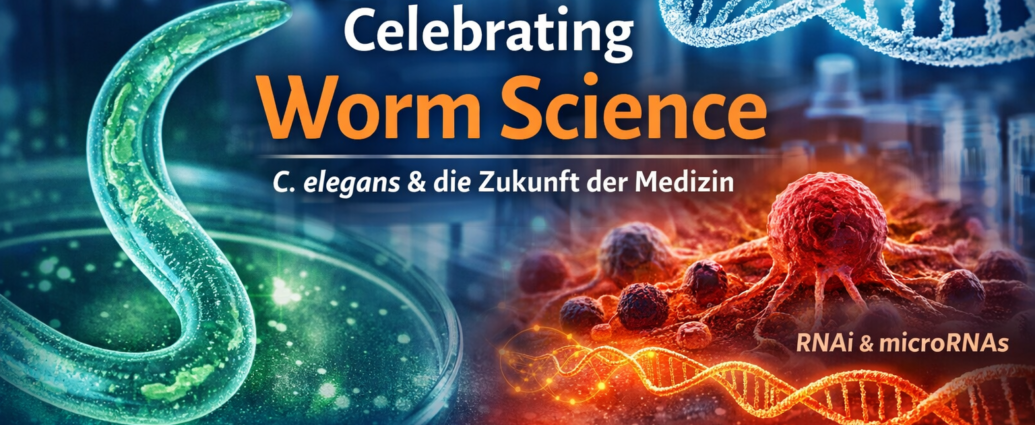
One millimeter small - and yet one of the greatest masters of modern biology: the threadworm Caenorhabditis elegans (C. elegans) has been a model organism that researchers have been using for decades to decipher the fundamental principles of life. At the beginning of January 2026, MIT published an article celebrating just that: „Worm science“ - science that uses an inconspicuous roundworm to gain insights that have changed our view of disease, therapy development and even cancer.
In this article, I summarize the most important points in an understandable way - and add the thoughts that arise from them for a holistic perspective in which Regulation, communication and „resonance“ (as a model of thought) play a role.
Why a worm of all things?
C. elegans is so popular in research because it:
- easy to grow is fast-growing and easy to manipulate genetically,
- transparent cells and processes can be observed directly,
- simply constructed (e.g. 302 nerve cells),
- and above all: Many mechanisms are evolutionarily conserved - therefore also present in a similar form in humans.
In short, what is understood in the worm is often a window into human biology.
Nobel Prize knowledge from C. elegans: Three milestones
The MIT text emphasizes that discoveries with C. elegans already with four Nobel Prizes are connected. These lines are particularly emphasized:
1) Apoptosis: programmed cell death - also central to cancer
Early pioneering work showed that cells not only develop during development, but also partly specifically removed become - through programmed cell death (apoptosis). Later, researchers (including Robert Horvitz and colleagues) identified central regulators.
Why this is important for cancer:
Cancer cells often „evade“ normal cell death. In certain blood cancers, for example, the human BCL-2 system (related to regulators found in worms) plays a major role - and this is precisely where modern active principles come into play: Enabling cell death again, where it was blocked.
2) RNA interference (RNAi): Targeted „silencing“ of genes“
The discovery of the RNA interference showed that cells can dampen certain gene activities via RNA mechanisms. Today, RNAi is not just a laboratory tool, but the basis for several approved drugs (e.g. for certain genetic diseases).
3) microRNAs: small molecules, big control
microRNAs are tiny regulators that determine, when and where Gene is active are. Disruptions in microRNA networks are associated with many diseases - including neurological disorders, cardiovascular problems, autoimmune processes and Cancer. At the same time, approaches are being developed to use microRNAs diagnostically or therapeutically.
An underestimated success factor: the „worm community“
A strong point in the MIT article: It wasn't just the organism itself that mattered, but the Culture of open cooperation. Early on, researchers shared methods, observations and ideas (e.g. via newsletters), later via platforms and resources such as databases and genetic centers. This accelerates science enormously.
Take-away for every medical innovation:
Progress is faster when knowledge is structured, accessible and jointly developed.
From worm to brain: connectomes & modern neuroscience
Another highlight: C. elegans was that first animal, whose neuronal circuitry has been completely mapped (connectome). This resulted in a „circuit diagram“ that has strongly influenced research into behavior, sensory systems and neuronal processing. Today, much more complex brains are mapped (e.g. fruit flies).
Bridge to holistic medicine: What does „regulation“ mean - and why „resonance“ is an exciting way of thinking
If we learn anything from the worm model, it is above all: Biology is regulation.
- Cells communicate, switch programs on/off, react to stress, signals and the environment.
- Health is often the ability, Stable control loops (homeostasis).
- Illness can arise when control loops derail - in cancer, e.g. growth/apoptosis, in inflammation, immune regulation.
In the Frequency therapy resonance„ is often mentioned. It is important to be scientifically correct here: the term is not used in biology in the same sense as in physics or in complementary processes. As a framework for thinking However, „resonance“ can help to focus on Communication, patterns and regulation without making premature therapeutic statements.
Practical impulses: What you can „take away“ from the article
- Basic research saves lives - often indirectly, but sustainably.
- Cancer research benefits from apoptosis mechanismsUnderstanding → more targeted treatment.
- Gene regulation (RNAi, microRNAs) is a key topic for diagnostics & new active principles.
- Open cooperation accelerated realization - a model for integrative medicine too.
- Holistic approaches should be based on Regulation Orientation: Sleep, stress, immune system, metabolic balance - and complementary procedures (if desired), responsibly classified.
FAQ
What is C. elegans?
A microscopic nematode that is used as a model organism in laboratories to understand biological processes.
Why is apoptosis so important for cancer?
Because many cancer cells bypass cell death programs. Some therapies attempt to reactivate these programs.
Have RNAi and microRNAs already arrived in medicine?
Yes - RNA-based therapeutics are established in some areas, and microRNAs are an intensive field for diagnostics/targeting strategies.
What does this have to do with frequency therapy?
Directly, it is about molecular biology. Indirectly, it reminds us that health is strongly linked to regulation/communication - a topic that is also often emphasized in complementary concepts.
Note / Disclaimer
This article is intended to provide information and classification of scientific content. Statements on frequency therapy are to be understood as a complementary perspective and do not replace medical diagnosis or treatment by doctors or alternative practitioners. Frequency therapy is not recognized by conventional medicine.

Comments are closed, but trackbacks and pingbacks are open.