





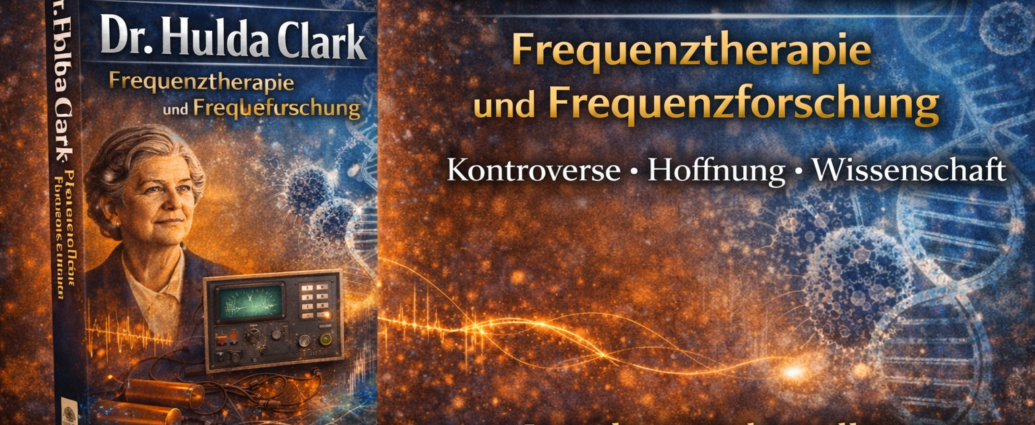
A book by Herbert Eder about controversy, hope and the critical classification of a much-discussed approach
There are books that confirm a topic. And there are books that really penetrate a topic. „Dr. Hulda Clark – Frequency therapy and frequency research“ from Herbert Eder clearly belongs to the second category.
Hardly any other personality is as controversial in the field of alternative medicine, frequency therapy and the cancer debate as Dr. Hulda Clark. For some, she is seen as a courageous border crosser, for others as a symbol of an approach that is insufficiently scientifically proven. It is precisely in this area of tension that this book operates - and therein lies its great strength.
Herbert Eder's approach to the subject is not superficial, not polemical and not uncritically admiring. He takes Dr. Hulda Clark seriously as a historical and professional figure and at the same time asks the questions that are indispensable today: What was the basic idea behind her model? What role did the zapper play? What is meant by Resonance, frequency and bioelectric effects in the Clark approach? And above all: Which classification is responsible, serious and scientifically tenable from today's perspective?
This book is therefore far more than just a book presentation about a controversial personality. It is a reflective contribution to one of the most sensitive questions in the field of frequency therapy: How do you separate hope, fascination and experience reports from provable effectiveness, methodological quality and medical responsibility?
Why this book is so relevant today
The topic is more relevant today than ever before. More and more people are looking for supplementary, complementary or alternative ways to support their health. Particularly in the case of serious illnesses, there is often a growing desire for methods that go beyond the traditional medical model. This need is particularly noticeable in the field of cancer care, holistic health concepts and frequency therapy.
This is precisely why a book like this is so important. It offers orientation in a field that is often characterized by strong assertions, emotional expectations and opposing opinions. Herbert Eder shows that the topic of Dr. Hulda Clark is not only historically interesting, but is still highly relevant today - because it is an example of the conflict between alternative healing claims, bioelectrical theory, social demand and scientific criticism.
Especially at a time when frequency therapy, Bioresonance, zapper technologies and resonance models are being discussed again and again, books are needed that not only convey fascination, but also Classification, Differentiation and Responsibility. This work fulfills exactly this task.
What this book is about
At the center of the book is the person Dr. Hulda Clark, her scientific background, her central theories and the history of the impact of her work. Herbert Eder first traces her biographical and professional career and shows how her basic scientific training was linked to her later assumptions about parasites, toxins, metals and bioelectrical processes.
Building on this, the book is dedicated to the so-called Clark model. It explains the basic assumption that parasites, environmental toxins and other stresses play a central role in chronic diseases and cancer in particular. Another focus is on the Zapper, The Clark approach understands this technology as a frequency-based method for influencing pathogenic organisms.
It is particularly interesting that Herbert Eder does not describe the topic in isolation. He places Clark's ideas in a wider context with modern Cancer research, Infection biology, Environmental medicine, Bioelectricity, complementary oncology and Evidence assessment. This creates an overall picture that not only traces the theory, but also places it in relation to current scientific knowledge.
The book deals with the following key questions, among others:
How is the theory of frequency therapy according to Dr. Hulda Clark structured?
What role do resonance, bioelectric effects and the zapper play in your model?
How plausible are the assumptions about parasites, environmental toxins and cancer from a modern perspective?
What does current research say about electromagnetic fields, frequency therapy and bioelectric influences?
Where are the opportunities, where are the limits, where are the risks and where are the ethical challenges?
It is precisely this structured approach that makes the work so valuable. It is not a one-sided opinion piece, but a serious examination of a topic that is often emotionalized rather than classified.
What makes this book special
The special quality of this book lies in its Balance. Herbert Eder writes neither as an uncritical advocate nor as a pejorative opponent. He takes the much more challenging path: he opens up a space for Understanding, Examination and Critical classification.
This is of enormous value, especially with a topic like Dr. Hulda Clark. After all, her work had a strong appeal for many people - not least because she promised simple, directly applicable models, offered technical solutions and gave patients the feeling that they could take action themselves. This book understands this attraction. It describes not only the methods, but also the psychosocial motives behind the demand for such approaches.
At the same time, the work remains consistently professional. It clearly shows that between bioelectric fascination and Scientific resilience there is a crucial difference. This is precisely what makes this book credible. It does not conceal the fact that there are interesting research approaches in the field of electromagnetic influences, resonance models and frequency research. But it also makes it clear that this does not automatically lead to clinically proven effectiveness in the sense of great promises of healing.
Another plus point is the thematic breadth. The book not only deals with Clark himself, but also with the wider context of Infections as cancer risk factors, Environmental toxins, Immune system, Tumor microenvironment, complementary procedures and methodological standards in medicine. This turns a single person into a much larger, deeper and more relevant debate.
A book between hope and responsibility
Perhaps this is precisely the strongest aspect of this publication: it understands that there is more to the subject than just theory. It is about people. About hope. About uncertainty. About the need not to remain powerless in the face of serious illness. And it is about the responsibility not to confuse this hope with unsecured promises.
Herbert Eder succeeds in entering this sensitive space with respect. He describes why alternative methods such as the Clark approach have an emotional appeal for many people. But he also shows why responsible integrative medicine needs scientific standards, methodological quality and ethical clarity.
This book is therefore not only an examination of Dr. Hulda Clark. It is also a book about the question of how modern medicine, complementary approaches and the human longing for orientation relate to each other.
For whom this book is particularly suitable
This book is ideal for:
People with an interest in Dr. Hulda Clark, Frequency therapy and bioelectric models
Readers who are interested in alternative approaches to health differentiated instead of one-sided want to understand
Therapists, counselors and professionals who are interested in complementary oncology, Resonance models and scientific classification employ
People who want to know why the Clark theories are still so hotly debated today
Readers who have a Serious, warm and intelligent book presentation search about a controversial topic
This work is particularly valuable for all those who are not only looking for answers, but also appreciate the quality of questions. For people who are open to new perspectives, but at the same time value responsibility and seriousness.
Conclusion
With „Dr. Hulda Clark - Frequency therapy and frequency research“ has Herbert Eder has created a book that gives a controversial topic the depth it deserves. It is a work about an influential, controversial figure in the field of frequency therapy who is still the subject of intense debate today. And it is also a book about the limits of simplification, about the attractiveness of alternative models and about the need for responsible scientific classification.
This is the particular strength of this publication. It does not seek to dazzle, but to clarify. It does not seek to polarize, but to understand. And it does not want to make hasty judgments, but to differentiate.
Anyone wishing to delve deeper into Dr. Hulda Clark, her frequency therapy, the history of its effects and the wider contexts of resonance, cancer research, complementary medicine and evidence will find this a high-quality, stimulating and remarkably balanced read.
A powerful book for all those who want to see more clearly between myth, method and medical responsibility.
Order now
The book can be ordered directly here:
About the book:
Dr. Hulda Clark - Frequency therapy and cancer research | he-pio-clark
Author
NLS Informationsmedizin GmbH, Herbert Eder
Disclaimer
The content presented is for information purposes only. Frequency therapy is not recognized by conventional medicine and does not replace diagnosis or treatment by trained doctors or alternative practitioners.

Comments are closed, but trackbacks and pingbacks are open.