




Introduction: Why the topic of EMF is so emotional
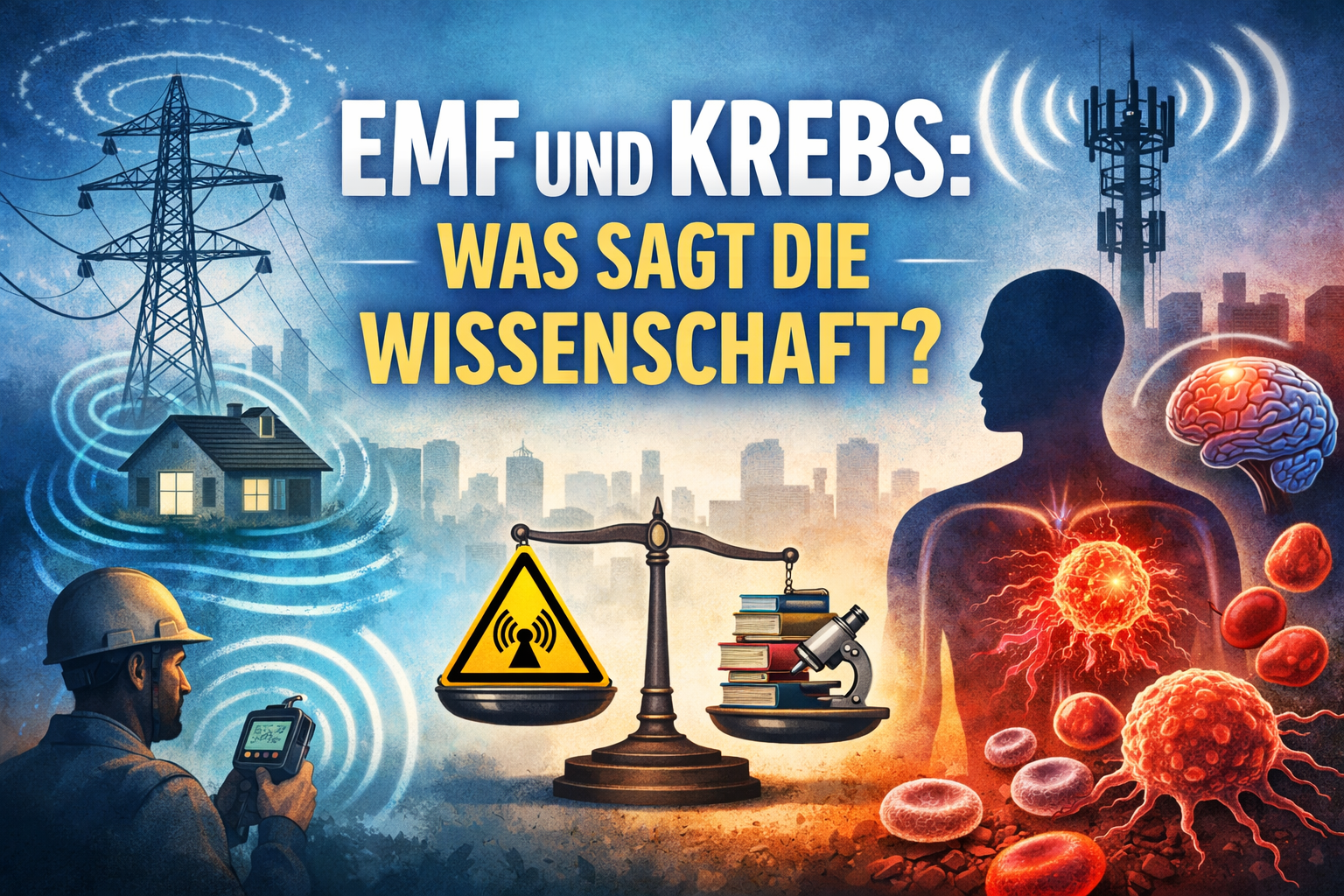
Electric and magnetic fields (EMF) occur wherever electricity is generated, transported or used - in other words, practically everywhere in everyday life. Precisely these Omnipresence is one of the reasons why the topic has been the subject of controversial debate for decades. The first epidemiological evidence sparked the debate back in the late 1970s; since then, there have been countless studies, reviews and expert panels - but no „one“ answer that satisfies everyone.
Important: The scientific discussion mainly revolves around Extremely low frequency fields (ELF, typically 50 Hz in Europe) - i.e. fields that occur in power grids and many devices. Cell phone radio is a different topic (higher frequencies), but is often lumped together.
What are EMFs actually - and where do we encounter them?
- Electric fields occur when voltage is applied (even without current flowing).
- Magnetic fields occur when current flows (e.g. when an appliance, cables or motors are switched on).
Typical sources:
- House installation, distribution boxes, power supply units
- Household appliances (especially with motor/transformer)
- Rail/tram (depending on system)
- High-voltage lines/substation
- Occupational exposure in electrical and energy professions
The core of the controversy: What do the studies say about the cancer question?
1) Epidemiology: small effects, difficult to interpret
The case study by Kheifets et al. describes a central problem: If a connection exists at all, the relative risks are usually small, and many studies do not have enough statistical power. In addition, results vary depending on the method of exposure assessment (e.g. measurements vs. wire codes).
A point that comes up again and again in the debate:
- With childhood leukemia some studies show positive associations, others do not.
- In adults (depending on the setting) it was also possible to Breast cancer, leukemia or brain tumors often with a focus on occupational exposure.
2) „Wire codes“ vs. measurement: why the results diverge
Many early studies used so-called Wire codes (a kind of classification of the power line configuration near the home) as a surrogate for magnetic field exposure. Later studies relied more heavily on Spot measurements or 24h measurements. The case study emphasizes that this diversity makes comparability difficult and that better, integrated exposure models are needed.
Biological mechanisms: „How“ should EMF cause cancer in the first place?
This is where it gets tricky: a stable, generally accepted mechanism is still lacking.
The case study summarizes:
- Animal studies were „largely negative“.
- In vitro studies sometimes show biological reactions, but are often difficult to replicate.
- And especially important: EMF do not „initiate“ classic steps of carcinogenesis such as DNA damage (as is the case with ionizing radiation, for example).
Hypotheses nevertheless exist - e.g. the Melatonin hypothesis (especially in relation to breast cancer) - but this is not a proven causal chain.
What do expert committees & ratings say (current classification)
IARC: „possibly carcinogenic“ (Group 2B)
The IARC/WHO monographs have Extremely low-frequency magnetic fields already 2001 as „possibly carcinogenic to humans (Group 2B)” mainly due to epidemiological findings on childhood leukemia.
WHO: major risk assessment (EHC 238)
The WHO has worked with the Environmental Health Criteria (EHC 238) presented a comprehensive evaluation (a very extensive work) that describes precisely this evidence situation and research gaps.
Exposure guidelines (ICNIRP)
ICNIRP guidelines are often decisive for limit and reference values in everyday life; ICNIRP has Low-Frequency Guidelines (including for 50 Hz), which are primarily based on Acute effects (nerve/muscle stimulation).
Note: In Europe, there are additional political recommendations/implementations (e.g. EU recommendations), which may differ from country to country.
„Prudent avoidance“: the pragmatic middle ground
Because the evidence is not so clear that one could say „danger proven“ - but also not so clear that the issue disappears completely - a pragmatic attitude has established itself in many countries/authorities: Prudent Avoidance.
In the case study, „prudent avoidance“ is described as:
- Steps to help people to be kept out of fields (e.g. rescheduling/rerouting, design of electrical systems),
- but only those measures that moderate costs.
That is important: Prudent avoidance is not a panic concept - rather „sensible provision without going mad“.
Practical measures in everyday life (without drama, but with meaning)
Here is a set of „low effort / low cost“ steps that often fit into the logic of prudent avoidance:
At home
- Distance works: For many sources, the magnetic field strength drops significantly with increasing distance.
- Power supply units/transformers Do not place directly at the head end (e.g. clock radio/power supply unit at the bed).
- Extension cable/multiple plug do not permanently „lay“ directly under the bed/workstation.
- Devices that you don't use: from (not standby) if it suits your comfort/consumption anyway.
Sleeping area & children's room
- If you want to optimize: Sleeping place rather where there are few electrical installations/distribution boxes directly behind it.
- No „high-tech“ measures without cause - first simple (e.g. test positions in the room).
If you live near the line
- Do not move automatically. It makes more sense:
- Serious measurement (or at least measure it correctly),
- Classify values (limit/reference values, typical background values),
- only then decide.
Why the debate remains so heated (and what we can learn from it)
The case study describes EMF as a prime example of how science, media and politics intertwine: high public concern, contradictory headlines, different interpretations by expert committees - and a topic that is difficult to „finalize“.
Furthermore: In epidemiology, the following often applies „absence of evidence is not evidence of absence“ - and at the same time very small effects can be difficult to prove, but can become socially relevant if exposure is extremely widespread.
Excursus: frequencies, health and cancer - making a clear distinction
Many people automatically associate „fields“ and „frequencies“ with therapeutic concepts. The dividing line is important here:
- Environmental EMF (e.g. 50 Hz) = unintentional exposure from infrastructure/everyday electricity.
- Therapeutic frequency approaches = targeted application with a different context, different dosage, different objective.
This is often mixed up in public discourse. For an objective discussion, it is worth looking at these two worlds separately.
FAQ
„Are EMFs dangerous now - yes or no?“
The serious short version: there have been inconsistent epidemiological evidence, especially in childhood leukemia, but no clear mechanism and overall difficult data situation. Electric_and_Magnetic_Fields_an... At the same time, the IARC classifies ELF magnetic fields as „possibly carcinogenic“ (2B) in.
„Is there any point in measuring at all?“
Yes - if measured correctly (measuring device suitable, measurement duration/location sensible). Research shows that the Exposure assessment is one of the most critical points.
„Cell phone = EMF = same topic?“
Not really. Cell phones work in the Radio frequency range (much higher frequencies) - the power grid fields discussed here are ELF. The case study mentions that public concern later extended to cell phones, but these are different types of exposure.
Conclusion: stay sensible - but not ignorant
EMF is not a topic for panic, but neither is it one that should be dismissed as „all nonsense“. The best possible attitude for many people is:
- Informed,
- pragmatic,
- Optimizing at low cost (prudent avoidance),
- and open to the fact that science sometimes has gray areas.
Sources & further information
- Kheifets et al (2001): Overview and case study of the EMF-cancer controversy, including mechanisms, study design and policy aspects. Electric_and_Magnetic_Fields_an...
- IARC: ELF magnetic fields as „possibly carcinogenic“ (Group 2B) - Classification and updates.
- WHO: Environmental Health Criteria 238 (ELF Fields) - comprehensive risk assessment.
- ICNIRP: Guidelines for low frequency fields (Low Frequency).
Disclaimer
This article is for information purposes only and does not replace medical advice or diagnosis. Frequency therapy is not recognized by conventional medicine and cannot replace therapy with trained doctors or alternative practitioners.