





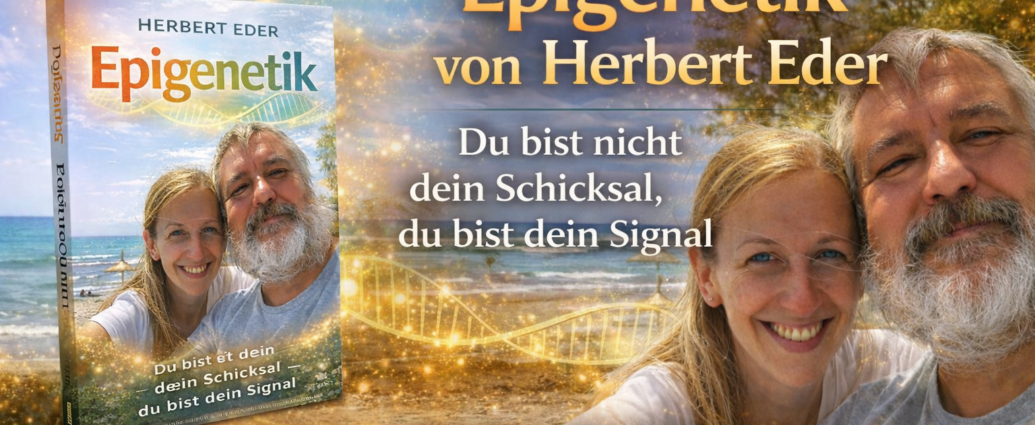
You are not your destiny, you are your signal
With „Epigenetics - You are not your destiny, you are your signal“ lays Herbert Eder presents a book that addresses a highly topical and at the same time deeply moving subject. It deals with the question of how much our lives are actually determined by our genes - and how much our environment, diet, stress, sleep, exercise, experiences and inner states can influence our health.
This book is far more than a scientific introduction to the Epigenetics. It is an invitation to rethink health. It is a work for people who want to understand that the human organism consists not only of fixed biological processes, but also of a dynamic interplay of predisposition, lifestyle and regulation. This is precisely where the special power of this book lies: it combines modern science with a message that gives hope, strengthens responsibility and opens up new perspectives.
What is epigenetics - and why is it so important?
Many people associate genes with something rigid and unchangeable. But this is precisely where Herbert Eder comes in. Epigenetics shows that genes are not simply „on“ or „off“, but can be regulated by a variety of influences. This also changes our view of health and illness.
Suddenly it becomes clear that biological processes cannot be viewed in isolation from everyday life. Diet, stress, lack of sleep, exercise, environmental toxins, emotional experiences and psychosocial factors take on a new significance. They are not just side effects of life, but can send signals that reach deep into the body's regulation.
It is precisely this perspective that makes the book so relevant. It not only explains a modern field of research, but also makes it clear why this knowledge is of enormous importance for our daily lives, our health decisions and our self-image.
A book with a strong message
The subtitle „You are not your destiny - you are your signal“ is far more than just a nice sentence. It sums up the basic idea of the book in a concise form. Herbert Eder conveys a perspective that is both scientifically exciting and humanly touching: people are not exclusively at the mercy of their disposition. There are spheres of influence. There are regulatory possibilities. There are connections that can be understood and taken seriously.
This message makes the book particularly valuable for people who are not just interested in theory but are looking for real guidance. It invites people to take responsibility for their own lifestyle, inner balance and health-related decisions more consciously.
Scientifically sound and at the same time easy to understand
A great advantage of this book is the combination of depth and accessibility. Many scientific works on genetics or molecular biology remain difficult to access for lay people. Others oversimplify and lose substance as a result. Herbert Eder achieves a convincing balance here.
The book is well-founded without being unapproachable. It introduces key concepts and mechanisms without getting lost in unnecessary complexity. This makes it suitable both for interested beginners and for readers who want to take a closer look at health, prevention and biological relationships.
It is a book that informs, but does not overwhelm. And that is precisely why it has a lasting effect.
Humans between genetics and the environment
A central theme of the book is the interface between genetic make-up and environment. Herbert Eder makes it clear that health cannot be derived from biological inheritance alone. Rather, it arises from the interplay of many levels. This perspective is particularly valuable because it does not lapse into simple determinism or naïve notions of feasibility.
Instead, a differentiated picture emerges: humans have a genetic basis, but the way in which this basis is regulated depends on many factors. It is precisely this interaction that makes the topic of epigenetics so fascinating.
This also makes the book a bridge between natural science and practical life. It shows that modern research does not only take place in the laboratory, but also gains significance in the midst of life.
A new look at health, lifestyle and prevention
The book is particularly strong where it emphasizes the importance of lifestyle factors for health and prevention. Nutrition, stress, sleep, exercise and psychosocial stress do not appear here as loose health advice, but as biologically relevant influencing factors.
This perspective is particularly important at a time when many people are suffering from chronic exhaustion, inner tension and health insecurity. The book shows that prevention is more than just avoiding risks. It starts with understanding how the body reacts to signals - and how we help shape these signals through our lifestyle.
This makes the work particularly valuable for people who want to understand health not only in a reparative but also in a preventative and holistic way.
A special focus on carcinogenesis and regulation
Another important focus of the book is the question of what role epigenetic processes can play in the onset and development of cancer. This gives the work additional depth and relevance.
Herbert Eder sheds light on how lifestyle factors, environmental pollution, stress and internal regulatory processes are embedded in larger health contexts. The focus on cancer prevention, resilience and the importance of biological control mechanisms in particular makes it clear that epigenetics is not just a theoretical topic, but has concrete significance for modern health issues.
This perspective particularly appeals to readers who want to think beyond purely symptom-oriented approaches and are looking for a deeper understanding of the connections between body, environment and lifestyle.
Complementary perspectives and holistic thinking
For many interested parties from the Information medicine and complementary approaches to health, it is particularly exciting that the book also opens up space for complementary perspectives. It combines classical scientific principles with an expanded understanding of regulation, influence and biological response.
As a result, the work is not narrow, but open and stimulating. It invites reflection without becoming arbitrary. It shows that scientific thinking and holistic health issues do not have to be mutually exclusive, but can complement each other if they are handled carefully and responsibly.
Who is this book particularly suitable for?
This book is ideal for:
People with an interest in Epigenetics, health and prevention
Readers who want to understand how Genes, environment and lifestyle interact
Interested in Cancer prevention, resilience and biological regulation
Therapists, counselors and professionals from the fields of Health, information medicine and holistic support
People who are looking for a book that Scientific content with hope, awareness and closeness to life connects
Why this book should be read right now
We live in a time in which health has become an ever greater challenge for many people. At the same time, the need for understanding is growing. Not just for quick answers, but for real contextual knowledge. This is exactly where this book comes in.
It does not deliver superficial slogans, but a deeper perspective. It shows that modern science does not have to be cold and abstract, but can provide orientation. It makes it clear that health is not a purely mechanical state, but the expression of a complex interplay between the system, the environment and the signaling effect.
This makes this book not only informative, but also encouraging.
Conclusion
With „Epigenetics - You are not your destiny, you are your signal“ has Herbert Eder has created a book that impressively combines modern science, health awareness and human depth. It is a work that explains, inspires and broadens the view.
Anyone who wants to better understand the connections between genetics, environment, lifestyle and biological regulation will find this a high-quality, stimulating and motivating read. This book shows that people are more than their predisposition - and that health in many areas is a dynamic process that deserves attention, awareness and responsibility.
A book worth reading for anyone who not only wants to manage health, but wants to understand it more deeply.
Order now
The book can be ordered directly here:
About the book:
https://www.frequenz-therapie.com/epigenetik/he-epigenetik
Author
NLS Informationsmedizin GmbH, Herbert Eder
Disclaimer
The content presented is for information purposes only. Frequency therapy is not recognized by conventional medicine and does not replace diagnosis or treatment by trained doctors or alternative practitioners.
Comments are closed, but trackbacks and pingbacks are open.