




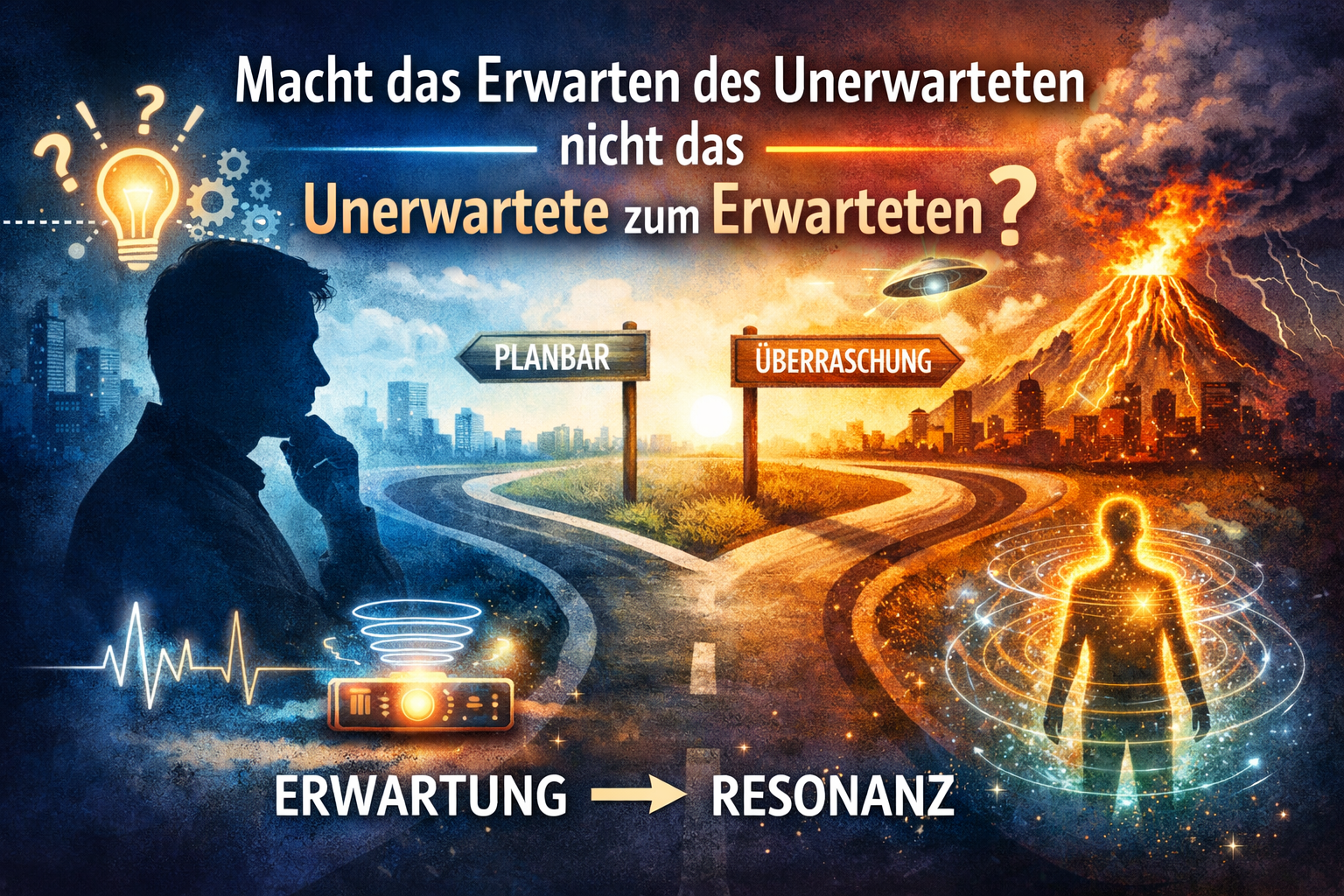
Do you know this: You want to open remain open to surprises - and suddenly you realize that you have already „priced in“ the surprise. You expect the unexpected. Sounds clever, feels like mental agility ... but doesn't that automatically make the unexpected the expected?
Yes - and that's the exciting point: It depends, like you expect. Do you expect concrete, or are you just expecting the possibility of deviations?
And precisely this question is not only philosophically interesting - it also has a very practical dimension: How does our nervous system react to uncertainty? Und was bedeutet das für Regulation, Stressverarbeitung und (begleitend) auch für Ansätze wie die Frequency therapy?
1) What does „expect the unexpected“ actually mean?
When we say in everyday life: „I expect the unexpected“, we often mean two things:
- Variant A (concrete): „Something will happen that I'm not expecting.“
→ Sounds paradoxical, because: As soon as you plan for it, it's no longer „unexpected“, but only „uncertain“. - Variant B (open): „I expect that things may turn out differently than I plan.“
→ This is not a contradiction, but Mental flexibility.
The trick is: You cannot expect the event, only the deviation as a possibility.
2) The paradox: Expectation turns surprise into predictability
Surprise lives from the fact that our brain Forecast and the reality of this prediction breaks. However, if you include „surprise“ as a fixed component, the following happens:
- You build a Meta expectation „Something's coming.“
- This reduces the impact of the unexpected.
- You will be surprised from the content, but less from the fact that something unexpected happens.
Short:
You do not expect what happens - but you expect, that things could turn out differently.
3) What insecurity does to the body: alarm vs. adaptation
This is where it gets exciting: for many people, insecurity is not just a mental state. It can be felt physically:
- shallow breath
- Chest pressure
- inner restlessness
- Sleep problems
- „Permanent tension“ without a clear trigger
Why? Because our nervous system is constantly trying to keep the world predictable. If it doesn't succeed, it often reacts with Stress activation.
And this is precisely where an important bridge to frequency therapy is created - because in practice, many people report that the biggest lever is not „even more control“, but rather Better regulation.
4) Frequency therapy as accompaniment: from expectation stress to resonance
In der Frequenztherapie (als Teil der Information medicine) wird häufig mit dem Bild gearbeitet, dass der Körper nicht nur „Chemie“, sondern auch Communication ist: Signale, Muster, Rhythmen, Resonance.
If someone constantly expects „the unexpected“ (i.e. is internally prepared for deviation), this can have the effect of permanently „fine-tuning“ the alarm:
- The body remains in a figure-eight position
- Regeneration becomes more difficult
- Stimulus processing becomes more sensitive
- the inner balance is more easily thrown out of sync
Frequency therapy applications are experienced by many users as an impulse to return the organism to a state of Harmony/resonance away from „constant alertness“ and towards a more adaptive adaptability.
This actually fits surprisingly well with the initial question:
It is not the unexpected that is the problem - but the inner reaction to it.
5) Expectation vs. openness: the difference that changes everything
To make it practical, here is a quick check:
❌ „Expect the unexpected“ as a stress mode
- „I'm sure something will happen soon.“
- „I have to be prepared, otherwise I'm at the mercy of others.“
- „If I take everything into account, I'm safe.“
This is often just worry in elegant packaging.
✅ „Plan for the unexpected“ as clarity mode
- „I have a plan - and room to maneuver.“
- „I can react without losing myself.“
- „I don't have to control everything - I just have to be able to regulate myself.“
And this is exactly where many accompanying methods come in - breathwork, relaxation, bodywork and even frequency therapy, if people experience this as supportive.
6) Conclusion: Does it turn the unexpected into the expected?
Yes - if you expect the „unexpected“ as a concrete event.
Then it logically becomes the expected.
No - if you only cultivate openness to deviations.
Then the event remains unexpected, but you remain more stable.
A set to go:
It is not the unexpected that should be expected - but your own ability to deal with it.
And this ability is not just mental - it is also physical. Regulation can be learned.
Mini-exercise (30 seconds) - plus frequency pulse
If you find yourself expecting „the unexpected“, try this:
- What is my plan? (1 set)
- Where do I leave room for maneuver? (1 set)
- What is my next small step - no matter what? (1 set)
Optional (if you use frequency therapy):
Afterwards, take 5-10 minutes to consciously get into a calmer state - some people combine this with a short frequency application to support the nervous system as a „reset“ and to feel more inner order again.
Disclaimer: Frequency therapy is not recognized by conventional medicine and cannot replace therapy by trained doctors or alternative practitioners. Please always seek medical advice in the event of complaints or illnesses.
Author: NLS Informationsmedizin GmbH, Herbert Eder