





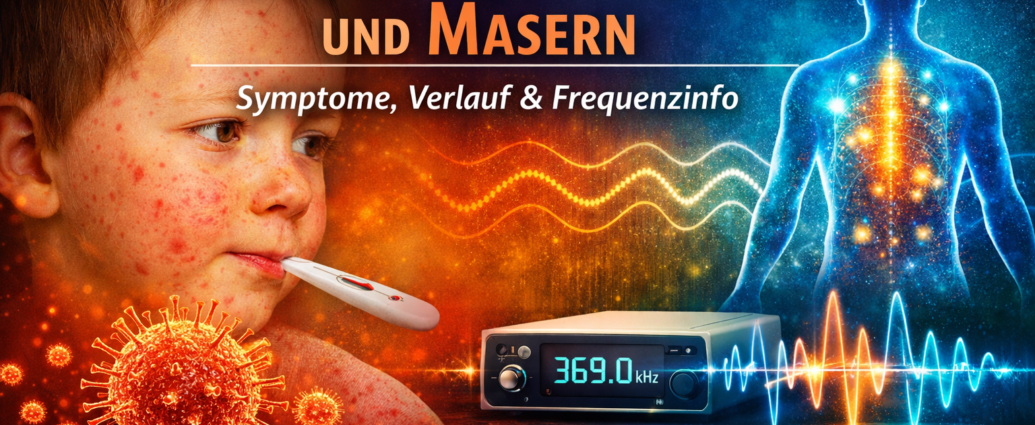
Symptoms, progression and additional frequency information
Measles is one of the best-known viral infectious diseases in humans. The disease is caused by the measles virus, which can be transmitted very easily from person to person. Infection occurs primarily via infectious droplets and through the air. After entering the body, the virus initially multiplies in the nasopharynx. It can then spread throughout the entire organism via the bloodstream and thus trigger a systemic clinical picture.
What is measles?
Measles is an acute, highly contagious viral disease that can affect the entire body. Unlike a pure respiratory infection, the disease is not limited to the nasopharynx. Rather, a general strain on the organism develops as the disease progresses. This explains why the illness is often associated with a distinct feeling of illness, exhaustion and several symptoms occurring simultaneously.
In the literature, measles is described as a classic infectious disease with a characteristic course. Particularly typical is the combination of initially flu-like symptoms and later skin rash. The disease therefore has a clearly recognizable course from a medical point of view, which is of diagnostic importance.
Typical symptoms of measles
At the beginning of the disease, fever, cough, runny nose and conjunctivitis usually occur. Many sufferers appear tired, sensitive to light and physically weakened. This first phase often initially resembles a more severe upper respiratory tract infection.
As the disease progresses, the reddish, blotchy rash typical of measles develops. In addition, the so-called Koplik spots are considered to be particularly characteristic. These are small whitish spots on the oral mucosa, which are mentioned in the medical description as a classic sign of measles.
It is the combination of fever, cough, cold, conjunctivitis, Koplik's spots and skin rash that makes the clinical picture of the disease very striking. Nevertheless, the intensity of the symptoms can vary from person to person.
How does the disease progress in the body?
After the virus is ingested via the respiratory tract, it first begins to multiply in the nasopharynx. From there, the infection can spread throughout the body via the blood. This systemic course explains why measles is not only visible on the skin, but affects the entire organism.
Many sufferers therefore not only experience the rash itself, but also a general weakness, reduced resilience and a pronounced feeling of illness. During this phase, the body is heavily involved in immunological and inflammatory processes. This makes it clear that measles is much more than a short-term skin condition.
Possible complications of measles
In addition to the typical main symptoms, accompanying symptoms and complications can also occur. Diarrhea, middle ear infections and pneumonia are among the symptoms described in the literature. These additional stresses can make the course of the disease much more difficult.
Particular attention should be paid to severe cases in certain age groups. Children under the age of five and adults over the age of twenty can be at increased risk of serious complications. Inflammation of the brain is also described in the literature as a severe form of the disease. This shows that measles must be treated with great medical care.
Prevention and medical care
Vaccination is a key area of medical prevention. The measles vaccination has been a routine immunization for many years and is often administered as a combination vaccination. The aim is to reduce the risk of contracting the disease and serious complications.
Even in the medical care of an existing illness, the procedure depends on the individual course, the symptoms and possible accompanying infections. Observation of the overall condition and the respective symptoms is crucial. Clinical assessment is particularly important in cases of high fever, significant weakness or signs of a complicated course.
Why measles affects the whole organism
Measles clearly shows that a viral infection causes more than just local symptoms. The spread in the organism creates a comprehensive clinical picture that can affect several organ systems. This is precisely why the focus is not only on individual symptoms, but also on the general condition, resilience and regenerative capacity of the body.
From a holistic perspective, this systemic stress is an important point. It shows that the illness should not be viewed in isolation. Rather, it is about understanding the entire organism in its reaction pattern. This perspective also forms the bridge to complementary approaches.
Complementary view of frequency therapy and frequencies
In the field of frequency therapy, people are often not only viewed in terms of individual symptoms, but also in the context of regulation, resonance and inner order. In a complementary understanding, the aim is to classify biological stress in an expanded picture of vibration, reaction and system dynamics.
In this context, frequencies are understood as supplementary information that is considered within a larger energetic or regulative model. The focus is not on the individual number, but on the context in which it is perceived. From a complementary perspective, such frequency lists can therefore be understood as a thematic orientation within the literature.
Frequency info
The following frequency ranges are mentioned in the literature in connection with the vaccination reference:
369-373, 382, 390, 436 kHz
The following frequency ranges are listed in the literature for measles:
364-373, 381-387, 390, 402-407, 450-456, 478, 492, 522-536, 564 kHz
This frequency information is understood in the complementary context of frequency therapy and frequencies as supplementary literature references.
Conclusion
Measles is a highly contagious viral disease with a typical course, characteristic symptoms and possible complications. The conventional medical view includes transmission, symptoms, course, prevention and the assessment of possible serious developments. In the complementary environment, the view of frequency therapy and frequencies can be understood as a thematic extension. The frequency ranges mentioned in the literature are placed in a larger context as supplementary frequency information.



Comments are closed, but trackbacks and pingbacks are open.