





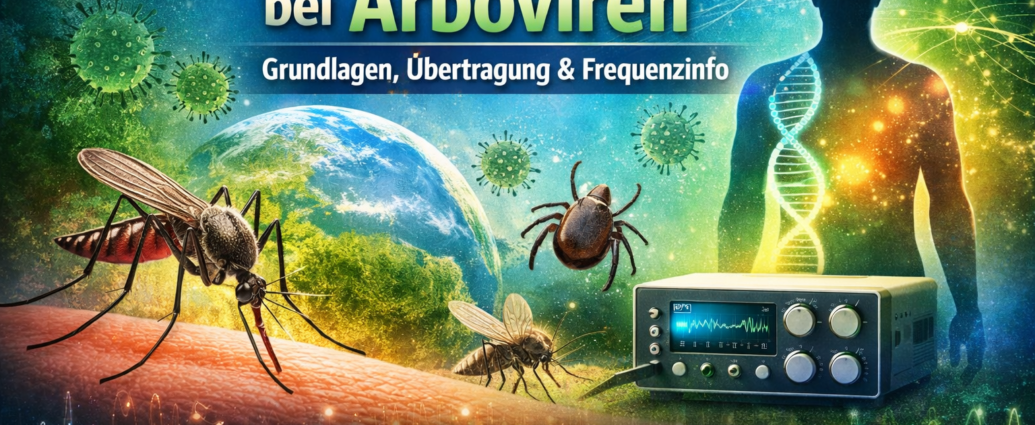
Basics, transmission and frequency information
Arboviruses form a large group of Viruses, which are mainly transmitted to humans or other hosts by arthropods. The literature describes a very extensive group of enveloped RNA viruses, which includes several hundred representatives. Transmission occurs primarily via vectors such as mosquitoes, sand flies, fleas, ticks or lice. It is precisely this particular form of transmission that makes arboviruses medically important, because they are strongly linked to ecological, climatic and regional conditions.
What are arboviruses?
The term arboviruses stands for arthropod-borne viruses, i.e. viruses that are transmitted by arthropods. This primarily refers to viruses that are transmitted by blood-sucking or stinging arthropods. The literature emphasizes that this term does not describe an actual taxonomic unit, but is rather a functional collective term for viruses with a similar transmission route.
This means that arbovirus is not a single type of virus, but a generic term for numerous pathogens that are grouped together due to their mode of spread. This classification is important because it shows that arboviruses cannot be understood as a uniform group of diseases. Rather, it is a diverse field with different viruses, different clinical pictures and different biological properties.
Which virus families belong to the arboviruses?
In the literature, this large, heterogeneous group is classified into several virus families. These include Togaviridae, Flaviviridae, Bunyaviridae and Arenaviridae. This classification makes it clear that arboviruses do not biologically belong to a single family, but comprise several larger virus lineages.
This is precisely why the medical consideration of arboviruses is complex. Different families can affect different organ systems, show different clinical courses and occur more frequently in different regions. The common denominator lies above all in the transmission route via arthropods and not in a uniform clinical picture.
How are arboviruses transmitted?
Transmission occurs primarily via arthropods as vectors. These mainly include mosquitoes, sand flies, fleas, ticks and lice. These animals ingest viruses and can transmit them to new hosts the next time they come into contact with them. This creates ecological chains of infection in which humans are often only part of a larger natural cycle.
Vector-dependent transmission is particularly important for conventional medical classification. It explains why certain arbovirus infections occur more frequently in certain regions, why seasonal dependencies can be observed and why environmental factors play a major role. Temperature, humidity, habitat of the vectors and contact between humans and animal reservoirs have a significant influence on the risk.
Why arboviruses are so medically relevant
Arboviruses are medically important because they not only occur in large numbers, but can also cause a wide variety of diseases. In general medical terms, the spectrum ranges from mild febrile infections to more complex courses with organ or nervous system involvement. The decisive factor is always which specific pathogen is involved.
The fact that more than 400 such viruses have been described makes it clear just how broad this field is. Arboviruses should therefore be understood less as a single disease pattern, but rather as a larger group of infectious agents that are linked by their transmission pathway. It is precisely this breadth that explains why arboviruses play a special role in tropical medicine, travel medicine, infectiology and environmental medicine.
The importance of vectors for the course of the disease
A central feature of arboviral diseases is the vector link. This means that not only the virus, but also the behavior, spread and biology of the transmitting arthropod play a role. As a result, the medical consideration of arboviral infections differs significantly from classic directly transmissible viral infections.
When a virus is linked to certain vectors, regional patterns, seasonal clusters and ecological correlations emerge. For example, the frequency of a pathogen can depend on how strongly mosquitoes reproduce, how tick populations develop or in which landscapes people are particularly often exposed. These correlations are of central importance when considering arboviruses in conventional medicine.
Conventional medical perspective on arboviruses
The conventional medical approach to arboviruses starts with the classification of the virus group. The transmission route, vector, geographical context and the respective virus family are important. Only in the next step is it possible to assess which symptoms are associated with a specific pathogen and which organ systems may be affected.
Precisely because the term arbovirus is so broadly defined, the focus is on differentiated classification. Medicine is not only looking for a symptom, but also for the origin, transmission route, possible vector, seasonal pattern and biological affiliation. This creates a structured basis for correctly classifying the respective infection.
Holistic view of the organism
From a holistic perspective, the group of arboviruses is particularly interesting because the focus here is not only on the pathogen itself, but also on the interaction between environment, vector, host and individual response. An infection does not occur in isolation, but is embedded in a larger biological and ecological system.
For this very reason, a complementary approach focuses not only on the pathogen, but also on resilience, regenerative capacity, constitution and the ability of the organism to react to external stresses. The system dynamics between environmental factor, carrier and body reaction are understood as an interrelated process.
Complementary perspective on frequency therapy
Around the Frequency therapy is often associated with terms such as oscillation, Resonance and regulation. In a complementary understanding, the aim is to consider biological stress not only in terms of substances, but also in connection with functional and regulatory patterns. The focus is on the organism as a whole and its individual reaction situation.
Particularly in the case of broadly defined pathogen groups such as arboviruses, such models attempt to consider not only individual pathogen data, but also the overall picture of exposure, adaptation and biological response. In this context, frequency therapy and frequencies are seen as complementary literature references within a larger understanding of resonance and system dynamics.
Frequency info
The following frequency ranges are mentioned in the literature for arboviruses:
428-435 kHz
In the complementary context of frequency therapy and frequencies, these frequency data are understood as supplementary literature references. Within complementary approaches, they are placed in a larger context of resonance, system dynamics and individual reactions.
Conclusion
Arboviruses are a large group of enveloped RNA viruses that are mainly transmitted by arthropods such as mosquitoes, sand flies, fleas, ticks or lice. The term does not describe a separate taxonomic unit, but a functional collective term for viruses with a similar transmission route. The conventional medical view is therefore the starting point for any well-founded classification, because it clearly describes the transmission route, vector reference, virus families and biological relationships.
In the complementary environment, the view of frequency therapy and frequencies can be understood as a thematic extension. The frequency ranges mentioned in the literature are classified as frequency information in a larger context.



Comments are closed, but trackbacks and pingbacks are open.