




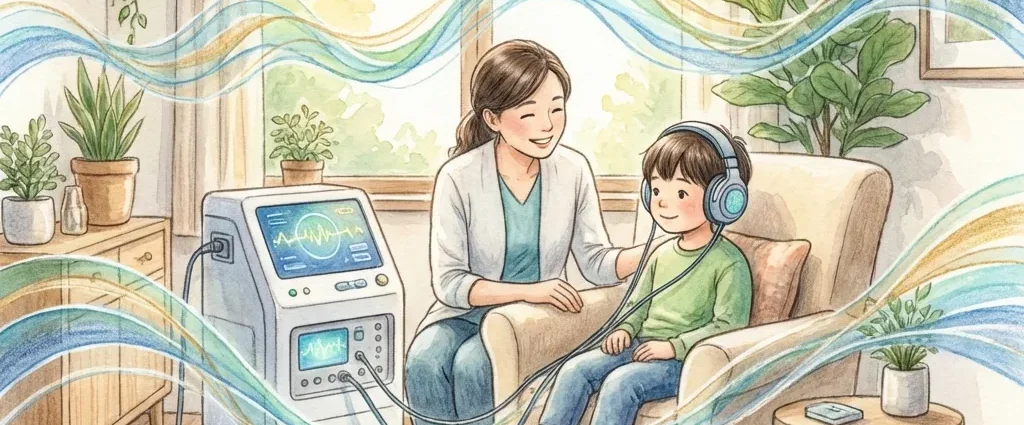
The use of frequency therapy in children is becoming increasingly important in complementary medicine. Parents, therapists and alternative practitioners are looking for gentle, non-invasive methods to treat developmental disorders, chronic complaints or functional imbalances. At the same time, working with children places particularly high demands on safety, dosage and therapeutic responsibility. Children are not „small adults“; their nervous system, metabolism and regulatory capacity are fundamentally different. This article therefore examines the use of frequency therapy with children from a scientifically sound, practical perspective and is aimed at advanced users who wish to work in a structured, reflective and responsible manner.
Basics of frequency therapy for children
Frequency therapy is based on the assumption that biological systems can be influenced by electromagnetic, mechanical or acoustic vibrations. Cells, tissues and organ systems communicate via electrical potentials and rhythmic processes. The aim of frequency therapy is to support regulatory processes, harmonize stress patterns and stimulate adaptive self-healing powers.
These regulatory systems are particularly plastic in childhood. On the one hand, this means a high level of responsiveness to therapeutic stimuli, but on the other hand also an increased vulnerability to overstimulation. While adults often work with longer exposure times and complex frequency sequences, the pediatric application requires reduced intensities, clear objectives and careful observation of the reactions.
From a scientific point of view, there are a growing number of experimental and clinical studies on the effect of low-energy electromagnetic fields on neuronal maturation, inflammatory processes and vegetative regulation. Although the data is heterogeneous, there are positive effects, particularly in the areas of stress regulation, sleep quality and functional pain, provided the application is age-appropriate. It is also worth taking a look at the Scientific study situation Frequency therapy 2026 - current research & evidence, which provides new findings on effectiveness.
Safety as the highest principle
Safety is the key factor in the use of frequency therapy for children. This is not just about technical limits, but also about developmental, neurobiological and emotional aspects.
Biological sensitivity
Children have a higher cell division rate, a still immature detoxification system and a more permeable blood-brain barrier. Frequency impulses can therefore have a faster and more intensive effect. What is perceived as mild stimulation in adults can already trigger a clear vegetative reaction in children.
Typical safety aspects
- Avoid high field strengths or intense amplitudes
- Limiting the duration of meetings
- Use of clearly defined, low frequency ranges
- Avoidance of aggressive or „pathogen-oriented“ programs
- Regular breaks between sessions
A key safety indicator is the child's reaction after treatment. Tiredness, increased sleep or short-term emotional fluctuations can be normal regulatory signs. However, persistent deterioration, anxiety reactions or somatic symptoms are clear warning signals.
Legal and ethical framework conditions
The use of frequency therapy in children is subject to different legal regulations depending on the country. Irrespective of this, basic ethical principles apply that are non-negotiable.
- Informed consent of the parents or legal guardians
- Age-appropriate education of the child
- Documentation of the applied parameters
- Clear differentiation from conventional medical diagnoses and therapies
Furthermore, transparent communication is crucial. Frequency therapy must not be presented as a substitute for necessary medical measures, but as an accompanying, regulative intervention.
Dosing principles of frequency therapy for children
The dosage in frequency therapy is not a rigid scheme, but a dynamic process. It is based on age, body weight, stage of development, symptoms and individual reactions.
Basic rule: less is more
In childhood, the principle of the minimum effective dose applies consistently. The aim is not maximum stimulation, but gentle stimulation of self-regulation.
Important dosage parameters are:
- Frequency range
- Intensity (amplitude, field strength)
- Session duration
- Repetition frequency
- Total duration of the therapy cycle
Age-dependent dosage
The following table shows a comparative overview of typical dosage frames in different age groups. These values serve as a guideline and do not replace individual adjustments.
| Age group | Frequency range (Hz) | Session duration | Frequency | Intensity |
|---|---|---|---|---|
| 0, 2 years | 1, 8 Hz | 1, 3 minutes | 1×/week | very low |
| 3, 6 years | 1, 12 Hz | 3, 5 minutes | 1, 2×/week | low |
| 7, 12 years | 1, 20 Hz | 5, 10 minutes | 1, 3×/week | low, moderate |
| 13, 17 years | 1, 30 Hz | 10, 20 minutes | 2, 3×/week | moderate |
These data illustrate the extent to which the parameters change with increasing age. Consequently, standardized adult protocols are unsuitable.
Age-appropriate frequency therapy protocols for children
An age-appropriate protocol takes into account not only biological factors, but also emotional maturity, attention span and cooperation skills.
Infants and toddlers (0, 2 years)
In this phase, the focus is on supporting basic regulatory processes. Frequency therapy is used here exclusively indirectly and very briefly, often via contact points close to the parents or in combination with physical contact.
Typical objectives:
- Supporting the sleep-wake rhythm
- Calming for vegetative restlessness
- Support for regulatory disorders
The therapy usually takes place passively, without the child being consciously aware of it.
Preschool age (3, 6 years)
Children of this age react very sensitively to their environment. Playful elements, short sessions and clear rituals are also crucial.
Possible focal points:
- Stress and anxiety regulation
- Support for emotional stability
- Support for functional complaints
Frequency therapy is ideally embedded in a quiet, familiar environment.
School age (7, 12 years)
With increasing cognitive maturity, children can be actively involved in the process. They are often able to describe bodily sensations in a differentiated way.
Therapeutic focus:
- Concentration and learning regulation
- Sleep quality
- Chronic functional pain
- Accompanying support for autoimmune processes
Structured protocols with clear objectives can be used here, as long as they remain customized. Similar to the Frequency therapy for chronic pain - mechanisms of action & applications the precise selection of parameters plays a central role.
Teenagers (13, 17 years)
Adolescents are in a phase of intensive neuroendocrine restructuring. Frequency therapy can have a regulating effect here, but must be designed in a respectful and participatory manner.
Relevant fields of application:
- Stress and exhaustion syndromes
- Chronic inflammatory processes
- Psychosomatic complaints
Involving young people in decision-making processes significantly increases effectiveness and acceptance.
Frequency therapy for chronically ill and autoimmune children
Chronic diseases and autoimmune processes in childhood pose a particular challenge. Frequency therapy cannot have a causal effect here, but it can have a regulative and symptom-relieving effect.
Special features of autoimmune diseases
- Overreactive immune system
- High inflammatory readiness
- Exhausted regulatory mechanisms
The therapeutic strategy should focus on stabilization, not stimulation. Therefore, low frequencies, short sessions and longer breaks are essential.
Integration into multimodal concepts
Frequency therapy is most effective when it is part of an integrative overall concept that takes nutrition, micronutrients, stress management and psychosocial factors into account. In addition, the article Autoimmune diseases Frequency therapy: balance instead of suppression offer additional insights. An isolated application without context is often ineffective.
Observation, documentation and adaptation
Professional frequency therapy with children requires continuous observation. Subtle changes in behavior, sleep or emotional expression are often more meaningful than verbal feedback.
Important documentation points:
- Initial state
- Applied parameters
- Short and long-term reactions
- Changes in everyday life
The ability to adapt protocols flexibly is a key quality feature of experienced therapists.
Scientific classification and limits of frequency therapy in children
Despite growing practical experience, the scientific evidence for frequency therapy in children remains limited. Many findings come from basic research, animal models or small clinical observational studies.
This means responsible use:
- No promises of a cure
- Critical reflection on own observations
- Openness to interdisciplinary cooperation
Frequency therapy should therefore be understood as an experimental method, the benefits of which vary from person to person.
Typical errors and risks in practice
Even experienced users can make mistakes when working with children. The most common ones include
- Transfer of adult protocols
- Session duration too long
- Misinterpretation of regulatory reactions
- Impatience with chronic courses
A deliberate, slow build-up of therapy reduces these risks considerably.
Future prospects for frequency therapy in children
With increasing research into bioelectricity, neuroplasticity and systems biology, frequency therapy could be used in a more differentiated and evidence-based way in the future. In addition, personalized approaches that take genetic, metabolic and neurophysiological factors into account are conceivable.
For children, this means the chance of even more individualized, gentler interventions, provided that ethical and scientific standards are consistently adhered to.
Conclusion
The use of frequency therapy in children requires a high degree of specialist knowledge, sensitivity and responsibility. Safety, age-appropriate dosage and individually adapted protocols are the cornerstones of successful therapy. For alternative practitioners, therapists and advanced users, frequency therapy offers a valuable tool for supporting children's regulatory processes, but only if it is used in a considered, measured way and embedded in a holistic treatment concept. After all, children not only react more quickly, but also more honestly to therapeutic impulses. If you are prepared to listen, observe and learn continuously, you can use frequency therapy as a gentle companion during sensitive developmental phases.

Comments are closed, but trackbacks and pingbacks are open.