





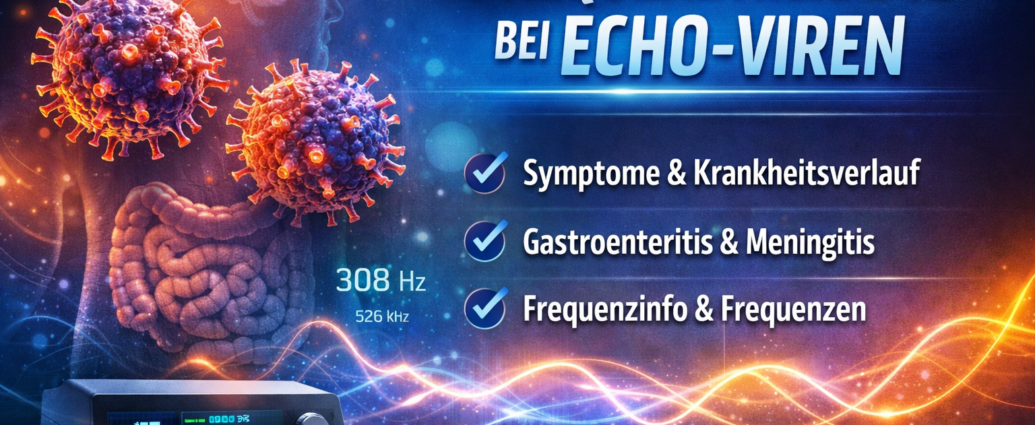
Symptoms, progression and frequency information
ECHO viruses, also known as enteric cytopathic human orphan viruses, belong to the group of enteroviruses and can cause very different clinical pictures in humans. The literature describes a broad spectrum ranging from gastrointestinal complaints and skin rashes to infections of the respiratory tract and nervous system. It is precisely this diversity that makes ECHO virus infections medically interesting, because they cannot be reduced to a single, clearly defined clinical picture.
What are ECHO viruses?
ECHO viruses are enteroviruses that can affect different organ systems in humans. Gastrointestinal complaints, febrile infections and skin symptoms are often the main symptoms. However, the clinical picture can vary considerably depending on the type of virus and individual constitution. Some infections are mild and unspecific, others affect deeper organ systems and require closer medical observation.
The literature describes ECHO virus infections as frequently occurring diseases that often manifest themselves as gastrointestinal infections or skin rashes. In some contexts, they are also associated with other complex symptoms. This makes it clear that ECHO viruses not only cause local irritation, but can also challenge the organism on various levels.
Typical symptoms of ECHO virus infections
The range of symptoms is wide. Gastrointestinal complaints, a general feeling of illness, fever and skin changes are common. Many infections are initially unspecific, so that the overall picture only becomes clearer as the disease progresses. This blurred early phase is typical of many viral diseases.
The manifestations described in the literature include gastrointestinal infections, febrile general illnesses and skin rashes. Depending on the organ system affected, respiratory symptoms may also occur. This results in a multifaceted picture that can develop from a simple infection to more pronounced systemic stress.
Gastroenteritis caused by ECHO viruses
Several ECHO virus types have been described as possible causes of gastroenteritis, which can occur in both summer and winter. Typical symptoms are gastrointestinal complaints that can quickly weaken the body. Such infections can be accompanied by significant exhaustion, especially in children or susceptible people.
The digestive tract plays a central role in enteric viral infections. Accordingly, an infection can not only make itself felt locally in the intestine, but can also affect the entire organism through fluid loss, weakness and vegetative stress. From a conventional medical point of view, it is therefore particularly important to monitor the general condition of the patient.
Summer flu and upper respiratory tract infections
Certain ECHO virus types are also associated in the literature with a febrile illness of the upper respiratory tract, which is described as summer flu. This is characterized by fever, throat discomfort and general malaise. Although the clinical picture often appears mild, it can have a significant temporary impact on everyday life.
In rare cases, herpangina-like changes are also described. These mainly affect the mouth and throat and show that ECHO viruses can not only cause intestinal or general signs of infection, but also involve the mucous membranes of the upper respiratory tract.
Diseases of the lower respiratory tract
In addition to upper respiratory tract infections, certain ECHO viruses are also associated with lower respiratory tract diseases in infants and children. Although adults are less frequently affected, deeper respiratory tract involvement can become medically relevant in young children.
It is particularly important to monitor the course of the disease in this age group, as respiratory diseases in young children can lead to general weakness and significant stress more quickly. The literature thus makes it clear that ECHO viruses can in some cases go beyond a simple infection.
ECHO viruses and the nervous system
ECHO viruses are of particular importance in connection with aseptic meningitis. The literature describes that a relevant proportion of such cases can be attributed to ECHO viruses. In some cases, such infections can also occur epidemically, which further underlines their health significance.
The symptoms of viral meningitis typically include fever, headache, vomiting, weakness and neck stiffness. In addition, milder forms can occur in which only fever and a general feeling of illness are the main symptoms. In more severe cases, encephalitis can also occur, in which normal brain functions are impaired.
Meningitis and encephalitis - severe forms of the disease
When ECHO viruses affect the central nervous system, the clinical picture can become much more serious. While meningitis is mainly accompanied by fever, headache, vomiting and stiff neck, encephalitis is characterized by disturbances in normal brain function. This can include personality changes, confusion, seizures, weakness in individual areas of the body and severe drowsiness.
Such neurological progressions illustrate that viral infections not only cause superficial symptoms, but can have a deep impact on the body's regulatory systems. This is precisely why conventional medical classification is crucial when signs of nervous system involvement become apparent.
Diagnosis and conventional medical classification
Conventional medical diagnosis is based on symptoms, course and supplementary examinations. Imaging procedures such as CT, MRI and immunological tests to determine antiviral antibodies are described in the literature. The aim is to classify the extent of involvement of various organ systems as accurately as possible.
The treatment is described as symptomatic. This means that the organism is supported on the basis of the respective symptoms. The focus is on stabilizing the general condition, monitoring the course of the disease and paying attention to possible complications, especially if the respiratory or nervous system is involved.
Holistic view of the organism
From a holistic perspective, ECHO virus infections show very clearly that a virus can affect numerous regulatory areas of the body simultaneously or sequentially. Digestion, respiratory tract, skin, autonomic nervous system and central neurological functions can be affected in different ways. This creates a complex picture that goes beyond the mere observation of a single symptom.
For this very reason, a complementary perspective focuses not only on fever, rash or gastrointestinal complaints, but also on resilience, regenerative capacity, vegetative stability and the individual reaction of the organism. This perspective attempts to better grasp the systemic dimension of stress.
Complementary perspective on frequency therapy
In the field of frequency therapy, terms such as resonance, oscillation and regulation are often used. In a complementary understanding, the aim is to look at biological stress not only from a material point of view, but also from a functional and systemic perspective. The organism is understood as a dynamic system that responds to stress with different reaction patterns.
Particularly in the case of infections with a variety of symptoms, such models of thought attempt not only to see the visible symptoms, but also to include the inner order, the regulatory capacity and the overall reaction of the body. In this context, frequency therapy is understood as a complementary approach that places biological processes in an expanded context of vibration and regulation.
Frequency info
The following frequency ranges are mentioned in the literature for ECHO viruses:
308-321, 369, 379, 391, 395-405, 470-476, 526 kHz
In the complementary context of frequency therapy and frequencies, these frequency data are understood as supplementary literature references. Within complementary approaches, they are placed in a larger context of resonance, system dynamics and individual reactions.
Conclusion
ECHO viruses can cause a wide range of symptoms. These include gastrointestinal infections, skin rashes, summer flu, upper and lower respiratory tract infections and, in more severe cases, aseptic meningitis or encephalitis. Conventional medicine is therefore the starting point for any well-founded classification, as it clearly describes the symptoms, course, diagnosis and possible complications.
In addition, a complementary perspective on frequency therapy can help to view the organism as a whole. The focus here is on regulation, stress processing and systemic connections. The frequency ranges mentioned in the literature are classified as frequency information in an extended context with frequency therapy and frequencies.


Comments are closed, but trackbacks and pingbacks are open.