





Symptoms, progression and frequency information
Group A coxsackie viruses belong to the enteroviruses and can cause very different clinical pictures in humans. The literature describes a broad spectrum ranging from febrile sore throats and respiratory infections to skin and mucous membrane changes. Depending on the type of virus and individual reaction, the symptoms can be mild or more severe.
What are Group A Coxsackie viruses?
Group A coxsackie viruses are a subgroup of enteroviruses. They are known to affect different tissues and organ systems. These primarily include mucous membranes in the mouth and throat, the respiratory tract, the skin, the gastrointestinal tract and, in certain cases, the nervous system or the cardiovascular system.
It is precisely this versatility that makes Group A coxsackie viruses medically significant. They do not cause a single, clearly defined clinical picture, but can manifest themselves in various clinical forms. As a result, the course of the disease strongly depends on which serotype is involved, the age of the person affected and the general condition of the organism.
Typical symptoms and clinical pictures
The literature describes a wide range of symptoms associated with Group A Coxsackie viruses. These include febrile infections, sore throat, mucosal changes, skin symptoms, respiratory problems and gastrointestinal symptoms. Diarrhea can also occur in connection with such infections.
Herpangina is a particularly characteristic clinical picture. This is characterized by small papular, vesicular or ulcerative changes in the soft palate, tonsils, pharyngeal mucosa and adjacent oral mucosa. This form usually occurs as a febrile illness and mainly affects children.
Acute lymphonodular pharyngitis is also described. This is characterized by raised, clearly defined, whitish to yellowish papules surrounded by a reddened border. It is typical that the changes occur simultaneously and do not ulcerate. This is also one of the known mucosal manifestations of individual Group A Coxsackie virus types.
Respiratory tract infections caused by Coxsackie A viruses
Some serotypes are primarily associated with upper respiratory tract infections. The clinical picture can be reminiscent of a common cold, but is sometimes characterized by a stronger tendency to fever. Complaints such as a sore throat, feeling ill and irritation in the throat can be the main symptoms.
Diseases of the lower respiratory tract are also described. These include tracheitis, bronchitis, croup, bronchiolitis and pneumonia. Such courses mainly affect infants and children, much less frequently adults. It is therefore particularly important to monitor the respiratory situation of young children.
Hand-foot-and-mouth disease and mucosal involvement
A well-known mucocutaneous clinical picture associated with Coxsackie A viruses is hand-foot-and-mouth disease. Changes in the hands, feet and mouth are typical. The disease often occurs in the summer months and early fall.
The combination of mucosal lesions and skin symptoms makes this clinical picture comparatively characteristic. Even if many courses remain mild, the disease can be distressing, especially in children, because eating, drinking and general well-being can be significantly impaired temporarily.
Eye involvement and other possible symptoms
Certain variants have also been associated with acute hemorrhagic conjunctivitis. This highly contagious form begins suddenly and can be accompanied by pain, sensitivity to light, conjunctivitis, eyelid swelling and subconjunctival bleeding. This shows that Group A Coxsackie viruses can affect more than just the throat or respiratory tract.
In addition, respiratory and gastrointestinal symptoms, acute kidney involvement, thrombocytopenia and hemolytic anemia have also been described in the literature. The clinical picture can therefore be varied, especially in infants and children.
Involvement of the nervous system and heart
In individual cases, aseptic viral meningitis may occur, occasionally with paralytic symptoms. Children are usually particularly affected. The initial symptoms may initially appear to be a non-specific febrile infection before further signs develop.
Involvement of the heart muscle and pericardium has also been described. Acute myocarditis and pericarditis can be associated with certain Group A Coxsackie viruses. Such involvement can be particularly severe in newborns, whereas in older children and adults, pericarditis is more often milder and often resolves.
Why the conventional medical view is so important
It is precisely because Group A Coxsackie viruses can show such a broad spectrum of organ involvement that conventional medical classification is crucial. It helps to differentiate between mild mucosal infections and more serious courses with respiratory, cardiac or nervous system involvement.
The conventional medical perspective focuses on symptoms, progression, possible complications and the assessment of the general condition. Close observation of the course of the disease is particularly important in infants, small children and people with significant weakness.
Holistic view of the organism
From a holistic perspective, Group A Coxsackie virus infections show very clearly that a virus does not just have to affect a single organ. Rather, the strain can affect the mucous membranes, skin, respiratory tract, gastrointestinal tract, heart and nervous system. This makes it clear how closely different regulatory systems in the body are linked to each other.
This is precisely why a complementary approach focuses not only on individual symptoms, but also on resilience, regenerative capacity, vegetative stability and the question of how the organism as a whole reacts to infections. This approach supplements the purely symptom-oriented view with a functional overall view.
Complementary perspective on frequency therapy
In the field of frequency therapy, terms such as oscillation, resonance and regulation are often used. In a complementary understanding, the aim is to place biological stress in a larger context of inner order, responsiveness and systemic balance. In this context, frequencies are not viewed in isolation, but are understood as a thematic orientation within a broader perspective.
Particularly in the case of infections with a wide range of symptoms, such models attempt to consider not only the visible symptoms, but also the systemic stress. This includes exhaustion, irritation, the need for regeneration and the interaction between different organ systems. In this context, frequency therapy is understood as a complementary way of thinking that places biological stress in a larger context of vibration and regulation.
Frequency info
The following frequency ranges are mentioned in the literature for Group A Coxsackie viruses:
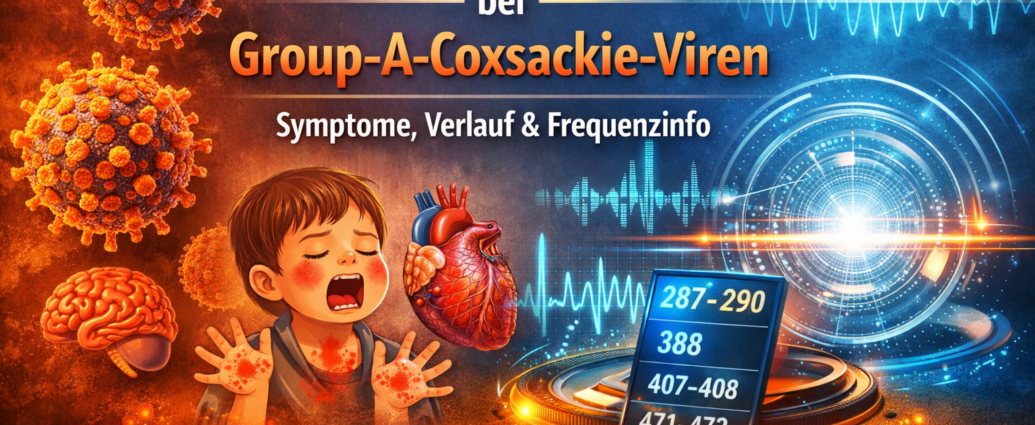
287-290, 292-304, 346, 388, 393, 407-408, 432-434, 444, 471-472, 552 kHz
In the complementary context of frequency therapy and frequencies, these frequency data are understood as supplementary literature references. Within complementary approaches, they are not isolated, but are placed in a larger context of resonance, system dynamics and individual reactions.
Conclusion
Group A coxsackie viruses can cause very different clinical pictures. These include herpangina, lymphonodular pharyngitis, respiratory tract infections, hand-foot-and-mouth disease, eye involvement, gastrointestinal complaints and, in individual cases, diseases of the nervous system and heart. Conventional medicine is therefore the starting point for any well-founded classification because it clearly describes the symptoms, course and possible complications.
In addition, a complementary perspective on frequency therapy can help to view the organism as a whole. The focus here is on regulation, stress processing and systemic connections. The frequency ranges mentioned in the literature are classified as frequency information in an extended context with frequency therapy and frequencies.


Comments are closed, but trackbacks and pingbacks are open.