





Rhinoviruses are among the most common triggers of acute colds in humans. More than 100 different types of rhinovirus have been described in the literature. It is precisely this diversity that explains why rhinoviruses play such an important role in everyday life and why they account for a significant proportion of respiratory diseases in children and adults. Conventional medicine considers them to be one of the most important pathogens of the classic common cold.
What are rhinoviruses?
Rhinoviren sind Viruses, die vor allem die oberen Atemwege betreffen. Sie sind eng mit dem typischen Bild einer gewöhnlichen Erkältung verbunden und spielen in der kalten Jahreszeit, aber auch darüber hinaus, eine bedeutende Rolle. Da sehr viele unterschiedliche Typen bekannt sind, kommt es immer wieder zu neuen Infektionen, obwohl der Organismus bereits frühere Kontakte mit ähnlichen Erregern gehabt haben kann.
Conventional medicine primarily classifies rhinoviruses as infections of the nose, throat and upper airways. In contrast to more severe respiratory tract infections, local symptoms and an overall mild course are usually in the foreground here. Nevertheless, such infections can have a significant impact on everyday life, as they are often accompanied by fatigue, malaise and a temporary reduction in performance.
Typical symptoms of a rhinovirus infection
The first signs often appear relatively quickly. The literature describes a scratchy throat, a blocked nose, runny nasal secretions, general malaise and a slight headache. Characteristically, these symptoms often begin gradually and develop into a typical cold within a short period of time.
In contrast to other viral respiratory tract infections, rhinoviruses are not usually characterized by a high fever. Rather, local irritation of the mucous membranes and a general feeling of physical weakness predominate. It is precisely this combination of a scratchy throat, nasal discomfort and a slight feeling of illness that many people perceive as the classic start of a cold.
How does a cold caused by rhinoviruses progress?
In many cases, the course of a rhinovirus infection is comparatively mild. The symptoms are mainly concentrated in the upper respiratory tract and usually disappear again within a short time. In the literature, recovery is generally described as rapid and complete. This explains why rhinoviruses are usually associated with uncomplicated colds despite their widespread distribution.
Nevertheless, even a seemingly harmless infection should not be underestimated. Even an ordinary cold can be subjectively perceived as clearly exhausting, especially in the case of increased stress, little recovery or additional irritation of the body. Tiredness, irritability, reduced concentration and a general weakening are therefore often also part of the overall picture.
Why rhinoviruses are so common
One of the main reasons for the wide spread is the large number of different rhinovirus types. As more than 100 variants have been described, the probability of repeated infections is correspondingly high. Even if the organism has already had contact with individual types, other variants can lead to symptoms again.
In addition, rhinoviruses are among the most important triggers of common respiratory infections. According to the literature, they can account for around half of respiratory diseases in children and adults. This high significance explains why rhinoviruses are usually classified as mild in medical terms, but are nevertheless very present in everyday life.
Conventional medical view of diagnosis and progression
From a conventional medical point of view, rhinoviruses are primarily characterized by their symptoms, course and differentiation from other respiratory tract infections. Typical symptoms are those in the nose and throat area, accompanied by a slight feeling of illness and occasionally mild headaches. The absence of a pronounced fever is often an indication of the rather uncomplicated course.
The main aim of the medical classification is to understand the infection as a mostly self-limiting process. This means that in many cases the organism stabilizes again within a short period of time. It is crucial to monitor the course of the disease, especially if symptoms become more severe, last for an unusually long time or additional symptoms occur.
The importance of the whole organism in cold infections
Even though rhinovirus infections are often mild, they do not only affect the nasal mucous membranes locally. Every viral infection challenges the body's regulation, mucosal defenses and general resilience. This is precisely why many people experience even simple colds as times of reduced energy and reduced resistance.
From a holistic perspective, it is interesting to note that even mild infections can be an expression of a momentary imbalance or increased stress. The body's reaction is not only reflected in visible symptoms, but also in tiredness, vegetative sensitivity and the need for rest and regeneration. This consideration creates a bridge to complementary approaches.
Complementary view of frequency therapy and frequencies
Around the Frequency therapy is often associated with terms such as oscillation, Resonance und Regulationsdynamik gearbeitet. Dabei geht es im komplementären Verständnis darum, biologische Belastungen in einen größeren Zusammenhang von innerer Ordnung, Reaktionsfähigkeit und systemischer Balance zu stellen. Frequenzen werden in diesem Rahmen nicht isoliert betrachtet, sondern als thematische Orientierung innerhalb einer erweiterten Sichtweise verstanden.
Particularly in the case of frequently recurring colds, complementary medicine often tries to look not only at individual complaints, but also at the overall pattern of the organism. This includes mucous membrane sensitivity, general constitution, regenerative capacity and the way the body reacts to repeated stress. In this context, the literature mentions certain frequency ranges that are additionally classified within such models.
Frequency info
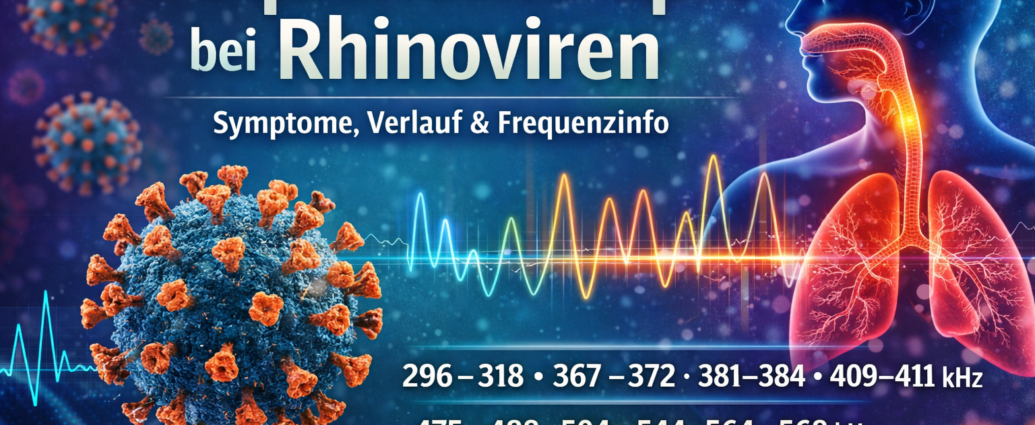
The following frequency ranges are mentioned in the literature for rhinoviruses:
296, 318, 340, 367-372, 381-384, 391-402, 409-411, 418, 450-454, 475, 488-504, 508, 511, 544-564, 568 kHz
The literature also points out that this list is not yet complete, as other rhinovirus groups with different frequency ranges are described.
In the complementary context of frequency therapy and frequencies, this information is understood as supplementary literature references.
Conclusion
Rhinoviruses are one of the most common triggers of common colds and mainly affect the upper respiratory tract. Typical symptoms are a scratchy throat, blocked or runny nose, slight discomfort and mild headaches, usually without a pronounced fever. Conventional medicine generally describes rhinovirus infections as frequent, usually mild and rapidly remitting. In the complementary environment, the view of frequency therapy and frequencies can be understood as a thematic extension. The frequency ranges mentioned in the literature are placed in a larger context as brief frequency information.


Comments are closed, but trackbacks and pingbacks are open.