




Symptoms, progression and frequency information
Rotaviruses are among the most important causes of acute gastrointestinal infections in infants and young children worldwide. Children between the ages of around six months and two years are particularly frequently affected. The literature describes rotavirus infections as occurring on all continents and in all population groups. Several serological groups are known, whereby groups A, B and C can infect humans. Rotavirus plays an important role as a cause of diarrhea, especially in young children.
What are rotaviruses?
Rotaviruses are pathogens that primarily affect the gastrointestinal tract. They are considered one of the most common causes of gastroenteritis in early childhood. Not every detectable rotavirus excretion in the stool is necessarily associated with a pronounced illness, but the Virus This is of particular medical relevance because it can quickly lead to considerable fluid loss in infants and young children.
The literature describes six serological groups, three of which are detected in humans. Group A is particularly well known as a frequent trigger of childhood gastroenteritis. In addition, rotavirus group B, which is sometimes referred to as adult diarrhea rotavirus, has also been associated with major outbreaks. This classification shows that rotaviruses are not a uniform group of pathogens with a single appearance, but can occur in various subtypes.
Who is particularly affected?
The highest incidence of the disease is described in the literature in infants aged around six to eleven months. Very young children are particularly at risk of more severe cases, as their fluid and electrolyte balance can become unbalanced more quickly. Mortality was also increased in certain regions and under difficult care conditions, particularly in children in the first year of life.
Especially in countries with limited access to clean water, hygienic standards and adequate medical care, a rotavirus infection can have serious consequences. This makes it clear that not only the pathogen itself, but also the general living conditions have a significant influence on the course of the disease.
How are rotaviruses transmitted?
According to conventional medical understanding, transmission is predominantly fecal-oral. This means that infectious material enters the mouth via contaminated hands, surfaces, food or water. Transmission via the air is only discussed to a much lesser extent in the literature.
It is particularly important that rotaviruses can have a certain stability outside the body. This means that contaminated surfaces and objects can also contribute to transmission. The infection can therefore spread quickly, especially in communal facilities, in the family environment or wherever there is close contact.
Typical symptoms of a rotavirus infection
Typical symptoms of rotavirus infections are fever, vomiting and watery diarrhea. These may be accompanied by abdominal pain and signs of general weakness. The combination of vomiting and repeated diarrhea is particularly distressing for infants and young children because it can lead to dehydration in a short period of time.
The literature describes that the disease often begins with vomiting and watery diarrhea, which can last for several days. The stools are usually watery and can occur in higher numbers per day. Occasionally, symptoms of an upper respiratory tract infection may also be present. This results in an overall picture that not only affects the intestines, but can also significantly affect the child as a whole.
How long does the disease last?
In many cases, the typical course is limited in time. The watery diarrhea often lasts for a few days, often no longer than three to four days, while other symptoms such as vomiting and general weakness may be felt for a little longer. In the literature, the total duration is often described as a few days.
In children with a stable immune system, rotavirus gastroenteritis is usually self-limiting. This means that the disease usually resolves itself. Nevertheless, the course of the disease should not be underestimated, as fluid loss is the greatest risk, especially in the acute phase.
Dehydration as a key risk
The most important medical problem with rotavirus infections is not just the diarrhea itself, but the risk of dehydration. If young children vomit and lose thin stools several times a day at the same time, the loss of fluids and electrolytes can quickly become critical. Signs such as tiredness, listlessness, dry mucous membranes or reduced fluid intake therefore deserve special attention.
It is precisely for this reason that conventional medical treatment does not focus on specific antiviral therapy, but on stabilizing the fluid balance. The central question is often whether the child can still drink enough or whether more intensive care is required.
Treatment and medical care
The treatment is described in the literature as non-specific. The focus is on oral rehydration, i.e. the targeted supply of fluids and electrolytes to prevent dehydration. In more severe cases, especially if children are not drinking enough or are already severely dehydrated, inpatient treatment with intravenous fluid administration may be necessary.
Rotavirus infections thus show very clearly that conventional medical treatment is often symptom-oriented and supportive. The focus is not on directly eliminating the virus, but on stabilizing the organism during the acute phase of the illness. This is particularly important for young children.
Prevention and hygiene
Hygienic measures play an important role in prevention. As the virus can be passed on via contaminated hands, surfaces, water or food, careful hygiene in everyday life is particularly important. The literature also mentions a live vaccination for children, which was used as a preventive measure.
Prevention is particularly important in the case of highly contagious diarrheal diseases. This includes hand hygiene, clean drinking water, hygienic handling of food and careful cleaning of contaminated surfaces. This makes it much more difficult to pass on the pathogen.
Holistic view of the organism
From a holistic point of view, a rotavirus infection shows particularly clearly how much the organism can be burdened by fluid loss, intestinal irritation and general weakness. Even if the illness is often self-limiting, it is a considerable challenge for infants and young children. The body has to stabilize digestion, circulation, fluid balance and regeneration at the same time.
This is precisely why a complementary approach focuses not only on diarrhea and vomiting, but also on resilience, regenerative capacity, vegetative stability and individual reactions. Especially in young children, it becomes clear how closely digestion, energy balance and general well-being are linked.
Complementary perspective on frequency therapy
Around the Frequency therapy is often associated with terms such as Resonance, vibration and regulation. In a complementary understanding, the aim is to consider biological stress not only at a material level, but also in connection with functional and regulatory processes. The focus is not on individual symptoms in isolation, but on the overall picture of the organism.
Particularly in the case of gastrointestinal infections with a significant systemic burden, such models attempt to consider not only the acute symptoms but also the overall reaction of the body. In this context, frequency therapy and frequencies are seen as supplementary literature references within a larger understanding of regulation and system dynamics.
Frequency info
The following frequency ranges are mentioned in the literature for rotaviruses:
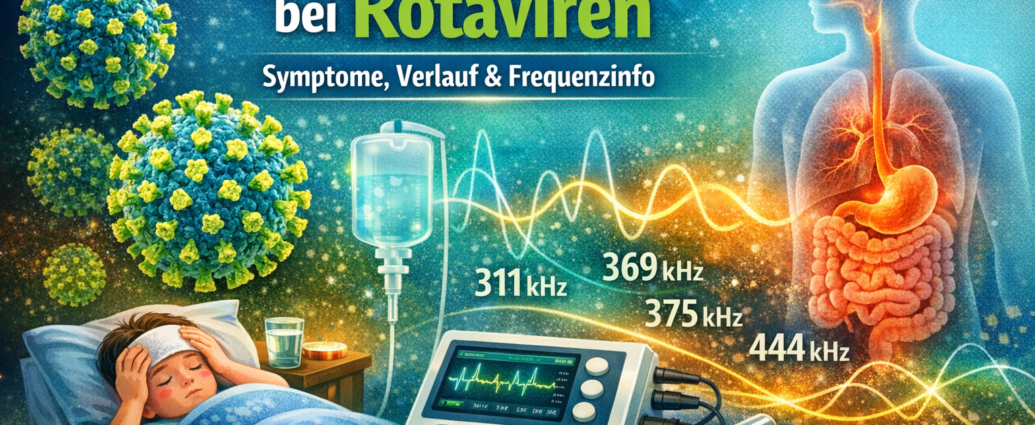
311-320, 334, 346, 369, 373-375, 392, 397, 403, 420, 432, 444, 472 kHz
At the same time, the literature points out that the resonance frequencies in relation to all groups of pathogenic rotaviruses are not fully known. In the complementary context of frequency therapy and frequencies, these frequency data are understood as supplementary literature references.
Conclusion
Rotaviruses are among the most important causes of acute gastroenteritis in infants and young children worldwide. Typical symptoms are fever, vomiting, watery diarrhea and the risk of dehydration. Conventional medicine is therefore the starting point for any well-founded classification because it clearly describes the transmission route, symptoms, course, fluid loss and prevention.
In the complementary environment, the view of frequency therapy and frequencies can be understood as a thematic extension. The frequency ranges mentioned in the literature are classified as frequency information in a larger context.