




When an illness is no longer curable, the view of therapy changes fundamentally. Palliative care is not about healing, but about relief, dignity and quality of life. During this phase, many patients and their relatives look for gentle ways to alleviate pain, calm inner turmoil and promote emotional stability. This is precisely where frequency therapy is becoming increasingly important in palliative care.
Frequency-based applications do not promise miracles. And that is not their claim. Rather, it is about providing supportive guidance that addresses the individual as a whole. Body, mind and emotions are given equal consideration. For many seriously ill people, this can be a valuable building block for feeling better, finding peace and gently alleviating stressful symptoms.
In practice, therapists, alternative practitioners and also relatives report that frequencies are often experienced as pleasant, non-invasive and respectful. This is particularly important in a palliative context. Nobody wants additional stress or aggressive procedures. Gentle therapy for the seriously ill means respecting the person's pace and taking their needs seriously.
This article examines the role of frequency therapy in palliative care from various perspectives. You will learn how frequencies can work, where their limits lie and how they can be used responsibly. It is aimed at people with previous experience as well as those interested in this topic for the first time.
Palliative care and the desire for gentle support
Palliative care means providing holistic support to people with advanced or terminal illnesses. The focus is on symptom relief, emotional stability and a self-determined experience of the remaining time. Pain, shortness of breath, anxiety and exhaustion are common challenges. Studies show that over 70 percent of patients receiving palliative care suffer from several distressing symptoms at the same time, which highlights the need for complementary, gentle approaches.
Many traditional medical measures are indispensable. At the same time, they have their limits. Medication can have side effects, such as fatigue, nausea or confusion. Some patients feel over-treated or lose contact with their own bodies. This is precisely where there is room for complementary approaches that accompany rather than control.
Gentle therapy for the seriously ill means methods that are less stressful but can still provide noticeable support. These include breathing work, music, touch and frequency therapy. It is not seen as a substitute, but as a supplement to conventional medical care. Its value often lies in the subjective experience of relief.
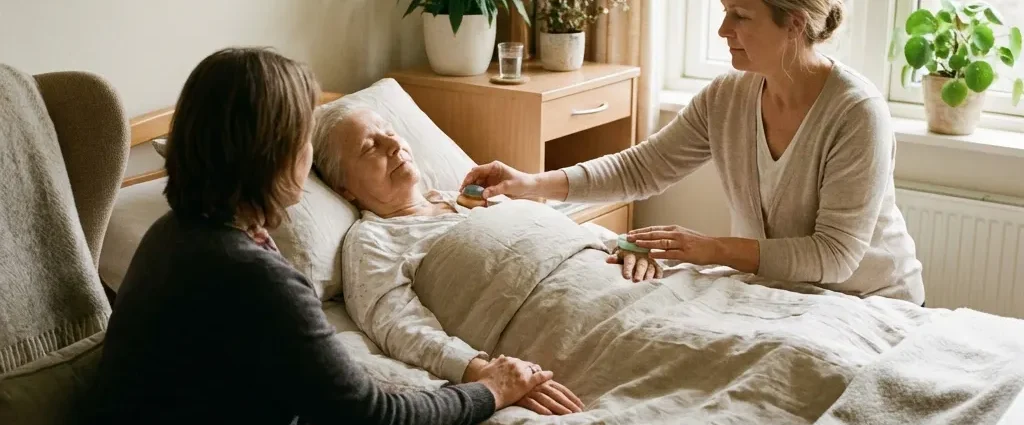
Palliative care practice shows that many people are open to new experiences, especially if they are not associated with pain or exertion. Frequency applications are often carried out with the patient lying down. The patient does not have to do anything. They are simply allowed to perceive.
This is also relieving for relatives. They experience that their loved one becomes calmer or sleeps better. These small changes have great significance. They create moments of closeness, hope and relief in an otherwise difficult time.
Basics of frequency therapy palliative care
Frequency therapy is based on the assumption that cells, tissues and organs react to electromagnetic vibrations. Every structure in the body has its own frequency. If this system is out of balance, complaints can arise. This approach can also be found in other complementary methods such as bioresonance or music therapy.
Palliative care is not about stopping or reversing pathological processes. Rather, the focus is on regulation. Frequencies are intended to calm the nervous system, change the perception of pain and release emotional tension. The focus is particularly on the parasympathetic nervous system, which is responsible for calm and regeneration.
Typical applications use low-frequency or high-frequency signals. These are transmitted via electrodes, coils or plasma technology. Many patients describe a feeling of warmth, tingling or deep relaxation. Some also report inner images or memories that emerge during the treatment.
It is important to adapt to the person's condition. The seriously ill often react more sensitively to stimuli. Low-dose, short applications are therefore preferred. Less is clearly more here, especially for weakened or very exhausted patients.
Experienced therapists report that regular, short sessions can be particularly helpful. They provide structure, convey security and create a recurring point of calm in the daily routine. Trust in the process is crucial. Further analyses of the Long-term effect of Solfeggio frequencies: Experiences after 6-24 months helpful to better understand long-term effects.
Pain perception and complementary pain relief
Pain is one of the central issues in palliative care. It is not only physical, but also emotional. Fear, grief and exhaustion intensify the perception of pain. Neuroscientific findings show that emotional stress can intensify pain signals in the brain.
Complementary palliative pain relief means addressing different levels simultaneously. Frequency therapy can make a contribution here by influencing the autonomic nervous system and reducing stress reactions. Many users report a subjective reduction in pain intensity or a changed assessment of the pain.
The aim is not to replace medication. Rather, frequency therapy can help to support the effect of existing measures. Some patients require lower doses or find the pain less threatening and omnipresent.
An in-depth look at the mechanisms of action can be found in the article Frequency therapy for chronic pain, mechanisms of action & applications. Many of the approaches described there can be carefully transferred to palliative care, particularly with regard to nervous system regulation.
The decisive factor is individual perception. What is pleasant for one person may be too much for another. This is why experience, empathy and close consultation with the patient and the team providing care are required.
Emotional support and inner peace through frequencies
In addition to physical symptoms, many seriously ill people suffer from inner restlessness, anxiety or depressive moods. Talking helps, but is not always enough. The body often stores emotions more deeply than words can reach. Especially in existential crises, some people withdraw inwardly.
Frequency therapy can create access here. Certain frequency ranges are experienced as calming. They promote relaxation, reduce stress levels and can strengthen the feeling of safety and security. This is particularly relevant in cases of nocturnal restlessness or anxiety.
In practice, there are often changes in sleep behavior. Patients fall asleep more quickly or wake up less frequently. The experience of inner peace, acceptance or reconciliation is also described. These effects are individual but recurring.
Especially in the last phase of life, such moments are precious. They allow farewell, reflection and closeness. Relatives report that conversations are calmer, emotional outbursts decrease and there is more space for silence.
This effect cannot be measured in the classical sense. It manifests itself in experience, in facial expressions, in breathing. And this is precisely what is of central importance in palliative care.
Frequency therapy for terminal oncological diseases
Many palliative situations arise in the context of advanced cancer. The burden here is often particularly high. Pain, fatigue, shortness of breath and emotional exhaustion go hand in hand. According to studies, up to 80 percent of terminal cancer patients suffer from relevant pain.
Frequency therapy is used cautiously in this context. The aim is not to influence the tumor process, but to alleviate accompanying symptoms such as tension, restlessness or sleep disorders. Transparency about goals and possibilities is essential.
Practical experience shows that frequencies can help to reduce tension and improve body awareness. Some patients report that they feel more like a person again and less like a patient, which boosts their self-esteem.
Further insights are provided by the articles on Breast cancer and frequency therapy and to Cervical cancer and frequency therapy. Even if these articles are not explicitly palliative in nature, they provide valuable background information on application and classification. In addition, the article Comparison of plasma devices 2026: RPZ 16 vs. M.O.P.A. contribute to technical orientation.
Role of therapists and alternative practitioners
The use of frequency therapy in palliative care requires specialist knowledge, experience and a sense of responsibility. Therapists must be able to realistically assess the patient's physical and mental condition and react flexibly.
Close cooperation with doctors and nursing staff is important. Transparency creates trust and prevents misunderstandings. Frequency therapy should be openly communicated, documented and integrated into the overall treatment plan.
Naturopaths with appropriate training can provide valuable input. They often have a holistic view and take time for discussions, which is not always possible in the hectic day-to-day running of a clinic.
A solid introduction to practical work is provided in the Practical guide for frequency therapy beginners, step by step described. Many of the principles mentioned there also apply in the palliative setting, but must be carefully adapted, particularly with regard to duration and intensity.
Boundaries, ethics and realistic expectations
As valuable as frequency therapy can be, it has clear limitations. It cannot cure illness or stop the dying process. Unrealistic promises are unethical and harmful, especially in a vulnerable phase of life.
Palliative care focuses on the autonomy of the individual. All treatment is voluntary and informed. The patient may stop or express changes at any time.
Contraindications must also be taken into account. Special care must be taken with certain implants, severe cardiac arrhythmia or unstable conditions. Professional expertise and a sense of responsibility are essential here.
Ethically responsible frequency therapy means not instrumentalizing people. Their experience, values and wishes count more than any method or theory.
Scientific classification and current research
Scientific studies on frequency therapy are continuing to develop. There are indications of effects in the areas of pain reduction, stress reduction and regulation of the nervous system. However, randomized studies are still limited.
For a more in-depth classification, we recommend the overview in the article Scientific study situation Frequency therapy 2026, current research & evidence. There, current approaches, results and methodological challenges are presented transparently.
Scientific modesty is particularly important in a palliative context. Not everything that works can be measured immediately. Nevertheless, every application should be reflected upon, documented and critically monitored in order to make experience systematically usable.
Dignity, closeness and gentle support until the end
In the end, palliative care is about humanity. Frequency therapy can be a tool to alleviate suffering and provide moments of peace. It does not replace care, but it can support and deepen it in a meaningful way.
For many of those affected, it is comforting to be able to actively do something for themselves without feeling overwhelmed. Relatives feel that they are not completely helpless, but that they can contribute something.
When frequency therapy palliative care is used with mindfulness, expertise and respect, it can be a valuable part of the last phase of life. Not loud. Not spectacular. But often deeply touching, dignified and humane.
Comments are closed, but trackbacks and pingbacks are open.