





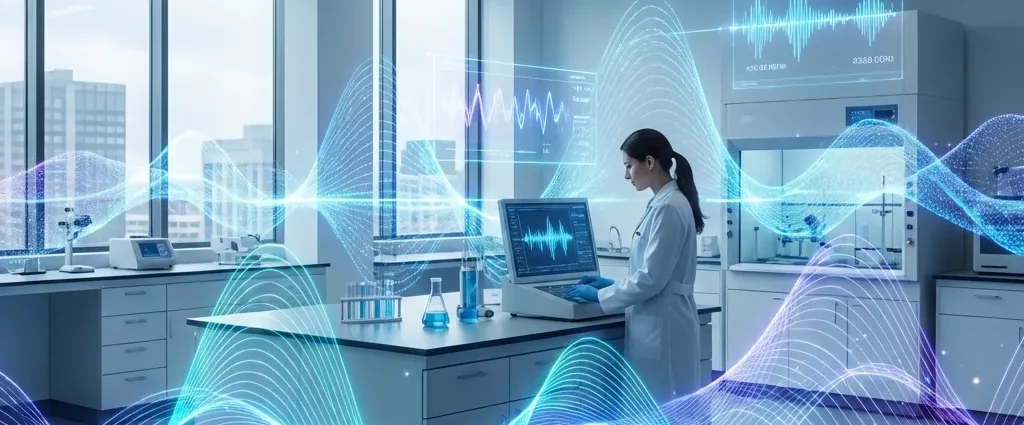
Many people feel that frequency therapy can make a difference. At the same time, there is great uncertainty. What is experience? What is science. And what can you really rely on in 2026. This is exactly where this article comes in. It classifies frequency therapy scientifically. Understandably. Practical. Without technical jargon.
The demand for scientific studies on frequency therapy has risen sharply. Alternative practitioners want to work with legal certainty. Therapists want to make well-founded arguments. Chronically ill people are looking for guidance. Especially in the case of autoimmune diseases, chronic pain or exhaustion. But many studies seem contradictory. Some show effects. Others do not. This causes confusion.
A core problem does not lie in frequency therapy itself. But in the study designs. Not every study can even show whether a frequency works. In 2026, it will be clearer than ever which scientific studies are really meaningful and which are not. This is exactly what we are looking at together.
You will learn what is actually meant by frequency therapy science. Which study designs are considered the gold standard. Why many frequency therapy studies fail. And how you can critically evaluate studies yourself. In the end, you will know which research is relevant. And how you can safely transfer this knowledge into practice.
What frequency therapy science is really investigating
In the public debate, frequency therapy often sounds like a standardized procedure. This is not scientifically correct. In research, we are not talking about a method, but about clearly defined physical interventions. Only these can be tested.
For example, high-frequency energy, pulsed electromagnetic fields, vibroacoustic stimuli or electrical neurostimulation are investigated. Each of these methods uses different frequency ranges, different intensities and different target structures in the body. This is crucial.
A clear rule applies to frequency therapy science in 2026. Only if a frequency can be physically measured, reproducibly applied and clearly described can it be scientifically investigated. Statements such as information fields or energetic signatures cannot be tested. They defy any study design logic.
In addition, the question of biological plausibility is increasingly coming into focus. Scientific research not only asks whether an effect is observed, but also how it could come about. Are there known mechanisms of action at cell level, for example via ion channels, membrane potentials or neuronal networks? Without such a theoretical framework, results remain difficult to classify.
This does not mean that experiences are worthless. But they do not belong in the realm of scientific studies. They provide hypotheses, not evidence. Mixing the two creates false expectations and undermines the credibility of the method in the long term.
Many serious research projects today work with objective measures. These include EEG, heart rate variability, functional imaging or standardized pain scales. These measurements are the only way to check whether a frequency therapy has any effect at all, how strong it is and under what conditions it occurs.
Which study designs will be considered the gold standard in 2026
Not every study has the same validity. There is a clear hierarchy of evidence in medicine. It shows which studies can be trusted. This is particularly important when evaluating frequency therapy studies.
| Rank | Study design | Significance |
|---|---|---|
| 1 | Systematic reviews of high-quality RCTs | Very high |
| 2 | Randomized placebo-controlled double-blind studies | High |
| 3 | Pilot RCTs with sham intervention | Medium |
| 4 | Observational studies and pre-post designs | Low |
| 5 | Case reports and user reports | Very low |
Systematic reviews are at the top of the list. They summarize several high-quality studies and evaluate them according to clear criteria. This is immediately followed by randomized controlled trials, or RCTs for short. They compare a real intervention with a sham treatment. Ideally double-blinded, so that neither subjects nor investigators know who is receiving which treatment.
2026 also applies: good studies are preregistered. This means that the research question, methodology and endpoints are publicly defined before the start. This prevents only positive results from being reported retrospectively. This procedure increases transparency and reduces bias.
Many works on frequency therapy do not reach this standard. This is no ill will. Often the budget is lacking. Or the technical ability to create a credible sham intervention. Blinding is particularly complex with physical stimuli.
Nevertheless, these limitations must be honestly stated. Studies with methodological weaknesses can provide indications, but not definitive statements. Anyone who sells them as proof is crossing a scientific boundary.
If you want to find out more about the valuation, you can find additional background information in the article Scientific study situation Frequency therapy 2026 - current research & evidence. It explains why seemingly contradictory results arise.
Why many frequency therapy studies do not provide clear results
A common misconception is that if a study shows no effect, frequency therapy does not work. It's not that simple. The problem often lies in the study design.
Many studies work with too small a number of participants, which makes it difficult to draw statistically reliable conclusions. Others use fuzzy endpoints or observation periods that are too short. Some only measure subjective perceptions without objective markers. Studies without sham interventions are particularly critical, as the placebo effect is strong, especially in the case of pain, sleep disorders or exhaustion.
Added to this is the high individual variability. People react differently to frequencies. If this heterogeneity is not taken into account, it dilutes possible effects. Modern studies therefore try to analyze subgroups or include individual parameters.
An example from complementary medicine clearly shows this. In a randomized pilot study, changes in heart rate variability were measured. The result was clear. The changes occurred independently of the intervention. This does not mean that frequencies have no effect. It means that this study was unable to demonstrate a specific effect.
This is important for practitioners. A single study is never proof. Only several well-done studies provide a consistent picture. Science thrives on repeatability, not on individual findings.
This is precisely why restraint when it comes to promises of healing is a sign of professionalism. It protects patients from false expectations and strengthens trust in reputable treatments in the long term.
In this context, it is also worth taking a look at Frequency therapy effect: What frequencies do in the body. There, plausible mechanisms of action are explained in an understandable way.
Neurostimulation is currently the strongest area of research in frequency therapy science
Neurostimulation is currently the most scientifically researched area of frequency therapy. This includes procedures such as transcranial alternating current stimulation, transcranial magnetic stimulation or deep brain stimulation. Frequencies are clearly defined, effects can be measured and study designs are comparatively easy to control.
Studies with individual frequency adaptation are particularly exciting. Experimental designs have shown that different frequencies influence different brain networks. Alpha, beta or theta ranges each show different functional effects. This is a major step forward compared to generalized approaches.
There is also reliable clinical data, for example for depression, chronic pain or neurological diseases. Meta-analyses show moderate but reproducible effects here. This puts exaggerated expectations into perspective, but confirms a real benefit.
We used magnetic resonance imaging to stimulate the brains of 20 healthy volunteers with specific frequencies and then measured what happened.
Such studies show how frequency therapy science can work. Clear research question. Controlled environment. Objective measurement. They do not promise a cure. But they do provide findings on which further research can build.
At this point, a video can help to make the basics understandable:
What official institutions say about the study situation
In addition to individual studies, assessments by independent institutes are important. They systematically analyze the available research and weight it according to quality. A key example is the assessment of radio frequency energy by a German federal institute.
One ongoing randomized controlled trial was identified which, on the basis of the available information, may be suitable to provide relevant findings on the benefits or harms of the method in the near future.
This statement is often misunderstood. It is not a rejection or a judgment on effectiveness. It soberly describes the state of research at the time of analysis. This is precisely the mission of such institutions.
International organizations such as the WHO and Cochrane are similarly cautious. They are calling for better studies, standardized protocols and clear endpoints. This is not a sign of skepticism towards frequencies, but an expression of scientific diligence.
For therapists, this means that anyone who wants to argue scientifically must understand this language. Careful wording is not a sign of weakness. They are a sign of seriousness and legal protection.
At the same time, such assessments open up opportunities. They show where there is a need for research and which issues will be relevant in the future. Practice and science can benefit from each other here.
Practical criteria for the evaluation of studies
So how can you judge for yourself whether a study is relevant? There are simple guiding questions. Firstly: Is the frequency precisely described? Secondly, is there a control group? Thirdly, was it blinded? Fourthly: Which endpoints were measured?
You should also check how large the sample was and whether a statistical power calculation was carried out. Small studies can overlook or overestimate effects. Conflicts of interest of the authors are also relevant.
Pay particular attention to objective markers. EEG, HRV or imaging are more reliable than pure questionnaires. Subjective data is valuable, but should be supplemented. The duration of the application also plays a role. Short-term studies say little about long-term effects.
For alternative practitioners, it is also important whether the intervention studied is similar to their own practice. Many laboratory studies work with devices or protocols that are not used in everyday life. These differences must be communicated honestly.
A practical context can also be found in the article Autoimmune diseases Frequency therapy: balance instead of suppression. It shows how scientific caution and therapeutic experience can come together. The article also offers Frequency therapy contraindications - when restraint is wise valuable orientation for safe use.
Future trends in frequency research until 2026
The science of frequency therapy continues to evolve. One clear trend is individualization. Instead of a fixed frequency for everyone, personal parameters are used, such as brain waves, heart rhythm or vegetative markers.
Adaptive systems are also gaining in importance. They adapt the frequency in real time to physiological feedback. Initial studies show that this could increase the strength of the effect. At the same time, the technical demands are increasing.
Multi-center studies are on the increase. Several research centers work together with identical protocols. This increases the informative value and improves reproducibility. At the same time, sham interventions are becoming increasingly sophisticated.
However, concepts without a physical basis are not being pursued. Concepts without measurability are slowly disappearing from serious publications. This is a healthy development in terms of scientific hygiene.
For users, this means that the gap between practice and science is narrowing. But it is not disappearing. Experience-based knowledge remains important. However, it is no substitute for evidence-based evaluation.
The essentials in a nutshell
Frequency therapy deserves a differentiated approach. Only clearly defined procedures with measurable parameters are scientifically meaningful. Good study designs are rare, but they do exist. In 2026, we will know better than ever what is important.
The most important points summarized once again. Firstly: Not every study is of equal value. Second: RCTs and systematic reviews are the benchmark. Third: Lack of evidence is not evidence to the contrary. Fourth: Honest communication creates trust.
Anyone who uses frequency therapy or is interested in it should learn to read studies critically. Ask about methodology, not just results. Combine research with experience without mixing the two.
Further in-depth content and practical classifications can be found at https://www.herbert-eder.com/. There, frequency therapy is not seen as a promise, but as a responsible approach. Furthermore, the contribution Frequency therapy 2026: Combination with bioresonance & magnetic fields an exciting addition for those interested in technology.
Frequency therapy Science does not mean knowing everything. It means asking the right questions. This is where the true art of healing begins.
Comments are closed, but trackbacks and pingbacks are open.