





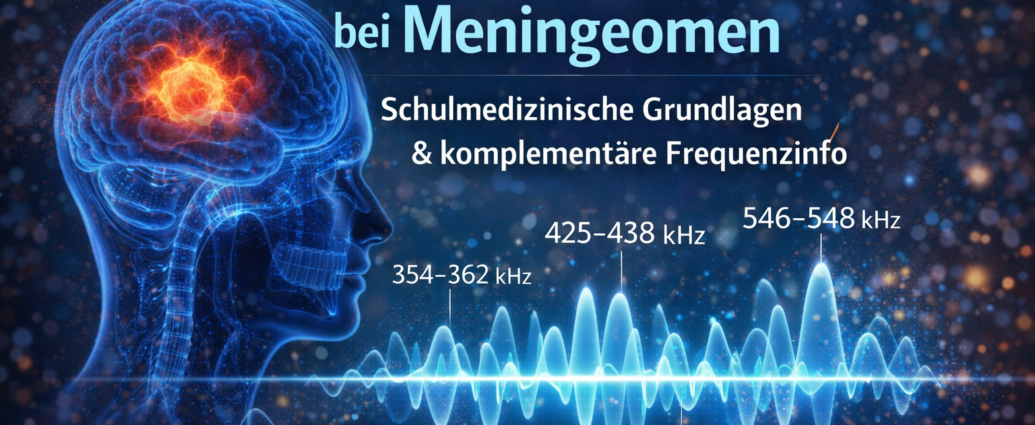
Conventional medical principles and complementary frequency information
Author: NLS Information medicine Ltd, Herbert Eder
Introduction
Meningiomas are among the best-known tumors in the central nervous system. They are described in the literature as frequent neoplasms that can occur both within the cranial cavity and in the area of the spinal canal. Although many meningiomas grow slowly, their clinical significance is considerable, as even a limited mass in the brain or along neural structures can lead to significant symptoms.
In conventional medical understanding, meningiomas are primarily characterized by their origin from the arachnoidal cover cells, their biological classification, their possible invasiveness and their positional relationship to the brain, spinal cord, bones and cranial nerves. At the same time, the topic is also important for the Frequency therapy of interest because certain complementary resonance areas are described in the literature, which are also considered in the context of information medicine.
The conventional medical aspects of meningioma are described in detail below. This is followed by the complementary frequency information with the resonance frequencies mentioned in the literature.
What is a meningioma?
A meningioma is a Tumor, which originates from cells in the arachnoid layer. These cells are located in the arachnoid layer, which surrounds the surface of the brain. In the literature, meningiomas are described as tumors that can occur on the surface of the brain, over the convexity, at the base of the skull, in the area of the spinal canal and, in rarer cases, intraventricularly or intraosseously.
The particular challenge with meningiomas is that the arachnoid cells can exhibit both mesenchymal and epithelial characteristics. This makes the exact classification of individual tumor forms challenging. In addition, similar neoplasms such as hemangiopericytomas or sarcomas can arise from other mesodermal structures, which can make differential diagnosis more difficult.
It is therefore very important for modern medicine to be able to distinguish precisely between a clear-cut meningioma and other, less clearly defined brain neoplasms. Molecular biological examinations play an important role in this in order to identify genetic changes and tumor biological characteristics more precisely.
Development and possible causes of a meningioma
The development of meningiomas is complex. The literature mentions various factors that can be involved in the development. These include mechanical influences, previous exposure to radiation, combined viral exposure and genetic predispositions.
Particular attention is paid to certain genetic changes. The best known is the loss of the NF-2 gene on the chromosome segment 22q. This gene codes for a tumor suppressor protein. If this protective function is lost, tumor growth can be promoted. In addition, the loss of chromosome 10 is associated with a higher tumor grade, a shorter time to recurrence and a less favorable survival situation. Progression towards an anaplastic meningioma is also associated in the literature with the area of 17q associated.
The invasiveness of individual meningiomas also depends on biological regulatory mechanisms. Of importance is the relationship between Matrix metalloproteinases (MMPs) and their Tissue inhibitors (TIMPs). This balance can influence the extent to which a tumor invades surrounding structures.
Another interesting aspect is the hormonal component. As meningiomas are more common in women and some tumors have receptors for oestrogen, progesterone and androgens, the literature also describes a link between hormones and the risk of meningiomas.
Viral connections in meningiomas
Viral factors are mentioned several times in the literature in connection with meningiomas. The following are mentioned in particular SV-40, Adenoviruses and HPV. These relationships are primarily considered in the context of complex multi-factor models in which genetic disposition, tissue changes and biological stress interact.
This area is particularly interesting for frequency therapy because not only the tumor tissue itself can be considered here, but also possible accompanying biological components. Within information medicine, this results in an expanded model of thought that considers structure, regulation and frequency patterns together.
Localization of meningiomas
Meningiomas can occur at very different locations. Typical localizations are
- the brain surface above the convexity
- the base of the skull
- the spinal canal
- Rarely intraventricular areas
- Rarely intraosseous structures
According to the literature, preferred regions for children include
- the orbit
- the temporal region
- the foramen magnum
- the Tentorium region
- the subfrontal base
- the Sella region
- the ethmoidal air sinuses
Meningiomas in children are often described in the literature as biologically more aggressive. They can grow faster, become larger, show more malignant changes and recur more frequently than corresponding tumors in adulthood.
The different types of meningioma
The behavior of meningiomas is divided into three main groups in the literature.
Benign meningioma (grade I)
The benign form usually grows more slowly and does not invade the brain parenchyma. Nevertheless, it can infiltrate neighboring bony structures and cause considerable discomfort as a result of its mass.
Atypical meningioma (grade II)
This form is considered to grow more aggressively and has a higher tendency to relapse. Biologically, it is between benign and highly malignant forms.
Malignant meningioma (grade III and IV)
The malignant form is much rarer, but shows invasive growth in the brain tissue and histological signs of malignancy. A recurrence rate of over 70 percent is described in the literature. The papillary forms in particular, which can mainly affect children, are considered aggressive.
A term used in the past is the angioblastic meningioma. Today, this entity is more clearly differentiated from the classic meningioma and is referred to as Hemangiopericytoma a sarcoma with a high tendency to recur and metastasize.
Symptoms of a meningioma
The symptoms of a meningioma depend greatly on its location, size, rate of growth and involvement of adjacent structures. The most important mechanisms include
- Increased intracranial pressure
- Involvement of cranial nerves
- Compression of the brain tissue
- Involvement of bone and subcutaneous tissues
Consequences of increased intracranial pressure
Increased intracranial pressure can lead to Papilledema, mental alertness, impaired concentration and, in extreme cases, even to a Herniation of brain tissue lead.
Involvement of cranial nerves
When cranial nerves are affected, a variety of neurological deficits can occur, including:
- Loss of odor
- Visual field defects
- Optic atrophy
- Double images
- Reduced facial sensitivity
- Facial nerve palsies
- Hearing loss
- Uvuladeviation
- half-sided tongue atrophy
Compression of the brain parenchyma
Pressure on the surrounding tissue can cause pyramidal tract-related signs, for example:
- Pronator drift
- Hyperreflexia
- Positive Hoffman sign
- positive Babinski sign
Meningioma of the optic nerve sheath
A special form is the Optic nerve sheath meningioma. It arises either from the arachnoid cells around the intraorbital or intracanalicular optic nerve or spreads from an intracranial meningioma into the orbit.
Typical complaints are
- painless progressive loss of vision
- Proptosis
- Exophthalmos
- Headache
- Reduced visual acuity
- Ptosis
- Diplopia
This form in particular shows how strongly a meningioma can affect functionally highly sensitive structures.
Diagnostics for meningiomas
The diagnosis of a meningioma is based on clinical symptoms and modern imaging. Specific laboratory screening tests are not described in the literature. The following methods in particular are used for precise imaging:
CT
The Computer tomography provides important information on location, size, bony involvement and space occupation.
MRI
The Magnetic resonance imaging is particularly valuable for the detailed visualization of meningiomas. It shows the relationship of the tumor to brain tissue, meninges, vessels and cranial nerves.
EPM
EPM is also mentioned in the literature.
Biopsy
In selected cases, histological confirmation by Biopsy or after surgical removal.
Meningiomas are often surrounded by a thin capsule of adjacent meninges and are thus relatively clearly demarcated from the brain and spinal cord.
Differential diagnosis
In the conventional medical differential diagnosis, meningiomas must be differentiated from other lesions, especially if focal hyperostoses are present. These include, among others:
- Osteomas
- Paget's disease
- Neurosarcoidosis
- Tuberculosis
- Lymphomas
- fibrous dysplasia
This differentiation is important because further treatment depends heavily on the exact type of tumor.
Conventional medical treatment of meningiomas
The therapy depends on the location, tumor size, growth, biological behavior and symptoms. Various conventional medical approaches are described in the literature.
Surgical resection
Surgical removal is often the most important treatment, especially if the tumor is accessible and the anatomical situation allows it.
Radiotherapy
It is particularly suitable for atypical or malignant tumors that have not been completely removed.
Chemotherapy
It can be used as a supplement in certain situations.
Symptomatic treatment
Depending on the clinical picture, the following measures may be necessary:
- Antiepileptic drugs
- Hydroxyurea
- IFN-alpha
- Corticosteroids to reduce the edema
Incompletely removed, multiple and malignant tumors show an increased likelihood of recurrence. The prognosis is much more favorable for completely resected tumors.
Why meningiomas are of particular interest for frequency therapy
Meningiomas are particularly interesting for frequency therapy for several reasons. Firstly, it is a form of tumor with a clear spatial relationship to the meninges, nerves, vessels and bone structures. Secondly, the literature points to additional biological factors such as viral loads, genetic changes and hormonal influences. Thirdly, meningiomas range from slow growth to highly aggressive forms.
Within frequency therapy, therefore, not only the tumor itself is considered, but also the surrounding regulatory field. Information medicine asks whether structural and functional characteristics can also be represented as resonance patterns. This is precisely where complementary frequency information comes in.
Frequency info - complementary resonance frequencies for meningiomas
In the literature Meningiomas following Complementary resonant frequencies called:
338, 344, 354-362, 379, 390, 406, 425-426, 428-438, 448-449, 480, 546-548 kHz
These frequency ranges are used within frequency therapy as complementary frequency info understood. Several resonance clusters that can be grouped into superordinate frequency fields are striking.
Early resonance ranges
- 338 kHz
- 344 kHz
These values mark early individual frequencies within the literature data.
Medium resonance field
- 354-362 kHz
- 379 kHz
- 390 kHz
- 406 kHz
This range forms a condensed medium frequency space, which is of particular interest within the complementary frequency analysis.
Central resonance zone
- 425-426 kHz
- 428-438 kHz
- 448-449 kHz
- 480 kHz
This shows a clear focus in the higher mid-kilohertz range. This compression is particularly relevant within frequency therapy because it indicates a larger resonance field.
Upper finishing area
- 546-548 kHz
This upper frequency range forms a striking end to the resonances of the meningioma mentioned in the literature.
Frequency info compact
Meningioma - complementary resonance frequencies:
338, 344, 354-362, 379, 390, 406, 425-426, 428-438, 448-449, 480, 546-548 kHz
Classification of the complementary frequency ranges
For frequency therapy, the condensed areas between 354 and 362 kHz, 425 to 438 kHz and 546 to 548 kHz of particular interest. Within information medicine, such clusters are often understood as resonance spaces in which complementary tissue information is bundled.
This perspective is particularly exciting in the case of meningiomas because the tumors are located at an interface between the nervous system, meninges, bones and vascular structures. The complementary frequency information is therefore not considered in isolation, but as part of an extended resonance image.
Conclusion
Meningiomas are among the most important tumor forms of the central nervous system and show a wide range from slow-growing benign findings to aggressive malignant progression. For conventional medicine, the focus is on precise imaging, neurosurgical assessment, histological confirmation and individually tailored therapy. Location, invasiveness, tendency to recur and the influence on intracranial pressure, cranial nerves and surrounding tissue are decisive factors.
The topic of meningioma also opens up a complementary perspective for frequency therapy. The resonance ranges described in the literature provide frequency information that can be considered in the context of information medicine. The clusters in the middle and upper kilohertz range in particular make it clear that meningiomas are also of great interest on a complementary frequency level.
The result is an in-depth look at meningiomas that combines conventional medical principles and frequency therapy in a structured presentation.

Comments are closed, but trackbacks and pingbacks are open.