




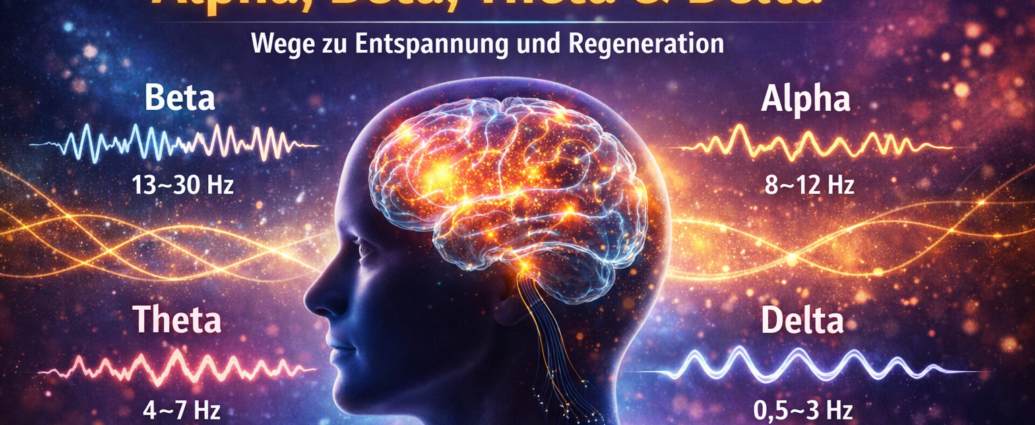
Our brain is never „off“. Even when we sleep, it works in characteristic rhythms - the so-called Brain waves or Brain frequencies. These rhythms can be measured as electrical activity patterns (e.g. by EEG) and are associated with states such as concentration, relaxation, meditation and deep sleep.
In this article you will get a clear overview of Beta, Alpha, Theta, Delta (plus gamma) - and why this knowledge is interesting when dealing with Stress regulation, sleep quality, regeneration and also Frequency therapy approaches busy.
What are brainwaves anyway?
Brain waves are rhythmic fluctuations in electrical activity in the brain. They are usually described by their Frequency (Hertz, Hz) - i.e. how many oscillations occur per second. Important: There is rarely „just one“ frequency. Usually one range dominates, while others are active in parallel.
Mnemonic:
- Faster waves → more alertness, thinking, performance
- Slower waves → more rest, sleep, regeneration
The most important brain frequencies at a glance
Beta (approx. 13-30 Hz): Alert, focused, performance-oriented
Beta dominates everyday life: when working, planning, speaking, making decisions.
Positive: Concentration, problem solving, responsiveness.
Too much beta is often associated with Stress, inner restlessness, „racing thoughts“ and superficial sleep.
Typical situations:
- Working through to-do lists
- Meetings, driving, learning
- Mental tension
Alpha (approx. 8-12 Hz): Relaxation with clear consciousness
Alpha is the „relaxation mode“: calm but awake. Many people experience alpha when walking, daydreaming or just before falling asleep.
Alpha can help with:
- Stress reduction and mental recovery
- creative ideas
- Transition into meditation
Typical situations:
- calm breathing, mindfulness
- light meditation
- Relaxed reading without pressure
Theta (approx. 4-7 Hz): Deep relaxation, trance, creative access
Theta often occurs in deep meditation, in the sleep phase or in states in which the subconscious „kicks in“ more strongly.
Theta is often associated with :
- emotional processing
- Intensive imagination and creativity
- Transitions between wakefulness and sleep
Typical situations:
- shortly before falling asleep
- deep meditation, trance states
- „Flow“ in creative processes
Delta (approx. 0.5-3 Hz): Deep sleep and physical regeneration
Delta is the classic area of the Deep sleep. Many regeneration processes take place during this phase: Tissue formation, immune system activity, hormonal regulation.
Delta is important for:
- Physical recovery
- Immune system and repair processes
- Stabilization of energy and resilience
Typical situations:
- Deep sleep (non-REM, „slow-wave sleep“)
- Rarely when awake (except in very deep meditative states)
Gamma (approx. 30-80+ Hz): Integration, peak performance, „aha moments“
Gamma is often associated with Information integration, learning processes and „highly coherent“ states. It is less a „relaxation area“ and more a marker for networked processing.
Typical situations:
- Intensive learning
- Complex problem solutions
- sudden insights
Why this is relevant for sleep, stress and regeneration
Many complaints in modern everyday life indirectly revolve around an imbalance between „gas“ and „brake“:
- too much permanent tension (lots of beta)
- too little genuine relaxation (alpha/theta)
- Too little deep sleep (delta)
If you know something like this more often:
- „I'm tired, but my head is awake“
- Falling asleep works, but not sleeping through the night
- Recovery never feels complete
... then it's worth taking a look at sleep hygiene, stress management and relaxation routines.
Practical ways to promote alpha/theta (without technology)
Here are a few simple methods that work well for many people:
1) Breathing rhythm (3-5 minutes)
- Breathe in for 4 seconds
- Exhale for 6-8 seconds
- Focus only on the exhalation
2) Body scan
- Attention slowly from the toes to the head
- Consciously „let go“ of areas“
3) Evening stimulus reduction
- No „dopamine fireworks“ 60-90 minutes before sleep (Shorts, News, Social)
- warm light, calm music, routine
4) Thought parking lot
- 10 lines: „What is open?“ + „What will I do with it tomorrow?“
This relieves the working memory.
And what does this have to do with frequency therapy?
In information medicine and in various complementary approaches, it is discussed whether external stimuli (e.g. light, sound, rhythmic impulses) can help the organism to get into Regeneration states to find.
Important here:
- Brain waves are Measurement phenomena - they indicate states, they are not „a switch“.
- In practice, frequency-based applications are usually accompanying used: for relaxation, to support sleep, to reduce stress, to promote well-being.
People who are under a lot of stress or in phases of intensive regeneration are often asked:
„How can I get my nervous system back into a calmer mode?“
Alpha/theta-oriented relaxation strategies (with or without additional stimuli) are a common approach here.
A sensitive point: cancer, stress and regeneration
For serious illnesses such as Cancer diseases regeneration is a key issue. Sleep, stress levels, mental stability and resources can play a major role in quality of life. At the same time:
- Frequency therapy is often used in this context as Supporting measure discussed (e.g. for relaxation).
- Diagnostics and therapy decisions however, belong in the hands of the attending physicians.
If you are in an oncological situation: Focus first on safe, evidence-based steps - supplementary methods (breathing, sleep, relaxation, accompanying procedures) should always be coordinated and responsible.
FAQ: Frequently asked questions about brain frequencies
Can I „force“ alpha or theta?
Rather not like a switch. But you can create conditions that make these states more likely: calm breathing, lack of stimuli, routine, relaxation.
Are more delta waves automatically better?
Not across the board. The decisive factor is a healthy sleep structure throughout the night (deep sleep + REM + light sleep) and how restful you feel.
Why am I tired in the evening but can't sleep?
The body is often tired, but the nervous system remains in active mode (lots of beta). Rituals, light management and breathing help many people.
Conclusion
Alpha, theta and delta are symbolic of calm, transitions and regeneration - Beta for performance and alertness. The aim is not to „chase“ a frequency, but to achieve a healthy change between activity and relaxation.
If you want, I can help you too:
- one 2-week evening routine (5-12 minutes),
- or the contribution as SEO-optimized site/landing page version rework.
Disclaimer
Frequency therapy is not recognized by conventional medicine. It does not replace diagnosis or treatment by trained doctors or alternative practitioners and is not intended as a substitute for medical therapies. In the event of complaints or illnesses (especially cancer), please consult a medical professional.

Comments are closed, but trackbacks and pingbacks are open.