





A historical view from a technical and frequency medicine perspective
hen Herbert Eder, frequency expert in the field of Information medicine, I find historical devices particularly exciting when they show how early people tried to combine health, vibration and technology. One of the best-known names in this context is Georges Lakhovsky. His multi-wave oscillator, usually called MWO for short, has retained a certain fascination to this day.
It is important for me to make a clear distinction: Historical significance is not the same as modern proof of efficacy. This is precisely why it is worth taking a closer look. The multi-wave oscillator is an interesting piece of technology and medical history, especially in the context of frequency ideas, resonance concepts and early hopes in connection with serious illnesses such as cancer.
Executive Summary
In the first half of the 20th century, Georges Lakhovsky developed the idea that living cells could be understood as a kind of electromagnetic resonator. In his thinking, disease appeared as a disturbance of a natural oscillation balance. This hypothesis was taken up and disseminated in his time, but does not correspond to the current state of evidence-based clinical medicine.
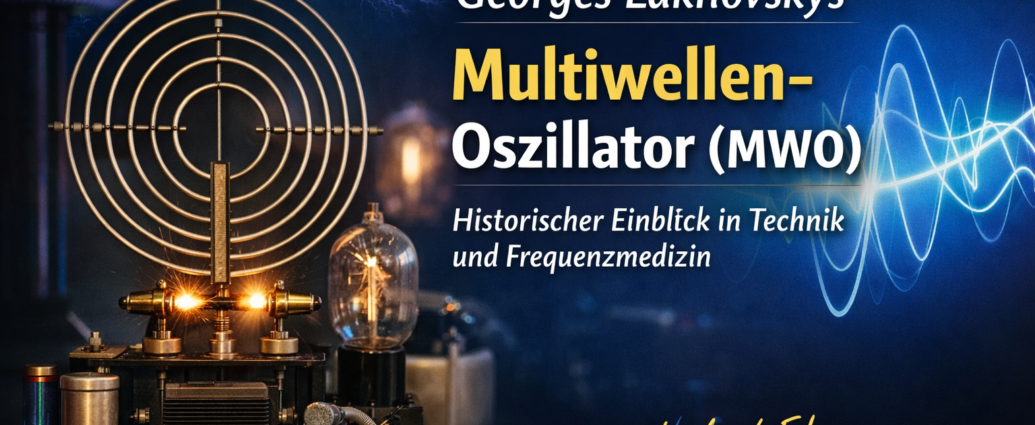
Technically speaking, the multi-wave oscillator is based on high-frequency generation with a transformer, interrupter, capacitor, spark gap and ring-shaped resonator elements. Lakhovsky wanted to generate a field of many wavelengths that would have a harmonizing effect on biological systems.
Historically, the concept is extremely interesting. At the same time, the sources show that many technical statements were formulated in very broad terms, while there is a lack of reliable, documented evidence of measurement and effectiveness by today's standards. Later measurement reports also indicate that specific devices could work in very different ways.
From today's perspective, it can be said that the MWO is a fascinating historical frequency device, but its therapeutic claims - especially in connection with cancer - are not backed up by modern clinical evidence. In addition, there are clear safety and legal issues.
Historical context and timeline
The time before Lakhovsky
The multi-wave oscillator did not come out of nowhere. Even before Lakhovsky, there were numerous devices that worked with high frequency, Resonance, discharges and electric fields. Especially around d'Arsonval, Oudin coils and Tesla-inspired constructions, the idea that electricity and high frequency could be used therapeutically was widespread.
This phase was a mixture of scientific curiosity, technical innovation and medical hopes. It is precisely in this cultural and technical environment that Lakhovsky's thinking must be placed. His work fits into an era in which electromagnetic phenomena were often interpreted not only in physical terms, but also in terms of the philosophy of life.
Timeline of the most important stations
High-frequency electrotherapy devices were already known and documented in Europe between 1890 and 1920.
In 1925, a report entitled „Curing Cancer with Ultra Radio Frequencies“ was published, which took up early ideas of Lakhovsky and his predecessor concept. Statements about very high frequencies and applications in connection with cancer already appear here.
In 1927, Lakhovsky published his work „Contribution à l'étiologie du cancer“.
This was followed in 1929 by „Les ondes qui guérissent“.
The priority of the central patent family was registered in 1931.
The British patent GB400257A appeared in 1933.
US patent 1,962,565 was granted in 1934. The German-language publication „Der Multiwellen-Oszillator“ also dates from this time.
In 1940, a contemporary review appeared in Nature that summarized Lakhovsky's resonance hypothesis.
Device design and basic technical principle
Structure according to patent situation
The central US patent describes a device that is intended to generate electric fields with several wavelengths. At its core, it consists of two sections: a high-frequency generation unit and a radiation or radiator section.
The generating unit works with typical elements of the high-voltage technology of the time: transformer, Trembler interrupter, capacitor, spark gap and coils. The second section consists of several concentric, open metal rings insulated from each other.
The technical goal was to generate not just a single frequency, but a mixture of different wave components. This idea was central to Lakhovsky. From his point of view, it was precisely this multi-wave effect that was to be particularly biologically effective.
The importance of the ring structure
The ring elements are not a decorative detail, but the actual core of the MWO concept. The patents describe open rings of different sizes with staggered interruptions. In some cases, small spherical end pieces are also mentioned, which are intended to have a capacitive effect.
From today's perspective, one could say that Lakhovsky combined momentum generation, resonance structure and geometric diversity to create a system that was intended to generate complex field behavior. Historically, this is an interesting approach. However, whether the biological effects he claimed follow from this is another question.
Spark gap and multiwave principle
The spark gap is crucial for understanding. It acts as a non-linear switch and generates pulse-like, broadband oscillation processes. This explains why Lakhovsky spoke of a device with many wavelengths.
To put it kindly: The basic idea is technically comprehensible if you only consider the bandwidth of the stimulated processes. However, this does not mean that the frequency components emitted were properly controlled, specifically dosed or biologically selective. This is precisely where the distance between the historical concept and modern assessment begins.
Patents and primary sources
The most important patent
The most important document is US patent 1,962,565, which describes the ring radiators, the open splits, the end balls and the combination of spark gap, capacitor and inductor. This patent is the central source for the technical reconstruction of historical thinking.
There is also a British patent specification of the same family, GB400257A. It confirms that Lakhovsky's concept was internationally disseminated and seriously patented. References to Belgian and French family members complete the picture, even if not all full texts are equally easy to find.
The books of Georges Lakhovsky
His books are particularly important for the history of ideas. In „Contribution à l'étiologie du cancer“ and „Les ondes qui guérissent“, Lakhovsky combines biological, physical and therapeutic interpretations. Especially in the context of cancer, it becomes clear how strongly his frequency theory was embedded in a comprehensive explanation of life and disease.
The German-language publication „Der Multiwellen-Oszillator“ is particularly valuable because it directly describes the device itself, its antenna arrangement and the claimed frequency ranges. Anyone who wants to understand Lakhovsky's point of view can hardly avoid this text.
Historical frequency claims
The early statements
As early as the 1920s, Lakhovsky made statements about very short wavelengths or high frequencies. In connection with a predecessor device, there is talk of wavelengths of around two meters, i.e. approximately 150 MHz. This is a remarkable historical statement.
Lakhovsky later formulated his claims much further. In the German-language publication on the multi-wave oscillator, he speaks of fundamental wavelengths between 10 centimetres and 400 meters. This would result in a very wide range of approximately 3 GHz to 0.75 MHz. He also mentions harmonic components up to the infrared range and even up to visible light.
How to classify these statements today
I think it makes sense to formulate this in a friendly but clear manner: These statements belong to the historical source and are therefore to be taken seriously - but initially as assertions of their time. They show how comprehensively Lakhovsky understood the potential of his device. However, they do not yet prove any modern metrological or therapeutic validation.
Especially in the world of Frequency therapy it is important not to prematurely equate historical statements with today's proven evidence. The MWO remains an exciting document of frequency history, but not automatically proof of clinical efficacy.
Measurement data, reconstruction and technical plausibility
Why concrete values are difficult
One major difficulty is that the primary sources leave many details open. Ring diameters, gap widths, exact capacitance values, real voltages or specific performance data are not consistently stated in the way that would be expected for a reliable technical reproduction today.
This is why every reconstruction is always an interpretation project. Different reconstructions can differ considerably. Even small changes in geometry, distance, coupling or environment can significantly influence the behavior.
Subsequent measurement reports
Later secondary measurements on MWO-like devices show some dominant regions in the kHz spectrum, around 200 kHz. This is interesting because it indicates that real devices do not necessarily produce the entire historically claimed spectrum with equal relevance.
Such measurements are helpful, but should be read carefully. They refer to specific superstructures, not automatically to every historical original. They can provide clues, but are no substitute for complete source criticism.
Plausibility from a geometric point of view
From a technical point of view, it is not implausible that ring structures of a certain size can be related to resonance phenomena in the MHz range. This makes it understandable why Lakhovsky came up with frequency concepts in the high-frequency and short-wave range.
But here too, geometric plausibility is not the same as proof of therapeutic effect. A serious evaluation requires more than just a suitable order of magnitude.
Cancer, resonance and therapeutic claims
Why the topic of cancer is so central to Lakhovsky's work
Lakhovsky linked his theory very strongly to the subject of cancer. In his writings, cancer appears not only as a disease, but also as an expression of a disturbed energetic or electromagnetic state of the organism. This is precisely why he believed that he could exert a harmonizing influence with suitable frequency fields.
Historically, this is understandable: at a time when many disease mechanisms were still unclear, the resonance idea offered a seemingly elegant and comprehensive explanation. From today's scientific perspective, however, this model is not sufficient to reliably explain or treat cancer or other complex diseases.
True to the source, but cautious assessment
As a frequency expert, I find it important to read historical pioneers with respect. Lakhovsky was undoubtedly an original thinker. Nevertheless, we should make a clear distinction between innovative spirit and demonstrable effectiveness. His texts document hope, theory and technical creativity - but they do not document modern clinical evidence that the multi-wave oscillator can effectively treat cancer.
Particularly in the case of serious illnesses, language needs to be used with special responsibility. It therefore makes sense to openly name the historical cancer references, but not to make any promises that go beyond this.
Modern criticism and scientific classification
The question of biological resonance
Lakhovsky's central idea was that cells or groups of cells could resonate with certain electromagnetic oscillations and thus be disturbed or harmonized. This image is fascinating and has influenced many later frequency concepts.
At the same time, biological matter is complex, lossy, electrically conductive and cannot be equated with a simple, narrow-band resonator. Modern biophysical considerations take a much more sober view of the matter. This does not mean that electromagnetic fields are biologically irrelevant - but Lakhovsky's simple resonance logic is not considered a reliable therapeutic basis today.
Historical significance remains
Trotz dieser Kritik bleibt Lakhovskys Werk historisch bedeutsam. Es zeigt, wie tief die Idee von Schwingung, Resonanz und Ordnung in die frühe Frequenztherapie eingewoben war. Wer die History der Frequenztherapie verstehen möchte, kommt an Lakhovsky kaum vorbei.
Security
Why particular caution is required here
The multi-wave oscillator is based on high voltage and spark discharges. This entails considerable risks: electric shock, HF burns, fire hazard, ozone formation and electromagnetic interference. For this reason alone, it is important to view the device primarily as a historical object and not as something that should be reproduced uncritically in practice.
Implants and sensitive environments
Such systems would be particularly problematic in the vicinity of sensitive electronics or medical implants such as pacemakers. Residential environments or uncontrolled rooms are also unsuitable for such high-frequency and high-voltage applications.
Legal classification in the EU
Medical device law
As soon as a device is advertised with claims for the treatment, alleviation or diagnosis of diseases, it may fall under the European Medical Device Regulation. This applies in particular if therapeutic claims are made in connection with diseases such as cancer.
Radio, EMC and product safety
Requirements from the Radio Equipment Directive, the EMC Directive and general product safety also come into play. Radio-based high-frequency systems are particularly sensitive from a regulatory perspective because they not only pose safety risks, but can also cause electromagnetic interference.
Conclusion from Herbert Eder
For me, Georges Lakhovsky's multi-wave oscillator is a fascinating chapter in frequency history. The device combines technical creativity, historical hope, resonance thinking and early ideas of electromagnetic influence on biological processes. The MWO therefore has a special place in the field of frequency therapy and its history.
At the same time, a friendly but clear classification is important. The historical value of the device is undisputed. However, the therapeutic claims - also in connection with cancer - cannot be regarded as clinically proven from today's perspective. Anyone studying Lakhovsky should do so with an open mind for historical ideas, but also with scientific sobriety, an awareness of safety and respect for the limitations of the sources.
If we take frequency history seriously, then not only as a collection of fascinating devices, but also as an invitation to make a clear distinction between inspiration, hypothesis and verified knowledge. For me, this is precisely where the real value of such topics lies.

Comments are closed, but trackbacks and pingbacks are open.