




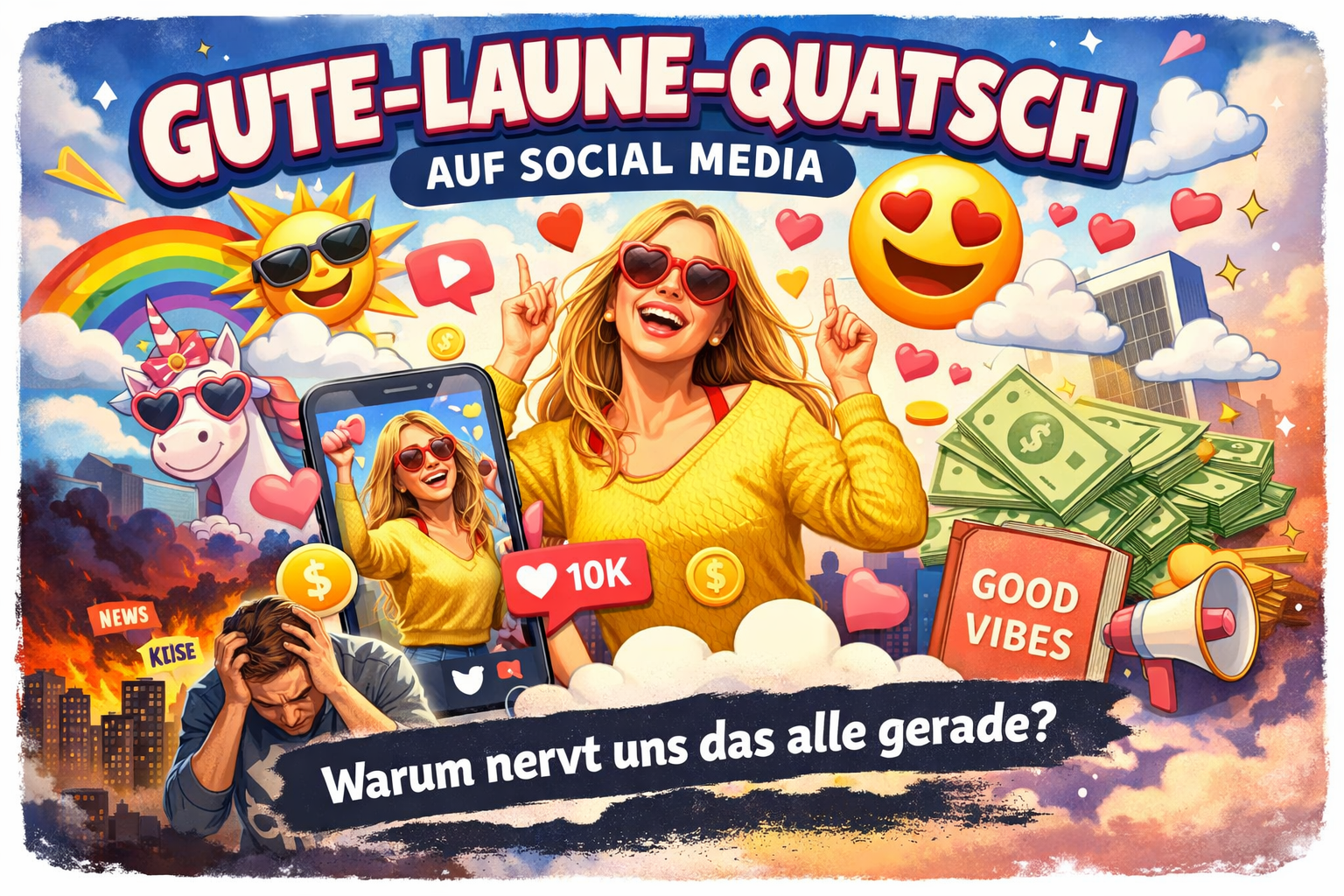
You scroll briefly through Instagram Reels, TikTok or YouTube Shorts - and bang: Smile, affirmations, „You just have to think positive“, manifestation, gratitude, morning routines, a perfect sunrise and a song that sounds like „everything will be fine“. And yes, sometimes that feels good. But often it feels like Frosting on a world that doesn't taste like frosting right now.
Many people now call this „good mood nonsense“. Not because a good mood is bad - but because this kind of permanent positivity is often assaultive, fake or too simple works. If this annoys you, you're not „too negative“. You're probably just too awake for a system that does not cope well with complexity.
In this article, we look at why this trend is emerging on such a massive scale right now, what it means psychologically and culturally - and which Actual question is behind your annoyance.
Why this „good mood nonsense“ is popping up everywhere right now
1) Algorithmic logic: positive performs better (and friction performs best)
Social media platforms don't reward truth, depth and fairness - they reward Attention. And attention is generated particularly reliably by content that:
- can be understood quickly (in 1-2 seconds),
- trigger a clear emotion,
- do not need any previous training,
- „are “shareable„ (“I'll send it on quickly"),
- and ideally Briefly relieve.
Good mood content works perfectly for this. It is Easy to consume, creates a „brief feeling of being better“ and often leads you straight to the next clip. Even if you're rolling your eyes inside, you'll still get stuck. And that's what counts.
What's more, positivity usually has a „soft“ surface. Fewer arguments, fewer comments with counter-arguments - but more likes, more saves, more „omg needed this“. This can be an advantage algorithmically. And if the algorithm notices: That keeps people on the platform, then - to put it simply - it is played out more strongly.
In short: It appears everywhere because it „works“ in the system.
2) Psychological escape: When the world is too loud, simple messages become a life raft
We live in a constant barrage of news, crises, pressure, comparison and accessibility. Many people are mentally exhausted without being able to put their finger on it. In such a state, a „good mood“ works like a Psychological painkillernot curative, but relieving in the short term.
- The brain loves simple answers when it is overloaded.
- The nervous system seeks security - and security is often associated with Control mixed up.
- Positivity formulas convey control: If I just think right, it will be good.
That is understandable. And sometimes helpful. The problem begins where „helpful“ becomes a „must“.
Because then subliminally:
„If you're sad, angry or exhausted, you're doing something wrong.“
And that can be very hurtful - especially for people who are dealing with real loss, illness, excessive demands or existential issues.
3) Commercial interests: A good mood is a business model
Good mood content is not just a trend - it is also a Market.
He sells himself because he:
- appeals to as many people as possible,
- hardly offends,
- names a „problem“ („you're not happy enough“),
- and offers a solution („I'll show you how“).
This results in products and funnels: Coaching programs, journals, challenges, memberships, courses, supplement ads, affiliate links, retreats, „high-vibe“ merch. Often it's not even malicious - it's just marketing logic: If you feel incomplete, you are more likely to buy.
And the more commercial a topic becomes, the greater the temptation to simplify it. Because simplicity scales better than truth.
4) Emotional contrast: The more drama in the feed, the stronger the opposite effect
Social media is often a rollercoaster ride:
Disaster news, political anger, scandals, ragebait, body comparisons, relationship dramas - and everything in between: „Smile! Life is beautiful!“
This creates a stark contrast, and contrast attracts attention. Some accounts are therefore deliberately „the bright counterweight“. This can feel like a relief - until it tips over and looks like Displacement works.
A typical example: You see a clip about illness, war, loss - and the next video is:
„If you're not shining today, you're choosing the wrong reality.“
It's not just annoying. It can feel like a emotional slap in the face feel.
5) Social media culture: superficiality as standard (and depth as a risk)
Depth is slow. Social media is fast.
Depth often means:
- Enduring contradictions,
- Allow ambivalence,
- Explain the context,
- Let feelings stand side by side („I hope“ and „I am afraid“),
- do not deliver a clear punch line.
This is difficult for platform logic. Because the platform does not ask: Is that consistent?
She asks: Will you stay tuned?
Then there is the culture of self-dramatization: many post positivity not only as a message, but as a Status symbol:
„Look, I've got my life under control. I'm on top of things. I'm ‚high vibe‘.“
And the more people do this, the more it becomes the norm. Anyone who doesn't smile comes across as „heavy“, „exhausting“ or „problematic“ in comparison. That's what makes it so toxic: it's not the good mood - it's the social expectation, that you have to show them.
Why this annoys you (and why it's completely healthy)
Your annoyance is often a sign of something very healthy: your sense of reality.
1) Because you sense when something „covers“ instead of „accompanies“ you“
Real support sounds different from a slogan.
Real support is more likely to say:
„It's hard right now. And you don't have to go through it alone.“
„Good-mood nonsense“ often sounds like this:
„Just think differently, then it's not difficult.“
And when you see through that, you rightly have an allergic reaction. Not because you hate hope - but because you Honesty need.
2) Because your feelings don't want to be „optimized away“
Feelings are not just disturbances. They are information.
- Anger shows boundaries.
- Grief shows meaning.
- Fear shows insecurity.
- Exhaustion indicates overload.
If the feed is constantly telling you to „get rid of it“, resistance arises internally. And this resistance makes sense.
3) Because you realize that this is often not compassion, but performance
Many positivity clips feel like a stage:
„Look how good I am.“
And you sit in front of it and think: Ok - and what about real life?
So the annoying thing is not „good humor“, but the gap between representation and reality.
4) Because your brain can't take contrasts forever
When you are bounced back and forth between extreme negativity (ragebait) and extreme positivity (good vibes compulsion), your nervous system gets restless. You don't feel more stable - you feel manipulated.
Then this feeling arises: Everything is either drama or cotton candy. Nothing is normal.
5) Because you sense that there is a silent guilt mechanism at work here
A particularly unpleasant side effect of a culture of positivity is that it can generate guilt.
If „good energy“ is supposed to be the solution, then it quickly sounds as if it is people's own fault if they feel bad. That's dangerous - especially when it comes to difficult issues.
And we have to be honest here: Especially in the case of serious illnesses such as cancer this logic can be extremely stressful. If those affected (or their relatives) are unconsciously told: „You just have to be positive“, this can create additional pressure - even though the reality is complex, requires medical support and nobody has to get their feelings „right“.
Hope can help. But hope is no substitute for reality, diagnostics, therapy, support and time.
The real question behind it: What really bothers you?
Most of the time it's not „good mood“. It's something deeper.
1) „Can life be difficult right now - without me having to make it go away immediately?“
Many people have learned that heavy things are embarrassing. Heavy things are unattractive. Heavy things are private.
Social media reinforces this: „Show the best seconds, not the most honest ones.“
If you are annoyed, you might ask this question internally:
„Can I be real without explaining myself?“
2) „Who can stand contradictions - and who needs everything to look nice?“
Contradictions are normal:
You can be grateful and still be tired.
You can have hope and still be afraid.
You can function and still fight inside.
„Good-mood nonsense“ often seems as if contradictions shouldn't exist. And your nerve reacts because you know: Yes, they do.
3) „Is this about me - or about me playing a role?“
Many good vibes messages are not addressed to you, but to the algorithm. To reach. To branding.
Being annoyed can also be a form of self-protection:
„I don't want to be part of a game that turns my feelings into commitment.“
4) „Do I seek comfort - or do I seek truth?“
Sometimes you want comfort. Sometimes you want clarity. Sometimes you want both.
The problem: many positivity formats provide comfort without truth. Or truth without comfort.
The mixture is rare - but that is exactly what would be beneficial:
„Yes, it's hard. And yet there are ways.“
What you can do instead (without becoming a curmudgeon)
1) Distinguish between „genuine hope“ and „positivity obligation“
Real hope recognizes pain.
Mandatory positivity skips it.
A simple test:
Does the content feel good after viewing more (more air, more compassion)?
Or narrower (more pressure, more guilt, more „I have to“)?
2) Don't just curate topics - curate tonality
Not „less news“ or „more good vibes“, but: more nuance.
Follow people who can say:
- „I struggle“ and „I keep going“,
- „I am sad“ and „I am not alone“,
- „It's complex“ without being dramatic.
3) Give your nervous system real relief, not just feed relief
Sometimes the need behind scrolling is simple: I am overwhelmed.
Then things that don't have to perform help:
- short walk,
- Breathing without a goal,
- Music that regulates you,
- a real conversation,
- Sleep (yes, banal - but massive).
And if you like the term, it can also be seen as a kind of „Resonance hygiene“ see. Not everything that is loud is harmonious. Not everything that radiates matches your inner frequency. Your annoyance is then not a problem - but an indication: This doesn't resonate with me.
Conclusion: being annoyed is not a mistake - it's a sign of maturity
„Good-mood nonsense“ is everywhere because it is algorithmically favored, psychologically relieving, commercially exploitable, works as a contrast and fits into a culture that loves unambiguity.
It's healthy that this annoys you, because you can feel it:
- Authenticity is more important than performance.
- Feelings are information, not disturbances.
- Complexity cannot be smiled away.
And perhaps the real question behind this is:
„How do I stay human - in a system that would rather have me smooth, fast and cheerful?“
If you want, I can also make a second version for you:
- as shorter, sharper column (more punchlines),
- or as SEO-optimized WordPress articles with meta description, keywords, subheadings for snippets and clear CTAs.
Note/Disclaimer: Frequency therapy is not recognized by conventional medicine and does not replace treatment by doctors or alternative practitioners.
Author: NLS Informationsmedizin GmbH - Herbert Eder