





Introduction
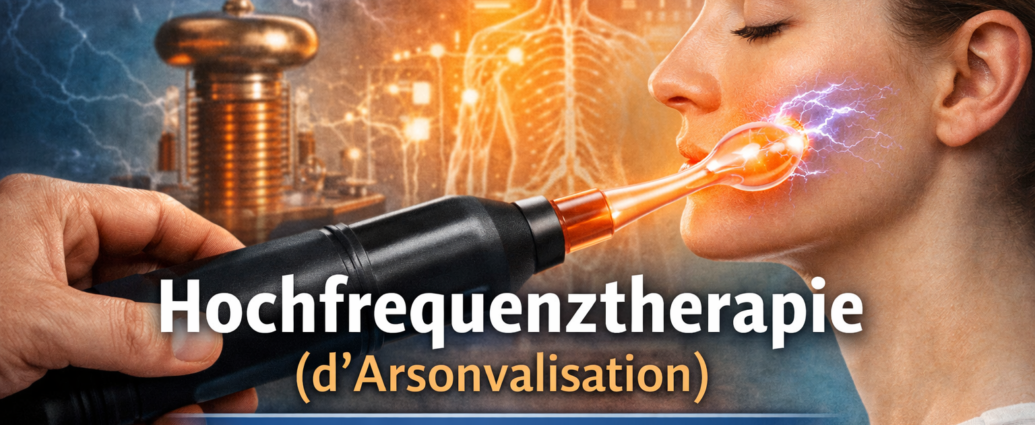
The High frequency therapy, also d'Arsonvalization is a historically well-known procedure from electrotherapy. It involves Short high-frequency pulses with very high voltage via a Treatment electrode to the surface of the body. In this article, you will find a clear explanation of how the method works technically, which treatment techniques are commonly used and how to classify the effects described.
What is d'Arsonvalization?
The d'Arsonvalisation is a type of Skin irritation therapy. Characteristic are Pulse sequences, where the vibrations are often steamed can be described: The rashes are higher at the beginning and subside within a short time.
A special feature: in contrast to many other electrotherapies, d'Arsonvalization is often unipolar carried out - i.e. with an active electrode on the patient. Depending on the technology, the „opposite pole“ is created by the capacitive termination of the system or by the proximity or contact of the practitioner.
Technical principle - simply explained
In simple terms, this is how the pulses are generated:
- The mains voltage is converted via a High-voltage transformer Energy provided.
- A Capacitor can store energy.
- Via a switching path (historically often a spark gap), the energy is transferred impulsively into a Resonant circuit (coil/capacitor) is discharged.
- This results in high-frequency oscillations, which are transmitted to the secondary side as Very high voltage are available.
- At the exit, the Therapy electrode connected.
Important for the classification: The Short pulse duration and Breaks between the impulses is the average current typically low, which means that the stimulation and heat effect can differ significantly from continuous current forms.
Typical treatment techniques
In practice, three basic forms are usually described:
1) Distance application (effluvia / tuft discharge)
The electrode is at a distance led. There are no powerful sparks, but rather finer discharge phenomena. Many perceive this as a mild Tingling or „whiff“ feeling.
2) Spark application (fulguration)
Here are Visible sparks generated in a targeted manner. This technique requires a Significantly stronger skin irritation and can - depending on the intensity - also trigger reflex muscle reactions.
3) Contact technique / punctual stimulation
The electrode is directly on the skin. In addition, the approach or contact of the practitioner can stimulate more precise (e.g. to focus on certain areas).
Which approaches are described?
The primary point of attack is the Skin. Classically, two ways of mediation are discussed:
Neural pathway (via nerve tracts)
Skin stimuli can trigger reactions via reflex circuits, such as local changes in blood circulation.
Humoral route (via blood/lymph)
It is also described that local reactions of the skin (e.g. released messenger substances) enter the circulation and influence systemic responses could.
In this context, terms such as viscerocutaneous and cutivisceral reflex arcs on: Certain internal organs and certain skin zones share segmental nervous circuits. This is explained in some teaching presentations as the basis for „remote effects“ - the practical significance varies depending on the school and context.
A brief look at history
- Nikola Tesla described at the end of the 19th century that very high-frequency currents can have a subjectively less „irritating“ effect, even at high voltage.
- Jacques Arsène d'Arsonval brought high-frequency currents into the medical context and coined the procedure that was later named after him.
- In German-speaking countries, the method is often associated with the further development and popularization by Valentin Zeileis associated with it.
Diagnostic orientation with gas discharge tubes (important note)
Sometimes glass tubes filled with noble gas (historically: Geissler tubes) are used for rough orientation. Depending on the field strength, the tube can shine with varying intensity, which allows conclusions to be drawn about Skin conductivity should suggest.
Important: This is - if at all - a Orientation and does not replace modern diagnostics.
Classification for cancer
Many people with serious illnesses - including Cancer diseases - for complementary procedures to support well-being, relaxation or body awareness. A clear distinction is crucial:
- A d'Arsonvalization is No replacement for evidence-based diagnostics and therapy (e.g. oncology, surgery, radiotherapy, medicinal procedures).
- If anyone is interested, the always should be coordinated with treating physicians - especially in the case of implants, skin problems, neuropathies or ongoing therapies.
Safety: when caution is advised
Depending on the device, technique and person, stimuli can be very different. Expert clarification is particularly important for:
- Pacemakers/implants
- Pregnancy
- Epilepsy/neurological diseases
- open wounds, acute skin inflammation
- severe circulatory disorders or acute infections
Conclusion
d'Arsonvalization is a traditional electrotherapy procedure that has been used for many years. Short high-frequency pulses primarily on the Skin is applied. Common techniques range from mild distance applications up to more powerful spark applications. Anyone interested in the method should be realistic: as a historically described stimulation procedure - not as a substitute for modern medical diagnostics or therapy.
Disclaimer
Note: Frequency therapy is not recognized by conventional medicine and does not replace diagnosis or treatment by doctors or alternative practitioners. In the case of complaints or serious illnesses - especially cancer - medical clarification and treatment is absolutely essential.
Comments are closed, but trackbacks and pingbacks are open.