





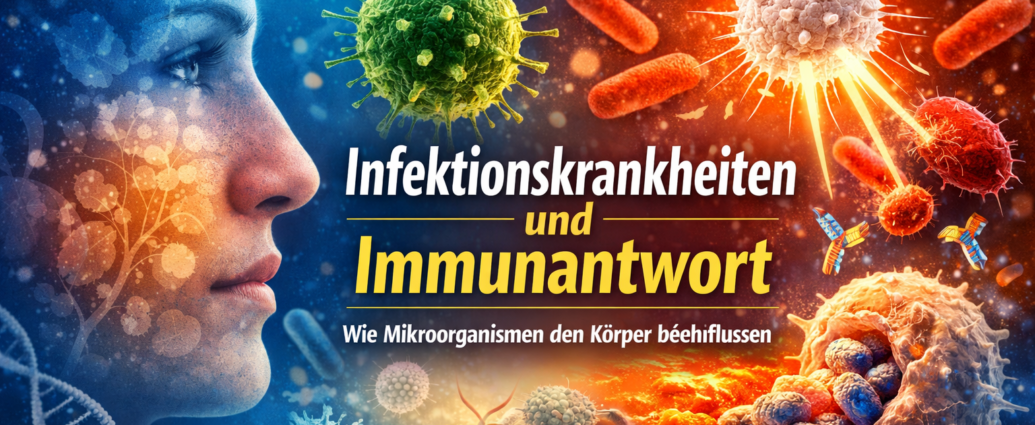
How microorganisms influence the body
Infectious diseases have been with mankind for thousands of years and, despite modern diagnostics, improved hygiene and effective therapies, remain one of the most significant medical challenges. Although some serious infectious diseases have been significantly reduced, the fundamental conflict between humans and microorganisms remains unchanged. New pathogens, resistant germs, chronic courses of infection and complex immune reactions show that infections are still a highly topical issue today.
It is not only the pathogen itself that is decisive, but above all the interaction between the microorganism and the host. Whether contact with a pathogen has no consequences, leads to silent colonization or triggers a pronounced disease depends on many factors. These include the type of pathogen, its quantity, its pathogenic properties and the ability of the immune system to respond appropriately.
Microorganisms as part of the biological balance
The human body is not sterile. A large number of microorganisms live on the skin, on mucous membranes and in various parts of the body. Many of these bacteria, fungi and other microbes are part of the natural microbial colonization of humans. They are not automatically harmful, but are often an important part of the biological balance.
Different relationships can exist between the organism and microorganisms. Some are beneficial for both sides, others are neutral for the host, while still others only become problematic under certain conditions. The so-called resident flora is particularly important. This natural colonization often protects the body from the invasion of pathogens by occupying habitats, nutrients and docking sites.
This protective function is known as colonization resistance. It is an essential part of the body's natural defenses. If this balance is disturbed, for example by medication, antibiotics, chronic stress or weakened defense mechanisms, the microbial situation in the body can change. This may increase the risk of infections.
Colonization and infection are not the same thing
A microorganism can be present on or in the body without immediately causing a disease. In this case, we speak of colonization. This means that a microorganism colonizes and possibly multiplies on a body surface without causing a pronounced pathological reaction in the body.
An infection, on the other hand, occurs when the organism responds to the invading pathogen with a biological defense reaction. This reaction can be silent or lead to clear symptoms. Not every infection is automatically symptomatic, but every manifest infectious disease requires an interaction between the pathogen and the host's defenses.
Whether a colonization becomes a disease depends primarily on three points:
- the amount of microorganisms entering the system
- from their virulence, i.e. their pathogenic strength
- from the efficiency of the body's own defenses
An initially harmless colonization can turn into a problematic process, especially if the immune system is weakened or the barrier function is impaired.
The importance of attachment to body cells
A central step at the beginning of many infections is adhesion, i.e. the adherence of microorganisms to the host's cells. This process is often very specific. The pathogen needs suitable structures to attach to the skin, mucous membrane or other tissue. Only when this attachment is successful can the microorganism survive and possibly spread further.
This is why it is often decided very early on whether a pathogen is quickly fought off by the organism or whether it can take hold. The ability to adhere is therefore one of the fundamental characteristics involved in the development of many infectious diseases.
When the microbial balance tips
Not only classic pathogens play a role. Microorganisms that normally live inconspicuously on the skin or mucous membranes can also become pathogenic under unfavorable conditions. In medicine, this is referred to as opportunistic germs or endogenous infections.
An important mechanism in this context is competition between microorganisms. Some bacteria inhibit the growth of other germs. If a dominant species is eliminated, for example through antibiotic therapy, previously suppressed microorganisms can suddenly take the opportunity to spread. This explains why new or secondary infections can occur after certain treatments.
This shows how finely tuned the body's ecological balance is. Even small changes can lead to the microbial landscape shifting and new problems arising.
Chronic and low-symptom infections
Not every infection is acute and noticeable. Some pathogens can remain in the organism for a long time without immediately causing serious symptoms. Such courses are described as chronic, latent or asymptomatic.
In such situations, the body lives with the pathogen, so to speak, without a manifest disease developing immediately. Under certain conditions, such as stress on the immune system or additional disruptive factors, this balance can later change. Symptoms can then occur or existing processes can be intensified.
This area in particular shows how complex infection biology is. It is not just about the simple scheme of „pathogen there, disease there“, but about dynamic interactions over longer periods of time.
How microorganisms influence the immune system
Many microorganisms do not only act by directly damaging tissue. They can also modulate the immune system, i.e. influence the way it reacts. Some pathogens promote excessive inflammation, while others have a dampening effect on certain immune functions.
Such an immunomodulating influence can result in concomitant infections occurring more easily or the organism reacting more sensitively to further stress. In some cases, this can also alter the general immunological balance.
This observation is important because it shows that infections should not be viewed in isolation. Instead, the pathogen, immune system, inflammatory processes and tissue reactions must be understood together.
The role of combined loads
In the medical debate, it is repeatedly discussed whether chronic diseases could also be partly related to mixed colonization or combined infection constellations. This refers to the simultaneous presence of several microorganisms, such as viruses, bacteria and fungi, which together influence biological processes.
Such considerations are scientifically interesting, but must be evaluated with great care. Not every correlation means a proven cause. Particularly in the case of complex chronic diseases, caution is required when infectious factors are used as the sole explanation.
It is therefore important for a serious medical contribution that combined infection models can be discussed as research approaches, but they should not be presented prematurely as the definitive proven cause of complex diseases.
How the body reacts to infections
The organism has several levels of defense. Firstly, the skin and mucous membranes act as physical and chemical barriers to protect against the penetration of germs. If this first line is overcome, mechanisms of innate immunity come into effect. They react quickly and non-specifically.
These innate defense mechanisms include:
- Macrophages
- natural killer cells
- the complement system
- inflammatory messenger substances such as cytokines
- cellular processes such as phagocytosis
These reactions are the body's first active response to invading microorganisms.
Humans also have acquired immunity. This is more specific and targeted. T lymphocytes, B lymphocytes and antibodies play a central role in this. The acquired immune system recognizes certain antigens, reacts specifically to them and can develop an immunological memory. This enables the organism to react more quickly and effectively when it comes into contact with a known pathogen again.
Inflammation as part of the immune system
Inflammation is often perceived as something negative, but is initially a sensible protective mechanism. At the beginning of an infection, it serves to direct immune cells to the site of the event, change the blood flow and contain the pathogen.
Typical reactions such as fever, local swelling, redness or an altered blood count are an expression of this immune response. In the case of a bacterial infection, the neutrophil granulocytes often increase first. Lymphocytes and monocytes may be more involved in prolonged or certain viral infections. Eosinophils play a role particularly in parasitic infections and allergic reactions.
Such changes show that the body does not react passively to an infection, but is highly active in trying to restore the biological balance.
When the defense is not enough
Not every immune response is successful. If an infection cannot be controlled locally, pathogens can enter the bloodstream. Depending on the type of pathogen, this can lead to bacteremia or viremia. In such cases, there is an increased risk that the process will spread throughout the body and affect other organs.
The development of sepsis is particularly serious. This is a systemic, life-threatening reaction to an infection. Not only the pathogen itself, but above all the excessive reaction of the organism can cause great damage. Inflammatory mediators, vascular changes and disturbances in organ supply lead to a highly critical condition.
In extreme cases, septic shock develops. Blood pressure then drops sharply, vital organs are insufficiently supplied with blood and severe organ failure can occur. Sepsis is therefore always an acute medical emergency.
Pathological immune reactions: Allergy and hypersensitivity
In addition to inadequate defense reactions, there are also misdirected or excessive responses of the immune system. These include allergic and hypersensitive reactions. In such cases, the immune system fights an irritant or pathogen components, but damages the body's own tissue at the same time.
Infection-related hypersensitivity reactions can occur via different immunological pathways. Depending on the mechanism, antibodies, immune complexes or cellular reactions may be involved. The result is inflammatory processes that are not solely determined by the pathogen, but essentially by the body's own reaction.
This makes it clear that disease is often caused not only by the microorganism alone, but also by the way in which the organism reacts to it.
Infections and autoimmunity
One particularly exciting area of research is the possible connection between infections and autoimmune processes. Autoimmune diseases do not arise from a single cause, but from an interplay of genetic predisposition, environmental factors and immunological dysfunctions.
Infections are discussed as a possible trigger or amplifier. Theoretical mechanisms include:
- molecular mimicry, i.e. structural similarities between pathogen components and the body's own tissue
- non-specific activation of autoreactive immune cells
- Local inflammatory processes with increased presentation of the body's own structures
However, it is important to make a sober classification. Not every autoimmune disease has an infectious cause, and even where links are suspected, the development is usually complex and multifactorial.
Why understanding the immune response is so important
The study of infectious diseases shows how finely tuned the interplay of microorganisms, barrier functions and immune defenses is. In this context, health often does not mean the complete absence of microbes, but rather the ability of the organism to live with them in a stable balance.
Only when this balance is disturbed, be it by a high pathogen load, aggressive virulence, a weakened immune system or a pathological immune reaction, do clinically relevant problems arise. This also explains the great importance of an intact mucosal barrier, stable microbial flora and functioning immune regulation.
Conclusion
Infectious diseases are much more than the mere invasion of bacteria, viruses or fungi. They are an expression of a complex biological interaction between microorganism and host. The natural flora, the quality of the barriers, the strength of the innate and acquired immune response as well as possible false reactions of the immune system jointly determine whether a colonization remains harmless or turns into disease.
Anyone who wants to understand infections must therefore always look at the whole system: the pathogen, the environment, the immune system and the body's individual ability to react. This is the key to a deeper understanding of health and disease.


Comments are closed, but trackbacks and pingbacks are open.