



Mebendazole polymorph C for the treatment of brain tumors - what does the US patent US 11,110,079 B2 really protect?
The US patent US 11,110,079 B2 (issued on September 7, 2021) describes a very specific „repurposing“ approach: the well-known anthelmintic active ingredient Mebendazole should not simply „off-label“, but in a defined crystal form (polymorph C) and in a specific galenic formulation (granulated) be used - with a focus on Brain tumors and optional combination strategies.
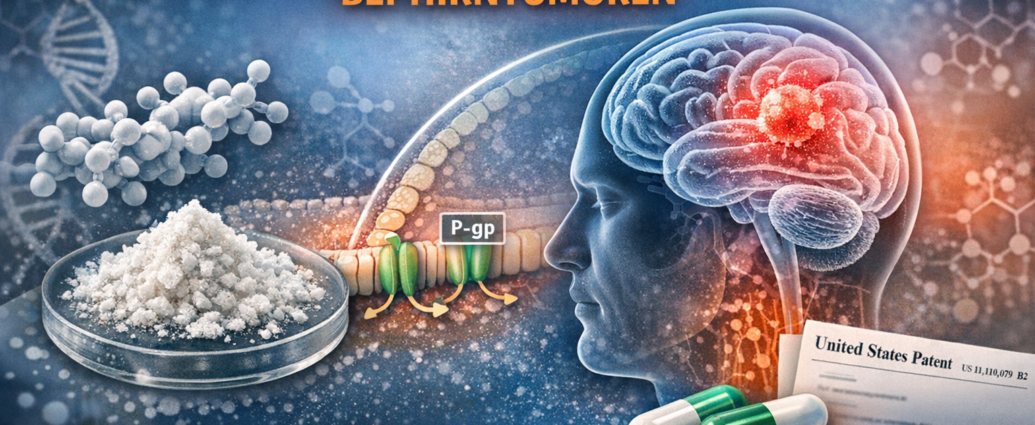
The direction of travel is clearly formulated in the abstract: Three polymorphs exist, the polymorph content is variable in existing preparations; as oral Form be Polymorph C „superior“ and reach Brain and brain tumors in effective concentrations; the efficacy could be additionally increased by combining with a P-glycoprotein inhibitor can be increased. In addition, a possible application for other tumors and as chemo-preventive approach.
1) Why a patent on a „crystal form“ can be clinically relevant
In practice, polymorphism is often underestimated until it „pops“: Solubility, dissolution rate, stability, transformations on storage and thus ultimately Bioavailability can differ significantly between polymorphs. In the case of substances with complex absorption and a narrow therapeutic „efficacy zone“, the Fixed phase (Polymorph A/B/C) could be a real game changer.
The patent argues precisely from this perspective: In the case of repurposed substances, it is not only the active ingredient, but often the reproducible form decisive.
2) Patent core: What is claimed?
The content of the claims is surprisingly „tangible“ and easy to read for clinicians because they name a specific administration and indication.
Claim 1 (core statement, analogous)
Treatment of a brain tumor in humans, by a sufficient quantity is administered in a pharmaceutical formulation that Mebendazole contains, where at least 90 % of mebendazole in the formulation Polymorph C and the formulation granulated is.
Literally: „...wherein at least 90% of the mebendazole... is polymorphic C and the pharmaceutical formulation is granulated.“ (Claim text)
Which brain tumors are specifically mentioned?
- Medulloblastoma (Claim 2)
- Glioma (Claim 3)
Further clinically interesting additional claims
- Tumor with multidrug resistant pump (Claim 4) - clinically thought of as an MDR/transporter issue
- Combination with NSAID or P-glycoprotein inhibitor (Claim 5)
- Simultaneous gift (claim 6)
- Explicit naming of Elacridar as P-gp inhibitor (claim 7)
3) The „reason why“: blood-brain barrier, efflux transporter and target concentration
The core oncological hurdle in brain tumors is often not the „ability“ of an active substance in the test tube, but the Achieving and maintaining effective concentrations in the CNS.
The patent combines two pharmacological levers:
- Polymorph C as preferred oral solid phase → Goal: better/more constant exposure
- Combination with P-glycoprotein inhibition (Example: Elacridar) → Goal: less efflux, potentially higher CNS exposure
What is important in practice: This is a Conceptual and preclinical argumentation model. It does not replace a clinical efficacy and safety evaluation, but it shows, where the inventors see the „bottleneck“: Shape + transporter biology.
4) Preclinical logic: Why „Polymorph C“ in particular?
The abstract claims that Polymorph C is „superior“ as an oral form and reaches brain/brain tumors in effective concentrations. The patent supports this statement with preclinical data (animal models/PK observations and efficacy curves).
The decisive factor for medical classification is not so much whether individual mouse survival curves look „impressive“, but:
- Reproducibility across models and laboratories
- Exposure-response relationship (AUC/Cmax vs. effect)
- Therapeutic window (especially for combination strategies)
- Transferability to human dose ranges
The patent itself mentions that for combined/prolonged regimens Toxicity (e.g. weight loss/mortality in prolonged trials). This is clinically crucial: CNS penetration „at any cost“ is not a benefit if systemic toxicity prevents its use.
5) Combination strategies: P-gp inhibition and NSAID coupling
A) P-glycoprotein inhibitor (example Elacridar)
Elacridar is named as a specific inhibitor in the claims. Clinically, this is a very delicate but pharmacologically comprehensible approach, because P-gp modulation:
- CNS exposure of many substances
- but also Interaction risks (CYP/transporter networks) and Security issues (off-target effects)
The key message for doctors/healthcare practitioners: The combination is part of the patented concept, but by no means automatically „practicable“ as long as no reliable clinical data on benefit/risk is available.
B) NSAIDs (e.g. Sulindac, Aspirin etc.)
The patent discusses prophylactic/adjunctive scenarios in which polymorph C is combined with a non-steroidal anti-inflammatory drugs formulated or combined. The list is broad (aspirin, celecoxib, diclofenac, ibuprofen, indomethacin, etc.). Clinically, this is plausible as an „anti-inflammatory/COX pathway“ idea - but equally so: not automatically evidence-based for oncology, but a „potential“ strand within the scope of the patent.
6) What does „granulated“ mean in Claim 1 - and why is it stated so explicitly?
The claim links the idea of efficacy not only to the polymorph component, but also to a Specific pharmaceutical processing („granulated“). This is typical when the inventors assume that:
- the Reproducibility release/absorption
- the Stability (Polymorphic conversions!)
- or the Handling (e.g. dosing capability, „sprinkle“ concepts in practice)
is essential for success.
For clinical readers, this is the hint: The patent is aimed at not on „any mebendazole tablet“, but on standardized Formulations that can be strictly controlled in studies/production.
7) Clinical classification: What is „evidence“ here, what is „hypothesis“?
What the patent does
- It defines a Precise pharmaceutical specification (≥ 90 % polymorph C, granulated).
- It claims a pharmacological advantage (CNS exposure/efficacy) and complements a Combination logic (P-gp, NSAIDs).
- It thus creates a protectable basis for development/studies.
What the patent does not replace
- none Authorization
- none Clinical evidence of efficacy in the claimed indications
- none Guideline recommendation
- No automatic derivation for „practice off-label“ without a study framework
Particularly in the case of brain tumors, a plausible concept can still fail without robust clinical data. pharmacokinetics, toxicity, tumor heterogeneity, interactions and endpoint issues.
8) Bridge to information medicine/frequency medicine
From the perspective of a integrative medicine is interesting about the patent that a classic pharmacological topic („active ingredient“) is strongly Structure and order states (polymorphism) is thought. This is not proof of frequency medicine procedures - but it is a good example of the fact that Material structure, stability and physical states may have therapeutic relevance.
If you want to build a bridge at this level, then do it seriously:
- PharmacologyPolymorphism → Bioavailability/exposure → Potential clinical effect
- Information medicine/frequency medicineHypothesis that biological systems can react to order/resonance
- Important: This bridge is conceptual, not equivalent to evidence. Clinical decisions must continue to be data-based take place.
9) Take-home messages for doctors & alternative practitioners
- The patent is a Formulation and development patent, not „proof“ of an established cancer therapy.
- Central is the Quality specification: ≥ 90 % Mebendazole polymorph C, granulated.
- The combination idea with P-gp inhibition (Elacridar) is pharmacologically comprehensible, but clinically particularly interaction/toxicity relevant.
- For brain tumors, the CNS exposure a key factor - the patent addresses precisely this problem.
Closing words
US 11,110,079 B2 is an example of how „drug repurposing“ is thought of in oncology today: Not only which active ingredient, but In which solid phase, in which galenic form, and with which transporter/combination levers a plausible therapeutic window could be achievable.
Medical note / Disclaimer
This article is intended to technical information and replaces none medical diagnosis, therapy decision or guideline consultation. Mebendazole is indicated in the following oncological indications not automatically established as a standard therapy; off-label applications belong - if at all - in medically responsible, evidence-oriented Framework conditions (studies/boards/monitoring).
Additional note: Procedure of the Frequency therapy are not recognized by conventional medicine and can none replace treatment by doctors or alternative practitioners.