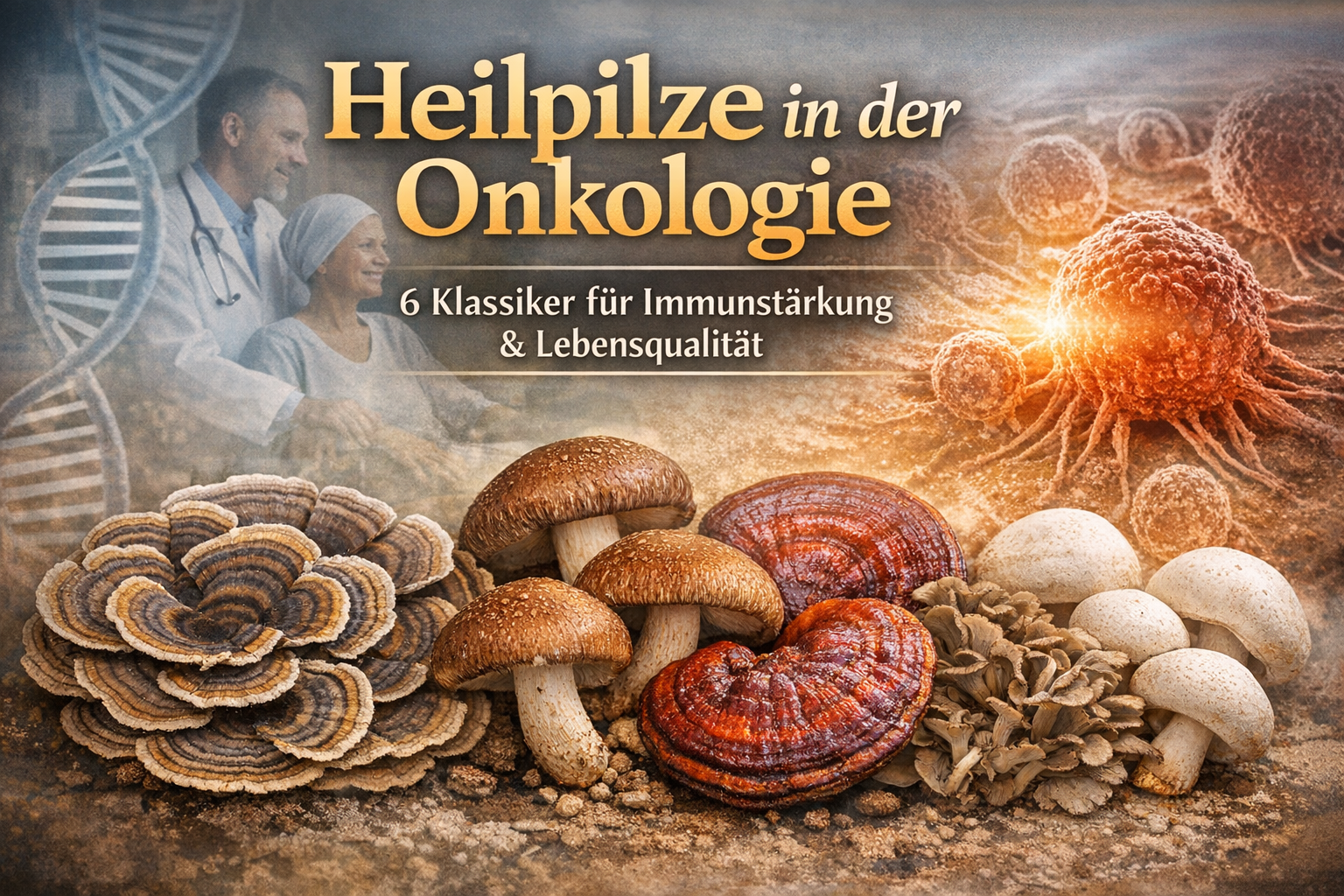
Medicinal mushrooms are used in the integrative oncology especially as Accompaniment used - with the goal, Support immune functions, Therapy compatibility and Quality of life and in some countries also to stabilize adjuvant (in addition) to standard therapy. Important: Medicinal mushrooms are No cancer therapy in the sense of a sole treatment and replace none medical diagnosis or therapy. The scientifically reliable part of mushroom medicine is also often linked to standardized extracts (e.g. PSK, Lentinan, Sizofiran) - not „mushroom powder in general“.
In this introductory article, I categorize the 6 mushrooms from your core list according to typical Objectives in oncology:
- Trametes versicolor (Turkey Tail / Butterfly Stramete; PSK/PSP)
- Lentinula edodes (Shiitake; Lentinan)
- Schizophyllum commune (Split leaflet; Schizophyllan/Sizofiran)
- Ganoderma lucidum (Reishi)
- Grifola frondosa (Maitake)
- Agaricus blazei (AbM)
This is mainly based on reviews and clinical classifications (e.g. NCI/PDQ, Cochrane, meta-analyses/reviews).
1) Objective: Adjuvant to standard therapy (immune „response modifier“ with clinical tradition)
This is about mushrooms/extracts that have been used in parts of Asia for decades. additional have been or will be used for chemotherapy/radiotherapy/surgery.
Most strongly „classically adjuvant“ anchored:
- Trametes versicolor → PSK/PSP
PSK (Krestin) is the best known clinically used extract of Trametes versicolor; there are older controlled studies in gastrointestinal cancer settings and reviews of PSK/PSP. - Lentinula edodes → Lentinan (injectable in studies/clinical use)
There are meta-analyses on lentinan in the context of Stomach cancer + chemotherapy (adjuvant), including evaluation of efficacy/safety in this setting. - Schizophyllum commune → Schizophyllan/Sizofiran (SPG/Sonifilan)
For Sizofiran, for example, there are reports of randomized studies and clinical application (mainly gynecological oncology in Japan).
➡️ Mnemonic: When someone refers to „medicinal mushrooms with a clinical adjuvant tradition“, it is usually precisely these three extract lines (PSK/PSP, Lentinan, Sizofiran).
Sub-article: „Trametes/PSK-PSP: What is really clinically proven - and what is not?“
2) Objective: Immune support & convalescence (e.g. after chemo, in case of increased susceptibility to infections)
This does not say „tumor directly“ so much as Immunocompetence (NK cell activity, T cell function, non-specific defense). The clinical strength varies - and is highly dependent on extract quality and study design.
Typical candidates:
- Trametes versicolor (PSK/PSP) - frequently discussed in the context of „immune recovery/secondary prevention“.
- Maitake (Grifola frondosa) - CAM-Cancer describes limited evidence for immunological parameters in patients, but none clear clinical evidence for direct antitumor effect in trials.
- Reishi (Ganoderma lucidum) - Cochrane: Insufficient evidence for first-line cancer treatment, possible role as adjunct remains uncertain; focus more on immune markers/response.
- Agaricus blazei (AbM) - Often in integrative concepts; evidence base heterogeneous, partly preclinical/smaller clinical approaches.
➡️ Practical idea: For this objective is often more decisive than „mushroom name“:
Extract standardization (β-glucans/polysaccharides), tolerability, interactions, timing in the course of therapy.
Sub-article: „Maitake & immune parameters: What does ‘NK cells up’ really mean clinically?“
3) Objectives: quality of life, fatigue, sleep, stress (supportive oncology)
Many patients turn to medicinal mushrooms in order to feel more „stable“. Energy, Sleep, General symptoms. Here the data situation is often „softer“ (observations, surveys, heterogeneous designs), but the topic is very relevant in practice.
Typically categorized:
- Reishi (Ganoderma lucidum) - is often used for „rest/stress/sleep“; for example, there are studies on reported symptom improvements and side effects in cancer patients (observational data).
- Agaricus blazei (AbM) - is partly used for general stabilization (immune/inflammation markers); clinical quality of the data varies greatly.
- Shiitake/Lentinan - in oncological contexts, Lentinan is also used with QOL aspects mentioned in study lines (especially in combination with chemo settings).
➡️ Important: „I feel better“ is not the same as „tumor is regressing“. The two must be clearly separated.
Sub-article: „Reishi in oncology: symptom support vs. the promise of a cure“
4) Objective: inflammation balance & mucosal/intestinal support (e.g. „chemo intestine“, general resilience)
Inflammation and barrier function (gut/mucous membranes) are really key issues in oncology - not only because of side effects, but also because of nutrition, microbiome, susceptibility to infection.
Mushrooms, which are often mentioned here:
- Lentinan (shiitake extract) - Reviews describe anti-inflammatory and immunological pathways as well as oncological contexts.
- Agaricus blazei (AbM) - is often described in reviews as immune/inflammatory modulating (quality depends on the study/product).
- Maitake - classified as immunological/supportive, but with limited clinical evidence.
➡️ Practical rule: If you have a sensitive digestive tract, the Dosage form (extract vs. powder), the Slow dose increase and the Accompaniment (nutrition/medication) is more important than „the right mushroom“.
Sub-article: „Medicinal mushrooms & microbiome in oncology: what is plausible, what is proven?“
5) Objective: Oncological aftercare & „secondary prevention“ (risk of recurrence in view, immune system being built up)
After primary therapy (surgery/chemo/radiotherapy), the question often comes to the fore: „How can I support my system in a meaningful way?“ In some integrative guidelines, the following in particular are mentioned here Trametes/PSK mentioned.
Frequently mentioned:
- Trametes versicolor (PSK) - In integrative oncology materials, PSK is discussed on the basis of clinical data and tradition for secondary prevention planning.
- Reishi / Maitake / AbM - rather than general immunological supporters, but with clearly variable evidence quality.
➡️ Important: Aftercare is an overall concept: exercise, nutrition, sleep, psycho-oncology, therapy adherence, aftercare plans - medicinal mushrooms are, if at all, the key, a building block.
Planned sub-article: „Trametes/PSK in aftercare: sensible goals, limits, quality criteria“
6) Objective: „Oncology-compatible use“ - safety, interactions, quality (often the most important objective)
No matter which mushroom you choose: In oncology Security central - due to liver values, blood coagulation, immunosuppression, transplant medication, immunotherapies and „polypharmacy“.
6.1 Interactions & caution (quick check)
- Reishi: Cochrane does not see sufficient evidence for „cancer therapy“, but points to a possible adjunctive role; in popular applications, interactions (e.g. blood pressure/blood sugar/blood coagulation) are also discussed - therefore always seek medical advice.
- All extracts: Quality/impurities, declaration (β-glucans vs. „polysaccharides“), origin, heavy metals - this is crucial for mushroom products.
6.2 The quality rule of thumb (practical)
- What exactly? (Mushroom or standardized extract such as PSK/Lentinan/Sizofiran)
- What for? (Clearly state objectives: QOL, immune build-up, aftercare ...)
- What does it collide with? (medication, therapy phase, liver/kidney, surgery dates)
Planned sub-article: „Combining medicinal mushrooms safely: Checklist for therapy phases, laboratory values, medication“
Bonus: Why frequency therapy is often included in integrative concepts
Combining many integrative approaches Biological support measures (nutrition, micronutrients, exercise, sleep, medicinal mushrooms) with regulatory procedures like Frequency therapy - with the aim of supporting stress axes and regulatory capacity. It remains important: Frequency therapy is not recognized by conventional medicine and replaces none Treatment by doctors or alternative practitioners.
Quick overview: Which mushrooms are suitable for which objective?
Adjuvant/clinical extract tradition: Trametes (PSK/PSP), Shiitake (Lentinan), Schizophyllum (Sizofiran)
Immune build-up/reconvalescence: Trametes, Maitake, Reishi, AbM (evidence varies)
Quality of life/stress/sleep: Reishi (frequently), AbM/Shiitake partly in support contexts
Inflammation/intestines/mucous membrane: Lentinan, AbM, partly maitake (supportive)
Aftercare/secondary prevention: Trametes/PSK (frequently mentioned), plus supportive options
Safety/quality/interactions: all - always clarify first
Outlook: The planned sub-article series (structure)
- Trametes versicolor: PSK/PSP, clinical data, aftercare
- Shiitake/Lentinan: Chemo combination, QOL, practical application
- Schizophyllum/Sizofiran: gyn. Oncology, study history, classification
- Reishi: Symptom support, security/interactions, quality issues
- Maitake: Immune parameters vs. clinical endpoints, what does that really mean?
- Agaricus blazei (AbM): Heterogeneous data, typical fields of application, points of caution
- Extra: Checklist „Medicinal mushrooms + oncotherapy“ (laboratory, medication, timing)
Medical advice
This article is for information purposes only and does not replace medical advice. In the case of cancer diagnoses and ongoing therapies, medicinal mushrooms should only in coordination with the treatment team - especially in the case of Immunotherapies, Anticoagulants, Diabetes medication or Liver/kidney problems.