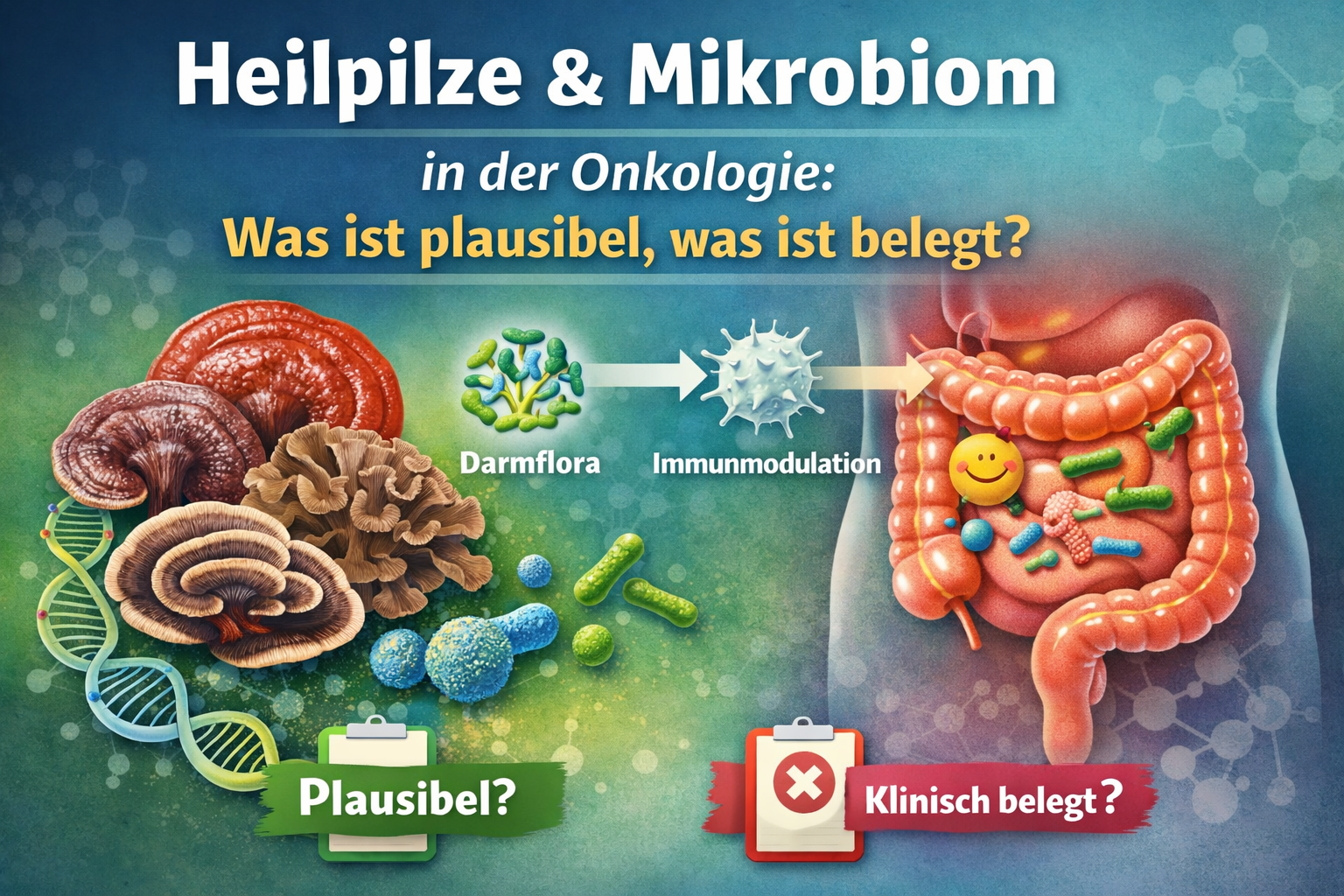
What is plausible, what is scientifically proven?
The gut is no longer just a „digestive tube“, but a central communication space between nutrition, the microbiome and the immune system. At the same time, interest in medicinal mushrooms (e.g. reishi, maitake, trametes) is booming. The exciting question is: Do fungal polysaccharides change the microbiome in a way that makes it really relevant in oncology - or is this mainly plausible storytelling?
This article deliberately separates Plausibility, Notes and Clinically proven effects.
1. why the microbiome is relevant in oncology at all
The microbiome can (depending on the context) influence
- Inflammation level and barrier function of the intestinal mucosa
- Metabolites such as short-chain fatty acids (e.g. butyrate), which have an immunological effect
- Systemic immune responses, that can play a role in cancer treatment
Important: This does not automatically mean that „optimizing the microbiome“ treats cancer. But it does explain why we are looking at it mechanistically in the first place.
2. what is microbiologically plausible about medicinal mushrooms
a) Mushroom fiber as „food“ for intestinal bacteria
Many medicinal and edible mushrooms contain Polysaccharides that are difficult to digest (a. o. β-Glucans, chitin structures). Some of these enter the large intestine where they can be processed by microbes - this is the classic principle of „prebiotic“ effects.
b) Immunomodulation depends in part on the microbiome (at least in animal models)
There is preclinical data that the Immune effect of β-glucans from the Initial composition may depend on the intestinal flora. This makes individualized effects plausible - but for the time being it remains predominantly at the laboratory/animal level.
c) „Good-immune axis“ as a translation model
The common working hypothesis today is: Fungal polysaccharides → Microbiome/metabolites → Mucosal/immune signals → Systemic effects. This is a coherent model that is well described in reviews - but model ≠ clinical evidence.
3. what is most clinically „proven“ in oncology (and what is not)
A distinction must be made here between:
- Whole mushrooms as food
- standardized extracts/drugs (with defined composition)
- Food supplements (strongly varying quality)
The strongest clinical block: Trametes versicolor / PSK (adjuvant, especially GI tumors)
For PSK (a protein-bound polysaccharide, historically derived from Trametes versicolor) exist Clinical data as adjuvant measure in combination with standard therapies - especially from Japan for Stomach and bowel cancer (Survival/recurrence data in randomized trials and meta-analyses/reviews).
Important for the microbiome question:
These PSK data are clinically relevant, but they do not automatically prove that the effect primarily via the microbiome running. Many studies discuss immunological mechanisms; the microbiome mediation is often rather plausible addition as a hard end point.
For „medicinal mushroom mixes“ in cancer: lots of biology, few robust human endpoints
A systematic overview of the last few years provides an overall picture: A lot of preclinical research, but heterogeneous, partly small clinical studies, different preparations, different outcomes - making it difficult to derive clear recommendations.
4. practical: where the most common misunderstandings lie
Myths vs facts box
Myth: „If a fungus improves the microbiome, it automatically helps against cancer.“
Fact: Microbiome change is a Mechanism note, but no clinical evidence of efficacy.
Myth: „Medicinal mushrooms are always harmless because they are natural.“
Fact: Natural substances can also Side effects and Interactions especially in oncology (e.g. with anticoagulants or immunosuppressive situations). For interactions, the specialist literature expressly advises professional supervision.
Myth: „An extract is like the whole mushroom.“
Fact: Extracts differ massively (polysaccharide profile, concentration, purity). Results are not transferable 1:1.
5 What is currently a fair, evidence-based classification?
Rather plausible / well justifiable
- Fungal polysaccharides can prebiotic work and microbial metabolites influence.
- Immunomodulatory effects can co-determined by the microbiome (especially preclinical).
Partially proven (depending on indication & preparation)
- PSK (Trametes derivative) as Adjuvant in certain settings (especially GI tumors; historical data mainly from Japan).
Not proven / not reliably derivable
- „Medicinal mushrooms cure cancer“ or replace chemo/immunotherapy/surgery
- „Microbiome detox“ or individual „fungal frequencies“ as cancer treatment (there are no reliable clinical endpoints for this)
6 If you still want to use it: sensible safety principles
Without dosage recommendations (these belong in the hands of a doctor), but as a Orientation:
- Always clarify with the treatment team if parallel Chemotherapy, immunotherapy, radiation, anticoagulation or Transplant/immunosuppression is in play.
- Standardization/quality is crucial: same type of mushroom ≠ same product.
- Realistic target picture: rather Support hypothesis (e.g. tolerability, immune markers in study context), not „tumor away“.
Conclusion
Medicinal mushrooms and the microbiome is a scientifically plausible field: polysaccharides, β-glucans and the gut-immune axis fit together mechanistically well. Clinically robust evidence but there are only in selected constellations and preparations - most prominently in the environment of Trametes versicolor/PSK as an adjuvant measure in certain GI tumor settings.
Anything beyond this should be considered Promising biology with still incomplete clinical translation categorize.
Author: NLS Informationsmedizin GmbH, Herbert Eder
Disclaimer: This article is for information purposes only and does not replace medical advice. In oncology, food supplements and extracts can have interactions. Please always consult your oncologist before making any decisions.