





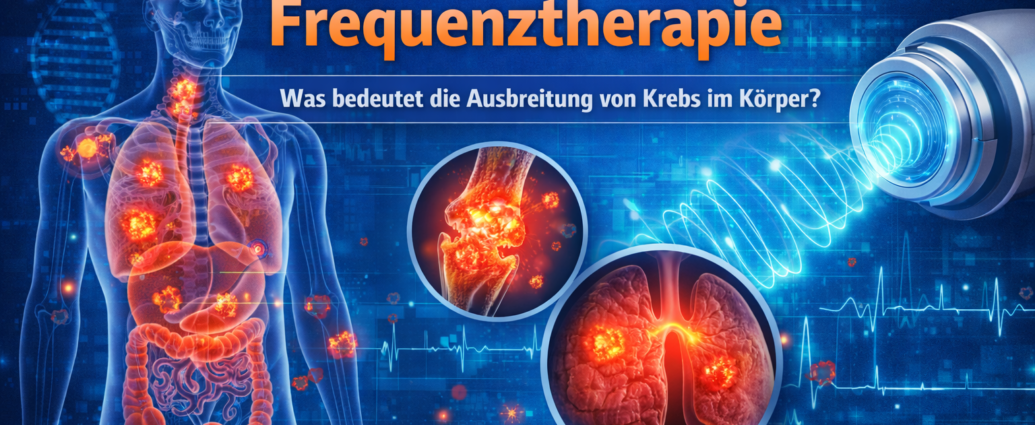
What does the spread of cancer in the body mean?
Metastases are among the most feared terms in cancer medicine. When people learn that a Tumor has spread throughout the body, fear, uncertainty and many questions often arise. What exactly are metastases? How do they develop? Why are they so medically significant? And what role do diagnosis, conventional medical therapy and complementary holistic approaches such as the Frequency therapy in this context?
It is particularly important to impart sound knowledge about cancer. Because only those who understand what is happening in the body can better classify medical connections and make decisions more consciously.
What are metastases?
Metastases are Daughter tumors, which develops from an original tumor, the so-called Primary tumor, and settle elsewhere in the body. They therefore do not develop independently, but emerge from cancer cells that have left their place of origin.
These cancer cells can spread via the Blood or via the Lymphatic system spread throughout the body. If they spread to other tissue and begin to grow there again, metastases develop. From a medical point of view, this is a decisive step in the course of the disease, as the disease then no longer only affects the original site, but the entire organism.
How do metastases develop?
The formation of metastases is a complex biological process. One of the ways in which cancer cells differ from healthy cells is that they lose their natural growth limits and often behave more aggressively. Some of these cells can detach themselves from the original tumor structure.
Several steps must take place for metastases to develop:
- Cancer cells detach from the primary tumor
- they penetrate blood or lymph vessels
- they survive transportation through the body
- they leave the vessels at another location
- they settle in new tissue
- they begin to form new tumor tissue there
This sequence shows that metastasis is not a random individual process, but a multi-stage process. Not every cancer cell that enters the circulation automatically leads to a metastasis. Nevertheless, it is precisely this process that is a central feature of many malignant tumor diseases.
Why are metastases so important?
Metastases are of particular medical importance because they indicate that a cancer has spread beyond its original site. This has an impact on:
- the assessment of the stage of the disease
- therapy planning
- the forecast
- the choice of diagnostic procedures
- the accompanying care of those affected
In many cases, it is not just the original tumors that are the main problem, but the spread to vital organs. If metastases form in the liver, lungs, bones or brain, for example, this can significantly impair organ function.
Where do metastases occur particularly frequently?
Metastases can occur in many parts of the body. However, certain organs and tissues are particularly frequently affected.
Bone metastases
Bones are a common site for metastases in various types of cancer. They can cause pain, impair the stability of the bone and increase the risk of fractures.
Liver metastases
Die Leber ist ein zentrales Stoffwechselorgan und durch ihre starke Durchblutung ein häufiger Ort für Tochtergeschwülste. Lebermetastasen treten unter anderem bei Darmkrebs, Brustkrebs und anderen Tumorerkrankungen auf.
Lung metastases
The lungs filter a large part of the blood circulation and are therefore also frequently affected. Lung metastases can go unnoticed for a long time or cause breathing difficulties.
Brain metastases
When cancer cells reach the brain, neurological symptoms such as headaches, seizures, dizziness or seizures can occur.
Lymph node metastases
Lymph nodes are often the first stage of spread via the lymphatic system. Their involvement plays an important role in the staging of many tumor types.
What symptoms can metastases cause?
Metastases do not always cause symptoms immediately. Some are only discovered during check-ups. When symptoms do occur, they depend heavily on the area of the body affected.
Possible symptoms can be
- persistent pain
- Unexplained weight loss
- Severe tiredness and exhaustion
- Shortness of breath or coughing
- neurological abnormalities
- Bone pain
- Pressure sensations or organ complaints
- general weakness
As these symptoms can also have other causes, a precise medical clarification is crucial.
How are metastases diagnosed?
Metastases are diagnosed using various methods. The aim is to determine whether a tumor has spread, which regions are affected and how active the disease is.
The most frequently used methods include
- Ultrasound
- Computed tomography (CT)
- Magnetic resonance imaging (MRI)
- PET-CT
- Scintigraphy
- Blood tests
- Biopsies
Precise imaging is particularly important in modern cancer medicine. It helps to assess progression and plan targeted therapies.
Does metastasis automatically mean hopelessness?
Many people immediately associate metastases with hopelessness. This idea is understandable, but not always true. The significance of metastases depends very much on this:
- what type of cancer it is
- how many metastases are present
- Which organs are affected
- how quickly the disease grows
- how well the disease responds to therapies
- the general condition of the person concerned
In some cases, metastases can be well controlled, sometimes over long periods of time. In other situations, the focus is on palliation, quality of life and stabilization. Modern oncology has made great progress in many areas, even if metastatic disease remains a major challenge.
What conventional medical treatment approaches are available?
The treatment of metastases always depends on the individual situation. It can combine different approaches:
Operation
If individual metastases are easily accessible, surgical removal may be advisable in certain cases.
Radiotherapy
It is often used to treat metastases locally, alleviate pain or slow down growth.
Chemotherapy
Chemotherapy has a systemic effect throughout the body and can therefore be used particularly when the disease is not limited to one location.
Targeted therapies
Depending on the tumor biology, drugs are used that specifically attack certain properties of cancer cells.
Immunotherapy
Certain modern procedures attempt to activate the body's own immune system against tumor cells.
Supportive therapy
This includes pain therapy, nutritional support, psychological support and measures to stabilize the patient's general condition.
Metastases and frequency therapy - a holistic approach
In the area of Frequency therapy disease is often understood not only as a local event, but also as an expression of disturbed regulation and communication processes in the organism. From this perspective, the focus is not only on individual tumor foci, but also on the entire internal environment, the stress situation of the body and its ability to regulate.
People with serious illnesses such as cancer often look for ways to provide additional support for their own organism. In such contexts, frequency therapy is seen by some users as a complementary approach to provide holistic support. From this perspective, this often involves topics such as
- Supporting the ability to regulate
- Consideration of energetic stress patterns
- Promotion of general well-being
- Accompanying stabilization during stressful phases of illness
- Holistic classification of physical and mental processes
However, it is important to make a clear distinction: metastases are a serious oncological situation that must always be medically clarified and treated. Complementary approaches can provide additional support from a holistic perspective, but do not replace the necessary conventional medical diagnosis and treatment.
Why do many of those affected want additional support?
Particularly in the case of metastatic disease, many sufferers experience not only physical stress, but also emotional, social and existential challenges. The diagnosis often affects their entire life. This is why many people have a growing desire for care that goes beyond purely technical treatment decisions.
From the point of view of many of those affected, holistic concepts can help to see people as a whole. These include
- emotional stabilization
- the feeling of actively contributing something
- the conscious support of regeneration and quality of life
- the integration of body, psyche and lifestyle
- a more intensive engagement with your own health journey
Metastases as an expression of a complex disease process
Metastases show that cancer is not a purely local phenomenon. Rather, it is a complex process in which cellular, immunological, biochemical and regulatory processes interact. For this reason, treatment is often complex.
Modern medicine works with highly developed diagnostic and therapeutic methods. Complementary holistic approaches such as frequency therapy are also used by some people to accompany the experience of the illness more comprehensively. However, a serious medical classification is always crucial.
Conclusion
Metastases are secondary tumors that develop when cancer cells break away from the original tumor and settle elsewhere in the body. They are a sign that a cancer has spread and play a key role in diagnosis, prognosis and treatment.
This is precisely why it is important to see metastases not only as a threatening concept, but also as a medically explainable event that can now be accompanied by many diagnostic and therapeutic options. As part of a holistic approach, many patients are also interested in complementary methods such as Frequency therapy, to support the organism on a regulatory level. It remains crucial that such approaches do not replace medical treatment, but should - if at all - only be understood as an adjunct.
Author: NLS Information medicine GmbH, Herbert Eder

Comments are closed, but trackbacks and pingbacks are open.