




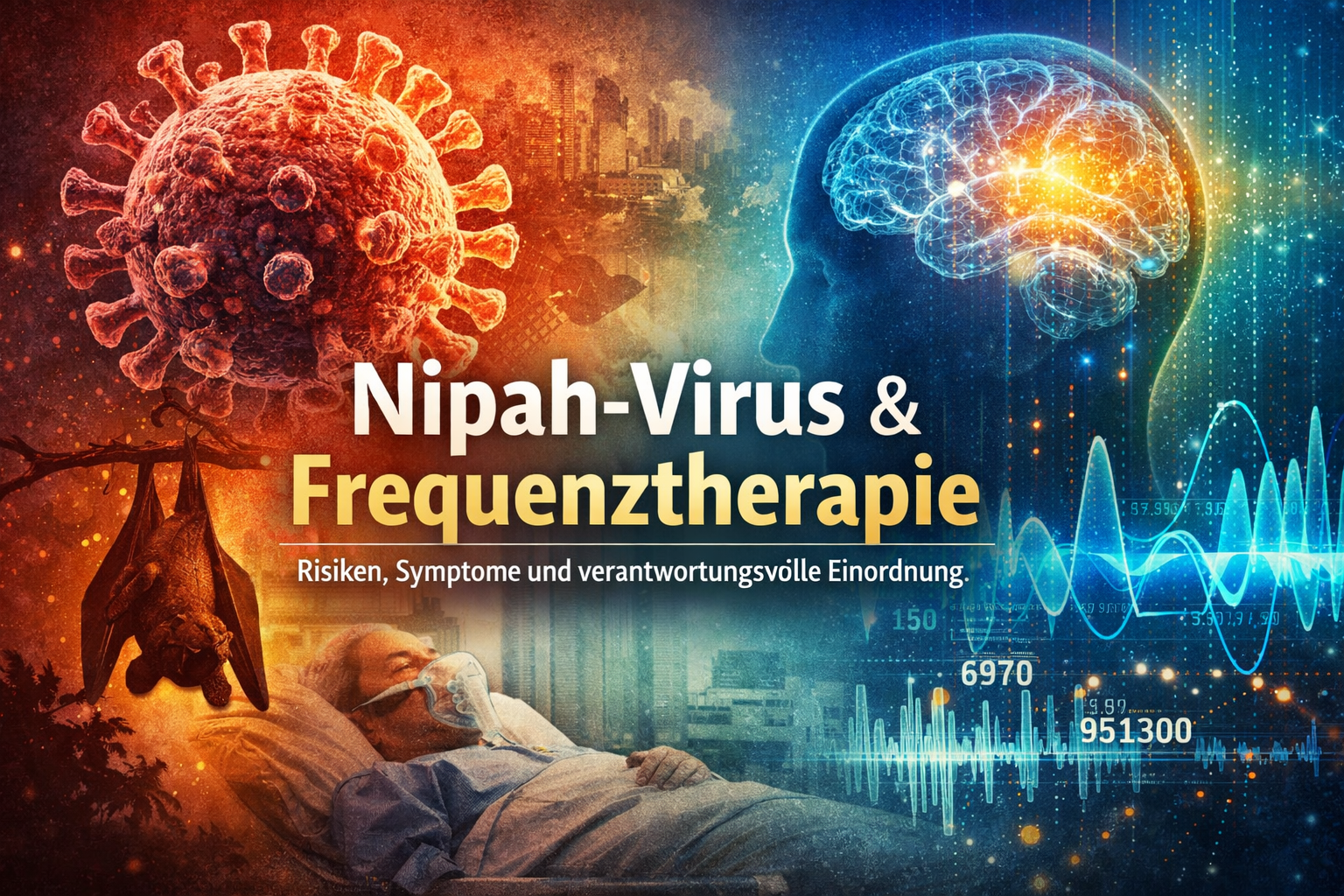
When the news talks about rare but dangerous viruses, uncertainty quickly arises. The Nipah virus (NiV) is one of those pathogens that are taken seriously medically because they Severe courses of illness can cause and in outbreak situations Human-to-human transmissions are possible.
In this article you will get a easy to understand but detailed overview:
- What the Nipah virus is
- How it is transferred
- Which symptoms are typical
- What you should know about prevention
- What makes sense in case of suspicion
And because many people also look for complementary approaches during challenging phases of their health, I end up also classifying the Frequency therapy a - clearly, responsibly and without promises of salvation, including the desired frequency program.
1) What is the Nipah virus?
The Nipah virus is a Zoonotic pathogens (animal → human), which belongs to the family of Paramyxoviruses belongs to. It became known at the end of the 1990s due to outbreaks in South and Southeast Asia. It is particularly relevant because it
- Severe respiratory infections can trigger and/or
- to Inflammation of the brain (encephalitis) can lead to.
Not every case is maximally severe - but compared to many other viruses, the potential for damage is high. For this reason, NiV is listed internationally as a pathogen with special attention.
2) Where does Nipah occur - and why there?
Historically and epidemiologically, Nipah mainly occurs in regions where
- Fruit bats (fruit bats) occur as a natural reservoir,
- humans, livestock and wild animals come into closer contact,
- food/cultivation areas are more likely to be open (e.g. due to bat visits).
Important: This does not mean that „every bat“ is dangerous - but that certain ecological constellations can increase the probability of spillover events.
3) Transmission routes: How do you get infected?
Several transmission routes have been described for Nipah:
a) Animal → human
- Contact with infected animals (e.g. pigs in certain outbreaks)
- Contact with body fluids or excretions of infected animals
b) Food / environment
- Food that has been contaminated by bats
(classic in the literature: open juices/fruit products; the hygiene chain is crucial)
c) Human → Human
- Close contact, especially with Body fluids (care, medical care without adequate protective measures)
- This plays an important role in outbreak situations, which is why isolation, contact tracing and hygiene concepts are key here
Practical consequence: For the general population in Europe, the risk is generally very low - it is particularly relevant when traveling to affected regions or when outbreaks are reported.
4) Symptoms: How do you recognize a possible Nipah disease?
The symptoms can vary. Typical courses often start „flu-like“ and can worsen significantly in some patients.
Common early symptoms
- Fever, headache and aching limbs
- Sore throat, cough
- Nausea/vomiting, fatigue
Warning signs / severe courses
- severe drowsiness, confusion
- neurological symptoms (e.g. seizures)
- Signs of a Encephalitis
- Partly severe breathing problems
Important: These symptoms are non-specific and occur with many infections. The decisive factor is the combination of symptoms plus appropriate exposure (stay in outbreak region, contact with infected persons, etc.).
5) Incubation period & progression: Why contact chains should be taken seriously
The incubation period can be several days to weeks. In outbreak situations, this is one reason why contact persons are traced in a structured manner: The aim is to recognize early on whether symptoms develop and to prevent them from being passed on.
6) Prevention: What really protects?
This is less about „special tricks“ and more about classic, effective public health measures:
When traveling to affected regions / outbreak situations
- consistent Hand hygiene
- No contact with potentially diseased animals / animal body fluids
- Food and kitchen hygiene (in particular avoid open/uncontrolled products)
- Reasonably assess crowds and close contacts in outbreak contexts
- Follow official instructions (health authorities)
In the healthcare setting (if relevant)
- Protective measures (gloves, masks/protective clothing depending on the risk)
- Isolation of suspected cases, structured testing and reporting
7) What to do in case of suspicion?
If someone
- has typical symptoms and
- there is a relevant exposure (e.g. travel area, contact with a confirmed case),
then applies: Do not „wait and see“, but seek medical advice.
It is important to clearly state the travel/contact history so that medical authorities can correctly classify the situation and select appropriate diagnostic/protective measures.
8) Frequency therapy in the context of infectious diseases: serious classification
Especially when people are afraid of viruses or feel weakened after an infection, the question often arises:
„Can frequency therapy help here?“
A clear, responsible differentiation is important here:
What frequency therapy can (realistically) be
- one complementary measure to the Relaxation and Stress regulation
- Support for subjective well-being (e.g. rest, sleep, feeling of regeneration)
- Accompanying in phases of high stress
What frequency therapy must not replace
- No diagnostics
- No antiviral therapy
- No intensive care medicine
- No replacement for medical treatment - especially for serious infectious diseases
And because serious illnesses (and also fear around infections) sometimes lead to „all-or-nothing“ thinking, the following applies:
If symptoms are serious (fever, shortness of breath, neurological abnormalities) Medical clarification always a priority.
Clear disclaimer on frequency therapy (please always observe)
Disclaimer: Frequency therapy is not recognized by conventional medicine. It replaces none diagnostics or treatment by trained physicians or alternative practitioners and is none Replacement for medically necessary therapies. In the event of severe or persistent symptoms or suspected infectious diseases, medical clarification is required immediately.
9) Frequency program Nipah virus
Here is the program you requested - purely as a list for training purposes. As always in the international literature, all frequencies are in Hz:
150 | 830 | 1700 | 6970 | 12590 | 62300 | 421000 | 465000 | 895000 | 951300