



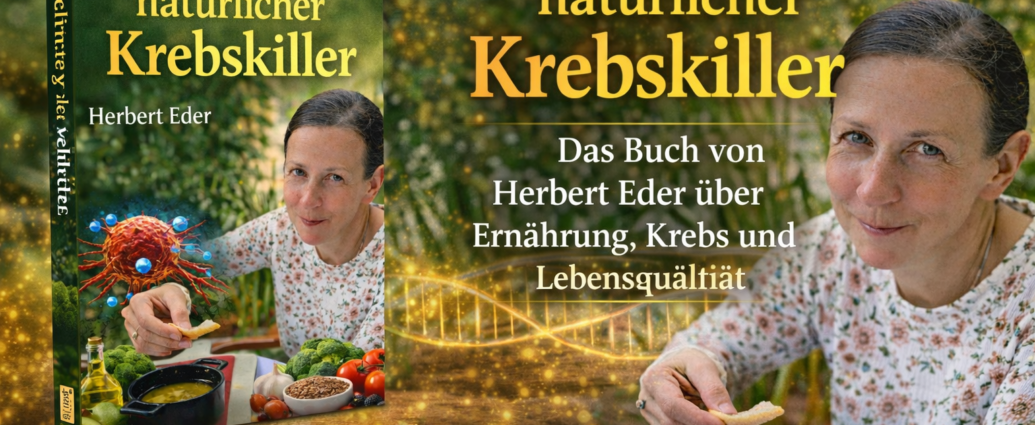
Herbert Eder's book on nutrition, cancer and new ways of oncological support
With „Nutrition as a natural cancer killer“ presents Herbert Eder a book that addresses a topic that is of enormous importance to many people: the role of nutrition in Cancer prevention, Therapy support, Side effect management and Quality of life.
This work is far more than a general guide to healthy eating. It is a well-founded, differentiated and at the same time practical examination of the question of what significance nutrition can actually have in an oncological context. Herbert Eder sheds light on various forms of nutrition, explains their theoretical background, describes opportunities and limitations and shows that nutrition deserves much greater importance in the treatment of cancer than it is often given in everyday life.
Even the title „Nutrition as a natural cancer killer“ is a deliberately powerful choice. It draws attention and makes it clear that nutrition is not understood here as a secondary health factor, but as a central element of a broader understanding of oncology. The book is aimed at people who are not just looking for superficial tips, but for real guidance in a field characterized by uncertainty, contradictions and many unanswered questions.
Why this book is so important today
Anyone who is confronted with the subject of cancer almost always asks the same question sooner or later:
What can I do myself?
This is precisely where Herbert Eder comes in. Because many sufferers, relatives and interested parties experience that although nutrition is often described as important, there is often a lack of concrete and comprehensible recommendations in everyday life. At the same time, countless diet trends, simplified promises of salvation and contradictory statements are circulating. This often leads to uncertainty, excessive demands and mistrust.
This book provides clarity. It does not regard nutrition as a fad, but as a serious component of a holistic approach to health, metabolism and oncological stress. It deals with the question of which forms of nutrition are scientifically discussed, which biological mechanisms play a role, how realistic it is to implement them in everyday life and what patients should actually pay attention to.
For this very reason, this work is of great practical value. It provides orientation without simplifying. It opens up perspectives without conveying a false sense of security. And it shows that nutrition in connection with cancer is neither trivial nor secondary, but an area that deserves more attention.
A book that brings science and everyday life together
A particular advantage of this book is its broad and at the same time clear thematic focus. Herbert Eder combines Tumor biology, Metabolism, Inflammation, Insulin-IGF-1 axis, oxidative stress, Microbiome, Immunomodulation and Body composition with specific questions of nutritional practice.
The result is not a superficial health guide, but a book with substance. It shows that nutrition should not be reduced to calories or prohibitions, but is closely linked to many biological processes that can play an important role in cancer in particular.
What is particularly exciting is that the book does not simply juxtapose different nutritional concepts, but looks at them systematically. Topics such as ketogenic diet, Budwig diet, Mediterranean diet, plant-based diets, High-fiber diet and Protein- and energy-adapted oncological nutrition are categorized in a differentiated way. This makes it clear that there is not one solution for everyone, but that each form of nutrition has its own opportunities, limitations and areas of application.
A new understanding of nutrition in oncology
A central concern of the book is to bring nutrition out of its marginal position in oncology. Far too often, it is still only seen as a supplementary side aspect. Herbert Eder makes it clear that nutrition can be much more: It can have an influence on nutritional status, on the tolerance of therapies, on side effects, on general well-being and on quality of life.
Especially in connection with Fatigue, Loss of appetite, Malnutrition, Muscle loss, Metabolic stress or therapy-related complaints shows how important a targeted look at nutrition can be. The book shows that the right diet is not only interesting in theory, but also plays a real role in the reality of life for many of those affected.
This work is therefore not only aimed at people who are generally interested in health issues, but especially at those who are looking for concrete guidance, comprehensible contexts and in-depth orientation.
The special focus on prevention and quality of life
Another big plus point of this book is that it doesn't just talk about treatment, but also about Prevention. Nutrition is understood here not just as a reaction to illness, but as an area that can have a long-term influence on risk, inflammatory processes, metabolic stability and general health.
At the same time, the work remains close to everyday life. It does not get lost in pure theory, but repeatedly asks about practicability. What use is a nutritional concept if it is not practicable in the patient's life? What risks arise from diets that are too strict? Where is individualization needed? Where does professional support make sense?
It is precisely this combination of theory, Practice and closeness to life make the book particularly valuable.
Not a simple diet, but a differentiated approach
What makes this work so different from many popular health books is its differentiated approach. Herbert Eder does not present any blanket patent remedies or simplified promises of salvation. Instead, he shows that nutrition in an oncological context is complex and needs to be considered individually.
This attitude makes the book serious and credible. It is not a book for people looking for simple buzzwords. It is a book for readers who are prepared to take a closer look. For people who want to understand that nutrition can play an important role in cancer care, but can only be used sensibly if it is considered in a reflected, adapted and responsible way.
Who is this book particularly suitable for?
This book is ideal for:
People with an interest in Nutrition and cancer prevention
Readers who want to take a closer look at oncological nutrition want to employ
Affected persons and relatives looking for sound guidance
Therapists and counselors who see nutrition as part of a broader understanding of health
People who Quality of life, Side effect management and Accompanying measures want to better understand cancer
Conclusion
With „Nutrition as a natural cancer killer“ has Herbert Eder has created a book that treats a central and highly topical subject with seriousness, depth and practical relevance. It shows that nutrition in cancer is far more than just general advice in passing. It can be an important part of prevention, support, stabilization and quality of life.
The work convinces with its broad thematic approach, its comprehensible preparation and its reflective attitude. Anyone who wants to take a closer look at the connections between nutrition, cancer, metabolism, microbiome and oncological support will find this high-quality, stimulating and relevant reading.
A powerful book for anyone who wants to understand health more deeply than just superficially.
Buy now
The book can be ordered directly here:
About the book:
https://www.frequenz-therapie.com/ernaehrung-als-natuerlicher-krebskiller/he-ernaehrung-tumor
Author
NLS Informationsmedizin GmbH, Herbert Eder
Disclaimer
The content presented is for information purposes only. Frequency therapy is not recognized by conventional medicine and does not replace diagnosis or treatment by trained doctors or alternative practitioners.

Comments are closed, but trackbacks and pingbacks are open.