





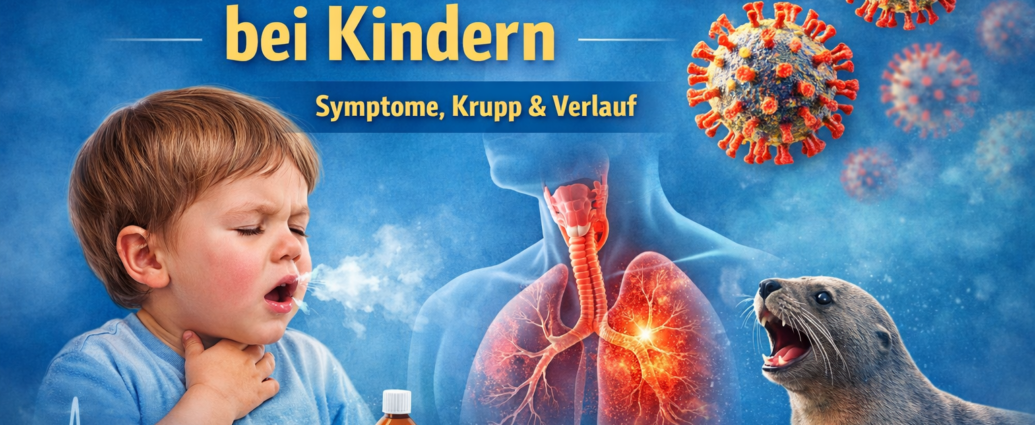
Parainfluenza viruses can cause a barking cough, hoarseness and croup in children. A detailed overview of symptoms, course and classification.
Introduction
Parainfluenza viruses are among the pathogens that repeatedly cause respiratory infections, especially in infants and young children. Although the name is reminiscent of real influenza, they are not classic flu viruses, but a separate group within the paramyxoviruses. They are particularly well-known because they are often associated with the so-called croup syndrome - an illness that often worries parents due to its sudden onset and typical barking cough.
Infections with parainfluenza viruses are particularly common in the cooler months. Many cases are mild and only affect the upper respiratory tract. In some cases, however, the inflammation can go deeper and cause significant symptoms, especially in young children. This is partly due to the fact that their airways are anatomically even narrower and can therefore swell up more quickly.
In this article, we take a closer look at the characteristics of these viruses, their most important symptoms, the typical course of the disease and the possibilities of accompanying support. We also look at complementary perspectives that are discussed in information medicine and frequency medicine, without leaving the ground of responsible classification.
What are parainfluenza viruses?
Parainfluenza viruses are RNA viruses from the paramyxovirus family. They have a single-stranded RNA of negative polarity and are distributed worldwide. A total of four types are distinguished, with type 4 being additionally subdivided into two subtypes. This distinction is important for virological classification, but in everyday life it is mainly evident that all types can cause respiratory infections.
Transmission usually occurs via droplet infection, i.e. through coughing, sneezing or close contact with infected persons. Indirect transmission via hands and contaminated surfaces is also possible. As children are in close contact with other children and their immune system is still developing, infections are particularly common in this age group.
The diseases show a certain seasonality. Typically, clusters occur in late fall, winter and early spring. Adults are affected less frequently or usually show milder symptoms, which is partly due to the fact that they have already had contact with similar virus variants in the course of their lives.
Why are young children particularly affected?
Infants and young children are often more sensitive to respiratory infections than older children or adults. The most important reason for this is their anatomy: the airways are narrower, so even slight swelling in the larynx or trachea can significantly impair the flow of air. What would only cause hoarseness in an adult can lead to noticeable breathing noises in a small child.
In addition, although the child's immune system is capable of learning, it is not yet fully mature. It comes into contact with many pathogens for the first time and can therefore initially react less efficiently. As a result, children are more likely to develop typical illnesses such as laryngitis, laryngotracheitis or the well-known croup syndrome.
Incubation period and onset of the disease
After contact with the virus, it usually takes around two to six days for the first symptoms to become apparent. The illness often begins relatively inconspicuously with symptoms reminiscent of a classic cold. These include
- Runny nose
- Slight increase in temperature or moderate fever
- Cough
- Hoarseness
- General feeling of illness
In many cases, these rather mild symptoms remain. In young children in particular, however, the disease can change and become more pronounced within a short period of time if the inflammation spreads to the larynx and trachea.
Typical symptoms of a parainfluenza infection
The clinical signs depend greatly on the age of the person affected and the extent of the inflammation. While adults and older children often only show mild cold symptoms, young children can have much more pronounced symptoms.
The typical symptoms include
Runny nose and irritation of the upper respiratory tract
It often starts with a runny nose and a slight scratchy throat. These symptoms seem harmless at first, but often mark the beginning of an upper respiratory tract infection.
Barking cough
A particularly characteristic sign is the harsh, dry, „barking“ cough. It is often perceived by parents as unusual and alarming. It is precisely this symptom that is typical of croup syndrome.
Hoarseness
Due to the involvement of the larynx, the voice sounds raspy, overheated or clearly hoarse. This is often quickly noticeable in young children.
Inspiratory stridor
Stridor is a whistling or harsh breathing noise. An audible noise when inhaling is particularly typical and is caused by a narrowing of the upper airways. This symptom should be observed carefully.
Mild to moderate fever
Not every parainfluenza infection is accompanied by a high fever. Often the temperature is only slightly elevated.
Restlessness, nocturnal deterioration
Many cases worsen in the evening and at night. The sudden onset at night with a barking cough and stridor is very characteristic of croup.
Croup syndrome: Why the symptoms appear so suddenly
Croup syndrome, often medically described as laryngotracheobronchitis, is an inflammation of the larynx, trachea and sometimes also the bronchi. The symptoms are not only caused by the virus itself, but mainly by the inflammation-related swelling of the mucous membranes and increased mucus production.
As the larynx is particularly narrow in small children, even moderate swelling can lead to distinct breathing noises and coughing fits. This explains why the symptoms often suddenly appear dramatic, even though the infection seemed comparatively inconspicuous during the day.
It typically starts in the middle of the night. The child wakes up, coughs barking, seems worried and breathes in audibly. This situation is often frightening for parents, even though many cases ultimately remain mild.
Infestation of the lower respiratory tract
In some cases, the infection is not limited to the upper respiratory tract. Especially in very young children, deeper parts of the respiratory tract may also be involved. This can lead to more severe symptoms, such as
- Significantly more difficult breathing
- Faster breathing
- more pronounced general impairment
- stronger weakness
- persistent fever
The younger the child, the more carefully such a course should be monitored. More serious respiratory infections always deserve a precise medical assessment.
Symptoms in older children and adults
Interestingly, the same group of viruses is often much milder in older children and adults. There, the symptoms often resemble a classic cold. Those affected tend to suffer from a runny nose, a slight cough, a scratchy throat or hoarseness without developing a pronounced croup.
This is probably due to several factors: larger airways, more previous immunological experience and a better overall functional reserve of the respiratory organs. As a result, the course of the disease is often less dramatic in this age group.
Possible complications
Although many infections are uncomplicated, complications are always possible. These include, in particular, an additional bacterial infection. If the viral inflammation is followed by bacterial colonization, symptoms can be exacerbated or prolonged.
Warning signs of a more complicated course can be:
- Increasing shortness of breath
- Significantly more difficult inhalation
- Conspicuous pallor or blue coloration
- Weak drinking in young children
- severe exhaustion
- High or persistent fever
- Significantly worsened general condition
In such situations, medical clarification is important.
How is the disease treated?
Treatment is primarily based on the symptoms and the severity of the course. This means that the virus is not directly „treated away“ in the traditional sense, but the body is supported and potential dangers are recognized early on.
Depending on the course of the disease, the following measures may play a role in everyday medical care:
- Observation of the general condition
- Adequate fluid intake
- Protection and rest
- Symptomatic respiratory support
- Medical check-up in the event of abnormal progression
Children with croup-like symptoms should always be assessed according to their age and the situation. It is particularly important to remain calm, as excitement can put additional strain on breathing.
Classification from the perspective of information medicine and frequency medicine
In the field of complementary methods, there are concepts that assume that biological systems can be viewed not only biochemically, but also in terms of information and frequency. In such approaches, pathogens, tissue and regulatory processes are understood as part of a complex oscillation and information process.
In this context, so-called frequency-based applications or RFR approaches are also mentioned. It is assumed that certain frequency ranges could have a regulatory effect on biological processes. From a conventional medical point of view, however, this mode of action is not recognized as a proven standard. For this reason, such an approach should only be understood as a complementary consideration, never as a substitute for diagnostics, pediatrics or medical treatment.
Safety, clinical observation and medical responsibility always take priority, especially in the case of respiratory infections in children.
Historically named frequency ranges in complementary concepts
In some alternative medical or frequency-oriented sources, the following frequency ranges are cited for parainfluenza and related viral strains:
338 kHz, 368-372 kHz, 381-384 kHz, 390-397 kHz, 410 kHz, 534 kHz, 564 kHz, 568 kHz
This information originates from complementary concepts and should not be equated with generally recognized conventional medical proof of efficacy. Anyone who engages in such procedures should view them responsibly, critically and always in a complementary manner.
Why clean differentiation is important
Especially in the field of infections, precise language is crucial. There is a difference between speaking from a historical, complementary or research perspective and asserting an established medical fact. In the case of parainfluenza viruses, it is well known medically that they can cause upper respiratory infections and croup, especially in young children. However, the claim that certain frequency applications demonstrably eliminate a virus is not proven in the sense of standard medicine.
For responsible education, this means: inform openly, but classify clearly.
Conclusion
Parainfluenza viruses are frequent triggers of respiratory infections in children and play a particularly important role in croup syndrome. While adults usually only develop mild cold symptoms, infants and small children can show significantly more severe symptoms due to their narrow airways. Typical symptoms include a barking cough, hoarseness and inspiratory stridor, often with a sudden onset at night.
Treatment is based on the symptoms and severity. Good observation is crucial, especially in young children and when there are signs of airway obstruction. Complementary approaches such as frequency-based models are discussed in some circles, but are not part of generally accepted standard medicine. They should therefore only be considered - if at all - as an adjunct and never instead of a sound medical assessment.
Disclaimer
Note: This article is for general information and does not replace a medical diagnosis or treatment. Frequency therapy is not recognized by conventional medicine and cannot replace therapy with trained doctors or alternative practitioners.


Comments are closed, but trackbacks and pingbacks are open.