



Teaser: What we know about EMF - and how frequency therapy can provide holistic support.
- EMF briefly explained: RF, IF, ELF, static fields
- 1) RF fields (cell phone, mobile radio): what does the evidence show?
- Children: a real „data blind spot“
- 2) IF fields: too little data, but growing relevance
- 3) ELF fields (electricity grid): where the debate is toughest
- 4) Static magnetic fields (e.g. MRI): focus on occupational safety
- 5) What research (still) needs
- Practical prevention in everyday life (without fear mode)
- Holistic classification: frequency therapy, regulation and cancer
- Conclusion
- FAQ
- Disclaimer
Introduction
Electromagnetic fields (EMF) have long been part of our everyday lives: mobile telephony, WLAN, Bluetooth, household appliances,
High-voltage power lines - even medical devices such as MRI work with strong magnetic fields.
Accordingly, questions such as: „Does cell phone radiation make you ill?“ or „Are children more at risk?“
In this article you will get a sober, study-based overview: What is well researched, where is the data thin?,
and what sensible precautionary measures make sense - without panic, but also without wiping away.
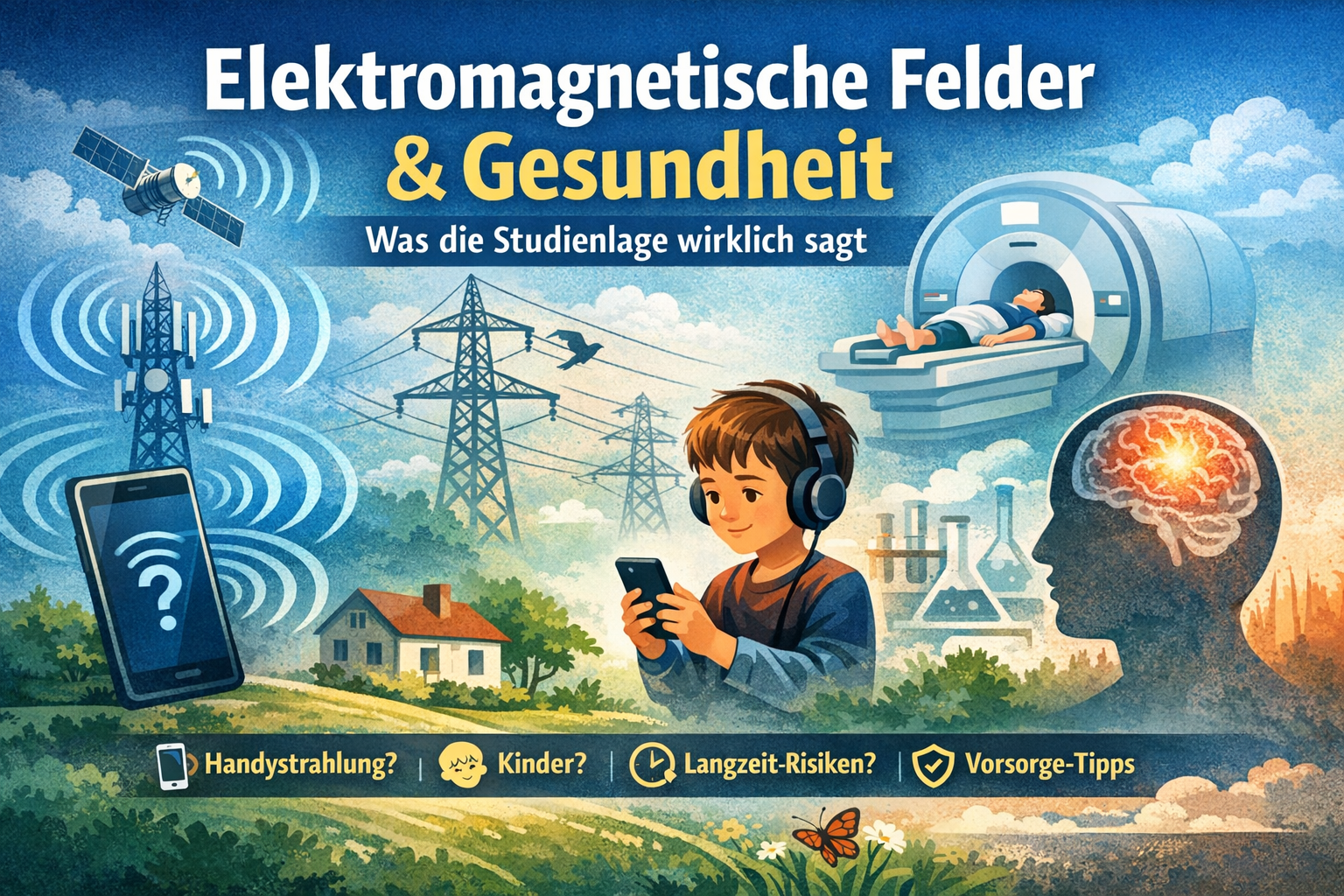
EMF briefly explained: RF, IF, ELF, static fields
Research distinguishes (simplified) according to frequency ranges:
- RF (radio frequency): z. e.g. mobile/cell phone (WLAN is in similar ranges)
- IF (Intermediate Frequency): Intermediate area, increasingly relevant due to new technologies
- ELF (Extremely Low Frequency): z. e.g. 50 Hz from the power grid, cables, transformers
- Static magnetic fields (SF): z. e.g. MRI environments
- Environmental/ecosystem effects: Impacts on animals/plants are still insufficiently assessed in some cases
1) RF fields (cell phone, mobile radio): what does the evidence show?
Evaluations of scientific studies come to a rather reassuring overall picture for many endpoints -
but with important limitations for long-term use and certain tumor types.
What is often emphasized in overviews:
- For cell phone use under ~15 years shows the overall epidemiological picture no clear increase of the risk of brain tumors.
- With Prolonged use data are partly sparse - Statements become more uncertain as a result.
- For Acoustic neuroma are mentioned in the literature Indications of possible connections discussed.
- Self-reported symptoms (e.g. headaches, tiredness, dizziness) show No consistent pattern across studies.
Children: a real „data blind spot“
Children and adolescents may be more sensitive due to development, anatomy and potentially lifelong overall exposure.
At the same time, there is a lack of solid, long-term studies on children for many issues. Practical prevention is therefore a sensible, calm strategy.
2) IF fields: „too little data“, but growing relevance
For Intermediate Frequencies data is often thin on the ground. Because technologies in this area are increasing,
become Long-term evaluations and better exposure measurements are more important.
3) ELF fields (electricity grid): where the debate is toughest
With ELF magnetic fields One point remains under discussion: the possible connection with childhood leukemia.
At the same time, mechanisms have not been conclusively clarified and the data situation is not equally strong in all areas.
- No consistent link to „electrical hypersensitivity“ (beyond self-reports)
- For some endpoints (e.g. breast cancer, cardiovascular disease), a connection is considered rather unlikely
- For neurodegenerative diseases and brain tumors, there are still some Uncertainty exist
4) Static magnetic fields (e.g. MRI): focus on occupational safety
With static magnetic fields the data situation is also limited. Particularly relevant here are
Risk assessments for personnel, that regularly works in strong magnetic field environments (e.g. MRI).
5) What research (still) needs
These points are often mentioned so that we can get better answers in the long term:
- Long-term cohort studies (less bias, better follow-up)
- Children's research (directly or via suitable models)
- Better exposure measurement (e.g. realistic everyday measurements)
- Mixed loads (because environment rarely means „only one frequency“)
Practical prevention in everyday life (without fear mode)
Even if many things are not clear, prevention can simple costs little and reduces unnecessary exposure.
Here are some practical basics:
For cell phone & WLAN (RF)
- Distance is king: Use loudspeaker/headset when making phone calls
- Do not carry your cell phone „permanently sparking“ on your body if you don't have to
- At night: Airplane mode or remove the device from the bedroom
- For children: Limit usage time, text/audio rather than long calls to the head
For household & electricity (ELF)
- Permanent workstations (bed/desk) not directly connected to large power sources, multiple sockets, transformers
- For powerful devices (e.g. induction): Keep your distance - continuous exposure is usually more relevant than short peaks
Mini strategy: Implement 2-3 measures that are realistic for you - and then you're good to go.
Constant stress caused by worry can have a greater biological impact than many everyday sources.
Holistic classification: frequency therapy, regulation and cancer
Many people subjectively experience „electrical stimuli“ as stress - regardless of whether studies provide hard biomarkers for this in every case.
From a holistic perspective, it is therefore worth looking at RegulationSleep, autonomic nervous system, relaxation,
subjective well-being.
Frequency therapy is often used in practice as Accompanying approach used to support the organism in the direction of balance
especially in cases of chronic stress, exhaustion or in the context of serious illnesses such as Cancer diseases,
where sleep quality, stress reduction and quality of life can be key issues.
Conclusion
- For many effects there are No consistent evidence below common limit value scenarios.
- However, there are Data gaps with long-term exposure, mixed exposure and in children.
- With ELF & childhood leukemia one connection remains the subject of discussion.
You can take sensible precautions with a few pragmatic measures - without fear mode.
FAQ
Does cell phone radiation cause cancer?
The overall evidence does not provide a clear signal for many tumor types with shorter use. Data is more limited for very long use,
and individual tumor types (e.g. acoustic neuroma) are sometimes discussed separately.
Are children more sensitive?
There are plausible reasons why children could be more sensitive - at the same time, there is a lack of strong long-term data for some questions.
Cautious reduction (without panic) is therefore a pragmatic approach.
Should I switch off WLAN at night?
If it calms you down: yes. It's a simple measure - and many people also notice a positive effect on their sleep hygiene,
because the cell phone is automatically less „present“.
Disclaimer
Frequency therapy is not recognized by conventional medicine. The contents are for information purposes only and do not replace any diagnosis or treatment
by doctors or alternative practitioners. In the event of complaints or illnesses - especially suspected cancer
please contact a healthcare professional.