




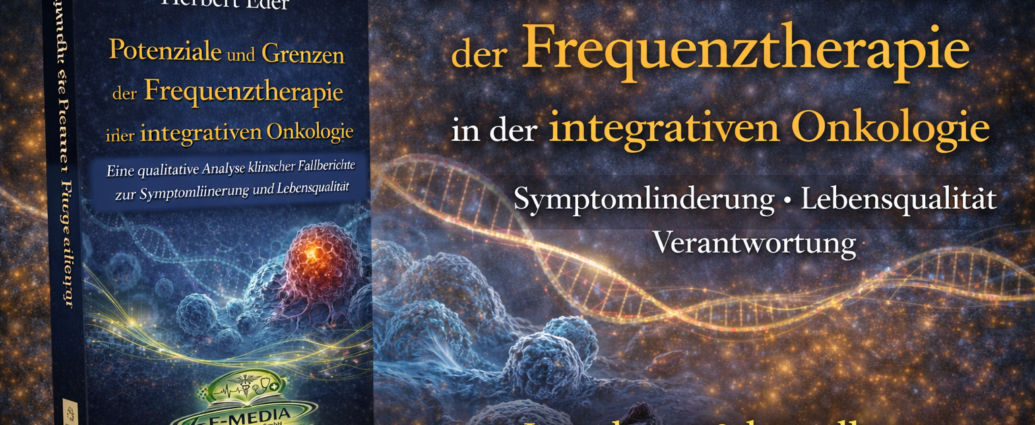
A book by Herbert Eder about quality of life, symptom relief and responsible support
There are books that polarize. And there are books that shed light on a complex topic with the necessary seriousness, depth and human sensitivity. „Potentials and limits of the Frequency therapy in integrative oncology“ from Herbert Eder clearly belongs to the second category.
The title alone makes it clear that this is not about simple promises or bold claims. This work poses a challenging question: what role can frequency therapy play in the context of a integrative oncology actually play when it comes to Symptom relief, Quality of life and the responsible support of people with cancer? It is precisely this sober, but at the same time deeply human question that makes the book so relevant.
After all, anyone dealing with cancer inevitably encounters one of the most central challenges of modern medicine: it is not just about fighting tumors. It is also about exhaustion, sleep, fear, loss of strength, hope, resilience and the question of how quality of life can be maintained or improved under difficult conditions. Herbert Eder addresses this area of tension with great care and approaches it from a perspective that combines scientific classification, biophysical thinking and clinical observation.
Why this book is so important today
Oncology has made enormous progress in recent decades. Diagnostics, surgery, radiotherapy, chemotherapy, targeted drugs and immunological treatment approaches have profoundly changed cancer medicine. At the same time, these advances have also given rise to a new awareness: Treatment is not only successful if it is medically and technically effective. It must also be measured by how people experience it.
This is precisely where this book comes in. It takes seriously the dimension that is often given too little space in everyday perception: the subjective stress of those affected. Fatigue, sleep disorders, exhaustion, inner tension, reduced resilience and the loss of quality of life are among the most formative experiences of their illness for many cancer patients. Therein lies the high topicality of this work.
Herbert Eder shows that the discussion about complementary and supportive procedures in oncology should not be conducted ideologically, but with clarity, differentiation and a sense of responsibility. This is precisely why this book publication is so important: it neither denies the importance of conventional medicine nor glorifies complementary approaches. Rather, it attempts to create a serious space for a reflective discussion of frequency therapy within an integrative oncological understanding.
What this book is about
The book focuses on the question of whether and to what extent frequency therapy can be used in the integrative oncology a contribution to Reduction of stressful symptoms and to the Improving the quality of life can provide. This is expressly not about replacing established medical tumor therapies, but about supporting and accompanying their use in a clinical and palliative context.
The book combines several major topics. It begins by examining the biological and systemic foundations of cancer and then introduces the reader to concepts of modern oncology and integrative cancer care. Building on this, it addresses the fundamentals of frequency therapy, its biophysical models, its assumptions of effectiveness, technical aspects as well as its limitations and safety issues.
What is particularly exciting is that the book does not leave these theoretical considerations in the abstract. Rather, clinical case reports are presented with regard to Symptom relief, Fatigue, Load capacity and Quality of life viewed qualitatively. This is precisely what gives the publication its special character: it is neither purely theoretical nor merely popularly written, but operates at the interface of model, observation and practical relevance.
What makes this book special
The real strength of this work lies in its attitude. Herbert Eder does not write in a missionary manner, but in a balanced way. The book's title already contains the decisive quality: it speaks not only of potential, but also of Boundaries. This alone lends this publication a high degree of credibility.
In many discussions about complementary methods, it is precisely this balance that is missing. Either such methods are hastily rejected or uncritically exaggerated. This book takes a different approach. It attempts to neither belittle nor glorify the topic of frequency therapy in oncology, but to place it in a serious, responsible and differentiated context.
In addition, there is the combination of a biophysical perspective, clinical questions and ethical reflection. The work not only asks what could be theoretically possible, but also what a safe, transparent and responsible application should look like. This is precisely where its maturity shines through. It is not a book for hasty answers, but for a deeper understanding.
Another plus point is the clear embedding in integrative oncology. Frequency therapy does not appear here as an isolated concept, but as part of a larger question: How can a person with cancer be supported holistically without abandoning scientific standards and without creating false hope? This question gives the book depth and makes it particularly valuable for many readers.
A book about quality of life, not illusions
Anyone reading this book will quickly realize that it is about more than just technology or theory. Ultimately, it is about people in an exceptional oncological situation. It is about the question of what support can look like that not only looks at tumor parameters, but also at exhaustion, sleep, inner stability and subjective experience.
Especially in oncology, the topic of Quality of life of enormous importance. Many patients experience that it is not only the diagnosis that is a burden, but also the persistent weakening of the organism, the emotional insecurity and the physical emaciation. The book takes this reality seriously. It asks whether frequency therapy in a supportive setting can help to alleviate symptoms and strengthen people in their resilience.
This focus makes the book presentation particularly powerful. It shows that the work does not focus on sensationalism, but on dignity, clinical relevance and genuine support.
The role of integrative oncology
Another key value of the book lies in its anchoring in the concept of integrative oncology. This field has been gaining in importance for years because more and more people want cancer care that not only offers standardized therapies, but also integrates supportive, quality-of-life-oriented and patient-centered elements.
Herbert Eder picks up on this development and shows that integrative oncology only makes sense if it is based on clear differentiation. Complementary procedures must be measured by responsibility, transparency and realistic communication. This is precisely why the book remains serious and professional.
It is this combination of openness and critical classification that gives the work its special profile. It invites us to think further without drifting into arbitrariness. It poses questions without creating premature certainties of salvation. And that is precisely why it appeals to readers who are looking for depth and seriousness.
For whom this book is particularly suitable
This book is particularly recommended for people who want to take a serious look at the possibilities and limitations of complementary methods in oncology. It is aimed at readers who are not looking for quick buzzwords, but for well-founded classification.
It is particularly suitable for:
People with an interest in integrative oncology and supportive cancer care
Therapists, counselors and professionals who deal with Frequency therapy, Quality of life and Symptom relief deal with
Readers who have a differentiated understanding between Potential and Border search
People who want to combine biophysical thinking, clinical observation and ethical responsibility interested
Patients and interested parties who are concerned with the question of what supportive care for cancer can look like without replacing conventional medicine
Why this book publication is convincing
This work is particularly convincing because it takes the subject seriously. It does not turn frequency therapy into a buzzword, but a touchstone for the question of what responsible integrative medicine can look like. Herbert Eder succeeds in striking a tone that is neither coldly academic nor emotionally exaggerated. Instead, the result is a text that is both professionally ambitious and humanly accessible.
The strength of the book lies in its clear perspective: cancer is not only seen as a local tumor process, but as a profound systemic burden. This results in the central importance of supportive measures that are not based on promises of a cure, but on Stabilization, Accompaniment and Quality of life are aligned.
This is precisely where the power of this publication lies. It lends structure, dignity and depth to a difficult topic.
Conclusion
With „Potentials and limitations of frequency therapy in integrative oncology“ has Herbert Eder has presented a book that addresses a sensitive and challenging topic with remarkable seriousness. It is a work about possibilities and responsibility, about supportive care and scientific classification, about biophysical thought models and the concrete reality of oncological stress.
This book publication is particularly valuable because it does not look for simple answers. It asks differentiated, reflective and practical questions. It makes it clear that integrative oncology is not about replacing necessary tumor therapies, but about the serious question of how symptoms can be alleviated and quality of life improved.
Anyone looking for a book that integrative oncology, Frequency therapy, Symptom relief and Clinical responsibility into a high-quality context will find this a powerful, thought-provoking and inspiring read.
Order now
The book can be ordered directly here:
About the book:
Potentials and limitations of frequency therapy in integrative oncology | he-onko-pot
Author
NLS Information medicine GmbH, Herbert Eder
Disclaimer
The content presented is for information purposes only. Frequency therapy is not recognized by conventional medicine and does not replace diagnosis or treatment by trained doctors or alternative practitioners.

Comments are closed, but trackbacks and pingbacks are open.