



What the IARC Group 1 classification really means (with evidence check 2015-2025)
Abstract
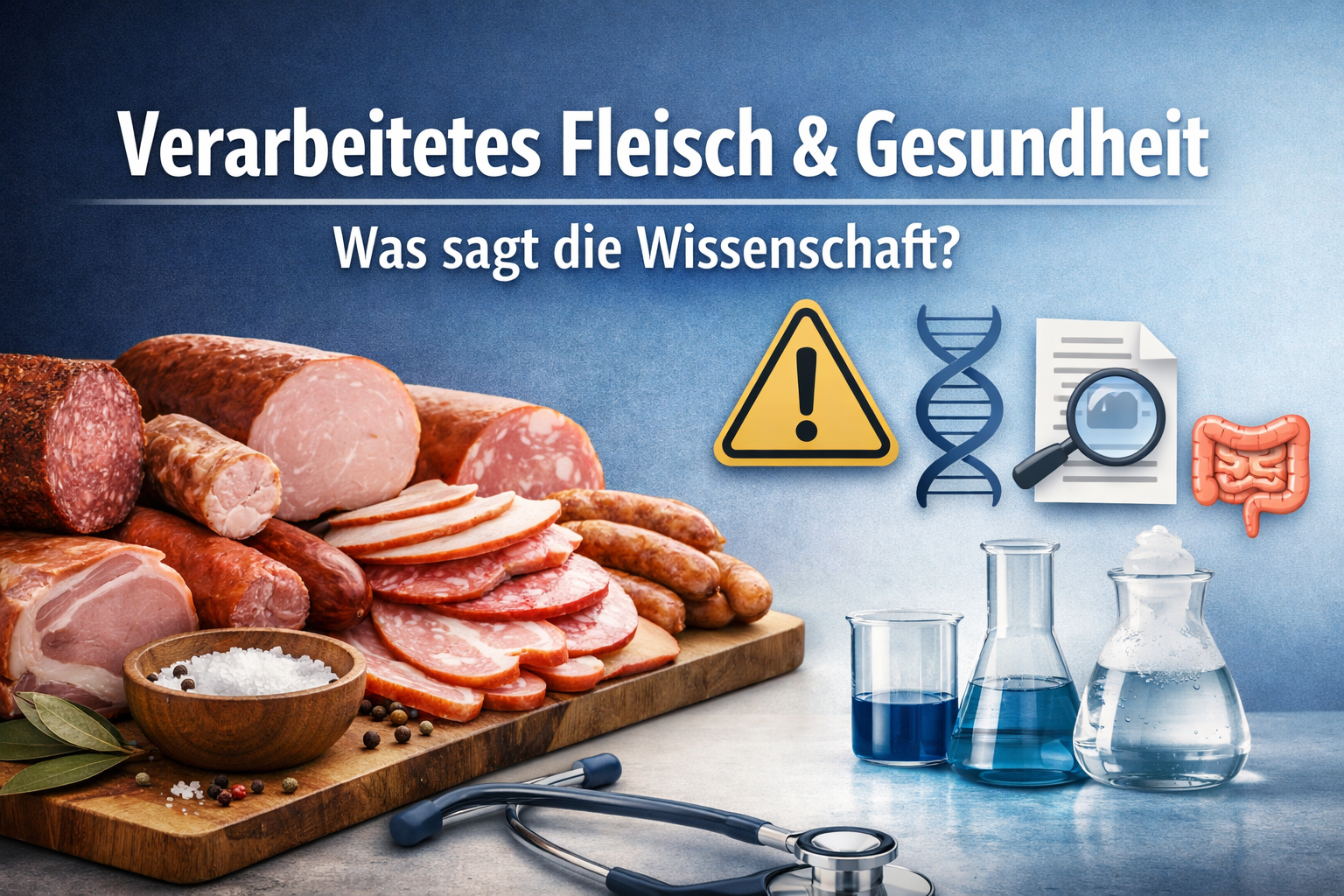
The WHO's International Agency for Research on Cancer (IARC) classifies Processed meat as „Carcinogenic to humans“ (Group 1) - with the most robust evidence for colorectal cancer. This classification is often misunderstood in social media: Group 1 describes the strength of the evidence (hazard), not the size of the risk. This article classifies the assessment scientifically, discusses the epidemiological evidence (including dose-response relationships), central limitations (confounding, measurement errors), plausible mechanisms (including N-nitroso compounds) and evaluates recent meta-regression analyses (Nature Medicine 2025).
1 Definitions: What counts as „processed meat“?
The WHO describes Processed meat as meat that has been Salting, curing, fermenting, smoking or other processes has been modified to increase taste/shelf life (e.g. ham, sausage, bacon, hot dogs, salami).
This definition is important because exposures (e.g. nitrite curing salt, smoked products, heat treatment, salt content) vary greatly depending on the product - and therefore also the potential biological mechanisms and measurement errors in nutritional studies.
2. IARC classification: „Group 1“ means hazard, not „same risk as tobacco“
The IARC evaluates the question: Can an agent cause cancer? (hazard identification). It evaluates not primarily the individual level of risk or „dangerousness“ in everyday life. The WHO explicitly emphasizes that the classification is the Strength of the evidence not the level of risk; therefore „in the same category as tobacco“ is formally correct, but misleading without classification.
Consequence for communication:
- „Group 1“ = Sufficient evidence in humans
- Not automatically = „very high risk“, but: „evidence is strong enough to plausibly support causality“.
3. what evidence led to the Group 1 classification in 2015?
The IARC working group relied on epidemiological studies, supplemented by animal and mechanistic data (monographs program). A central, often quoted quantification is: per 50 g of processed meat per day (≈ a small portion, depending on the product) ~18 % higher relative risk for colorectal cancer.
3.1 Relative vs. absolute risk
The 18 % are a Relative risk (RR increase) - no statement that „18 % of consumers get colorectal cancer“. The absolute risk difference depends on the Initial risk (age, genetics, screening, lifestyle, overall diet). It is therefore scientifically sound to always define relative effects as Context size not as the sole basis for communicating fear.
3.2 Dose-effect and consistency
Dose-response findings (more consumption → higher risk) support causality arguments according to Bradford-Hill criteria, but are methodologically challenging in nutrition research because exposure is often roughly recorded (FFQs, recall bias).
4 Methodological key points: What can nutritional epidemiology (not) do?
Most of the data on the „processed meat ↔ disease risks“ link comes from Observational studies (cohorts, case-control). This results in typical challenges:
4.1 Confounding (residual confounding)
Processed meat products often correlate with other factors: lower fiber intake, less fruit/vegetables, smoking, alcohol, less exercise, socioeconomic factors, etc. Even with statistical adjustment Residual confounding possible - especially if confounders are measured incompletely or inaccurately.
4.2 Measurement error of the exposure
Nutrition is often estimated using questionnaires; portions/product types are variable. Measurement errors often lead to Bias towards zero (underestimation), but can also generate distortions if misclassification is systematic.
4.3 Heterogeneity
„Processed meat“ is not a uniform substance: cured vs. heavily smoked vs. highly heated; nitrite/salt content, preparation, accompanying food. This makes it difficult to make precise, product-specific statements.
Practical conclusion:
The IARC classification shows: Evidence is sufficient for „may cause cancer“. For the exact Risk level in subgroups remains uncertain.
5. mechanisms: Why might processed meat have a cancer-promoting effect?
The IARC describes that processing such as Curing and smoking Education carcinogenic chemicals can lead to - among other things. N-nitroso compounds and polycyclic aromatic hydrocarbons.
These mechanistic data are important because they provide the biologically plausible bridge between exposure and endpoint. The mechanism is not „a single substance“, but rather a Ensemble from:
- Formation of reactive compounds (e.g. N-nitroso chemistry),
- oxidative/nitrosative stress,
- Interactions with gut microbiome and inflammatory processes (depending on study design/interpretation).
6. the status up to 2025: „Burden-of-Proof“ meta-regression (Nature Medicine 2025)
A much-discussed paper (Nature Medicine 2025) used Burden of proof meta-regression, to establish dose-response relationships for processed meat (as well as sugary drinks and trans fats) in relation to Type 2 diabetes, ischemic heart disease and colorectal cancer to quantify.
Essential points for a scientific classification:
6.1 What this method aims to achieve
The BoP approach attempts to provide conservative, evidence-weighted risk estimates, including uncertainties and potential biases. This is methodologically interesting because dietary effects are often small and highly dependent on study design/adjustment.
6.2 What the results (and the authors) should not claim
The study also reports associations at comparatively low quantities; at the same time, the strength of evidence in the BoP framework as rather weak (often abbreviated in the public debate).
From this follows scientifically: Indication of risk yes, Causality and exact threshold remain reliable to a limited extent in observational data.
6.3 „No safe quantity“ - how to formulate this precisely
Some organizations state that No intake level with „certainly zero risk“ can be linked. A WCRF factsheet states that there are no level, that with certainty „imply “no increased risk".
The choice of words is scientifically clean: „cannot be proven to be risk-free with a high degree of certainty“ is something other than „Proven: every smallest amount causes damage“.
7. consensus-based recommendations: „Few, if any“
The World Cancer Research Fund (WCRF) clearly summarizes the prevention message: „Eat little, if any, processed meat“ and red meat only moderately.
AICR (the American WCRF partner organization) also communicates in a very similar way.
These recommendations are close to consensus because they respect the core of the evidence without making false equations („like tobacco“).
8 What social media posts often misrepresent
Common error 1:
„Group 1 = as dangerous as tobacco“
Correction: Group 1 = Evidence strong, not „risk equal to high“.
Common error 2:
„18 % more risk“ without context
Correction: Relative risk, depending on initial risk; also dose, product mix, overall lifestyle.
Common error 3:
„Proven: no safe quantity“
Correction: Observational data often cannot identify a clear threshold; serious is: no quantity that Reliable is shown to be risk-free.
9. conclusion
- The IARC assessment supports the statement that Processed meat one carcinogenic hazard with the most robust evidence for colorectal cancer.
- The classification as Group 1 is a statement about the Strength of evidence, not about the Risk size compared to other Group 1 agents.
- Dose-response analyses (including BoP approaches up to 2025) suggest a correlation even at lower quantities, whereby the Evidence quality and residual bias are to be considered transparently.
- Prevention-oriented organizations therefore take a pragmatic approach: „little, if at all“ processed meat.
Sources
- WHO Q&A: IARC assessment, definitions, hazard classification
- IARC press release PR240 (50 g/day ≈ +18 % CRC risk)
- IARC Monograph page (mechanisms, including N-nitroso compounds)
- Nature Medicine 2025 (BoP meta-regression; PM, T2D, IHD, CRC)
- WCRF recommendation „little, if any, processed meat“
- WCRF factsheet (wording for „no level certainly risk-free“)
What does the IARC Group 1 classification mean for processed meat?
The IARC Group 1 classification means that there is sufficient evidence for the carcinogenic effect of processed meat for humans, especially for colorectal cancer. It is an assessment of the strength of evidence, not the magnitude of risk.
What exactly are processed meat products according to the WHO definition?
Processed meat products are meat that has been altered by salting, curing, fermenting, smoking or other processes to improve flavor or shelf life, such as ham, sausage, bacon, hot dogs and salami.
What does the classification in group 1 mean for the risk assessment?
The classification in Group 1 assesses the strength of the scientific evidence for the carcinogenic effect and not the individual risk or the danger in everyday life. It indicates that the evidence for causality is plausible.
What scientific evidence led to the classification of processed meat as carcinogenic?
The assessment is based on epidemiologic studies, animal and mechanistic data showing that processed meat consumption is associated with an approximately 18 % higher risk of colorectal cancer per 50 g daily.
Why is the statement „there is no safe amount of processed meat“ scientifically appropriate?
Because observational studies cannot identify an exact threshold for a safe level, it is reputable to say that no intact level can be proven to be risk-free with high certainty, rather than claiming that any amount causes harm.
Study critique box: How reliable are statements on processed meat?
1. observational data ≠ randomized evidence
Most of the findings on processed meat come from Cohort and case-control studies. These show Associations, no „hard“ evidence such as randomized long-term trials (which are practically impossible to conduct in cancer). Nevertheless, the IARC classifies Group 1 because the overall evidence (including consistency, dose-effect, mechanisms) is strong enough. (who.int)
2. confounding: sausage eaters often live „differently“
Processed meat products often correlate with other risk factors (e.g. less fiber/vegetables, more alcohol, smoking, less exercise). Studies try to control for this statistically, but Residual confounding remains possible - especially if lifestyle factors are inaccurately recorded. This is a core problem of nutritional epidemiology and one of the reasons why recent analyses explicitly emphasize uncertainty. (nature.com)
3. measurement errors in nutrition: „How much ham?“ is difficult to measure
Nutrition is usually recorded via food frequency questionnaires or reminder logs. This leads to:
- Portion and recall errors
- unclear product definitions („ham“ ≠ „salami“ ≠ „hot dog“)
- Changes over time (people do not eat the same for 10 years)
Such measurement errors often dilute effects (bias towards zero), but can also create distortions if certain groups systematically report differently. (who.int)
4. heterogeneity: „Processed meat“ is not a uniform substance
Processed meat„ covers very different products (nitrite curing salt, smoking, fermentation, salt content, preparation). This makes it difficult:
- clear Dose-response curves
- „one“ safe/unsafe threshold
- Transferability between countries/product standards
Mechanistically relevant are, among others. N-nitroso compounds and other process/smoking by-products - but their quantities vary greatly. (publications.iarc.who.int)
5. effect sizes: Why RR 1.07 should be read differently from RR 1.18
Many nutritional risks lie in the area of RR 1.05-1.20. That is:
- not huge (compared to smoking and lung cancer),
- but relevant at population level because a large number of people are exposed.
Important: Small RRs are also more susceptible to bias. That is why the combination of Consistency, Dose-effect, Mechanisms and Plausibility decisive.
6 „Group 1“ vs. „18 % per 50 g“ - which is robust?
- Robust: Hazard classification (Group 1) + focus on Colorectal cancer. (who.int)
- Quantification (18 % per 50 g/day): useful as a guide, but dependent on study spectrum, exposure measurement and populations. (iarc.who.int)
7 What does the Nature Medicine 2025 analysis really say?
The 2025 work utilizes a conservative Burden of proof approach and reports connections of processed meat with, among others. Type 2 diabetes, ischemic heart disease and colorectal cancer, but at the same time emphasizes the limited strength of evidence in their rating system. It follows that: Risk plausible, exact thresholds/sizes uncertain. (nature.com)
Mini conclusion
The evidence is strong enough to classify processed meat as carcinogenic risk factor seriously - but science is working here with Probabilities, not with „ham = cancer“. Serious is: Reduce frequent consumption, without false equations („like tobacco“) and without absolute statements („any amount is certainly fatal“).