


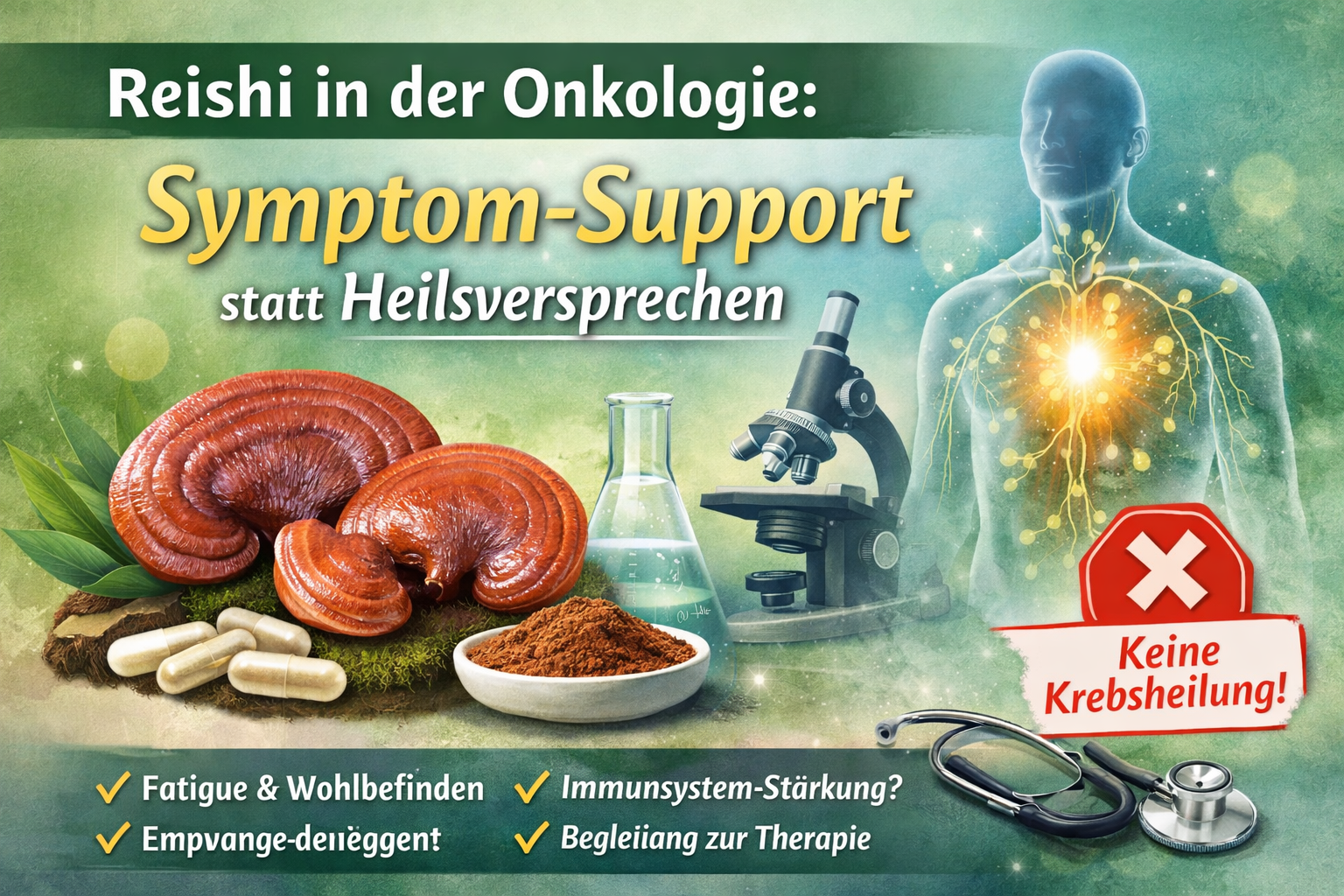
Many cancer patients are looking for something that gives strength, cushions side effects and „strengthens“ the immune system“ - without false hopes. Reishi (Ganoderma lucidum, „Lingzhi“) is often mentioned here. The good news: There are rational starting points and some clinical evidence for support effects. The important limitation: Reishi is not a cancer cure and should never be marketed as a substitute for standard oncological therapies.
What is Reishi - and why is it so interesting?
Reishi is a traditionally used medicinal mushroom. Scientifically, the focus is primarily on two groups of substances:
- Polysaccharides (including beta-glucans) → immunomodulating effects
- Triterpenoids → Inflammation-related and metabolic effects (preclinical)
These mechanisms are biologically plausible, but mechanism ≠ clinical evidence for tumor effect.
What does the clinical evidence in oncology really say?
The best-cited overall view is the Cochrane evaluation:
- Not sufficient, to use Reishi as First-line or „cancer therapy“.
- Possibly as an add-on (adjunctive) makes sense - especially in the context of immune parameters and partly Tumor response in small studies, but with limited data quality overall.
Integrative oncology sources also emphasize: Small studies indicate support benefits, but it needs more robust data.
Put positively: If Reishi has a place, then most likely as Symptom support - not as a promise of salvation.
Where Reishi is most likely to have a „positive“ effect in practice: Symptom support
Depending on the situation, patients report (and individual studies/observations indicate) that reishi can provide support for
1) Fatigue, energy, resilience
Cancer-associated fatigue in particular is common - and many people are looking for „something natural“. In patient-related surveys, users sometimes report noticeable improvement in symptoms (self-reported outcomes).
2) Sleep, stress regulation, „getting through therapy better“
Reishi is traditionally described as „adaptogenic“. Clinical data is mixed here, but it is often used in integrative oncology. for support accompaniment discussed.
3) Immunomodulation (not „immune boost“)
Reishi can Immune markers (e.g. in study contexts). This can be interesting - but does not automatically mean „tumor disappears“.
The red line: symptom support vs. promises of salvation
This is the clear boundary that I also draw in communication. deliberately positive-serious would draw:
✅ Serious: „Can help with fatigue/general well-being, possibly immune parameters - as a supplement.“
❌ Dubious: „Cures cancer“, „replaces chemo“, „kills tumors safely“, „guarantees remission“.
It is precisely because reishi is popular that it is often exaggerated in marketing - and that is simply dangerous in oncology.
Safety: what you need to be aware of in oncology
Reishi is often considered to be well tolerated, but there are Relevant interactions - particularly important for standard oncological drugs and concomitant therapies:
- Blood clotting: Possible increased risk of bleeding with Anticoagulants/platelet inhibitors
- Blood sugar & blood pressure: Possible additive effects (hypoglycemia/hypotension)
- Immunosuppression/Transplant: with particular caution due to immunomodulatory effects
Practical rule (very useful): Reishi always with the oncology team - especially before surgery, under anticoagulation, with liver problems or complex therapy regimens.
Practical implementation (without dogma)
If Reishi is used, then it is best used in this way:
- Qualitystandardized extracts, transparent analyses (heavy metals/pesticides), reputable manufacturers
- Start low, go slowStart low, observe tolerance
- Time window: clarify all aspects of chemo/immunotherapies particularly carefully (interactions/uncertainties)
- Define goal: „I want to support X (e.g. fatigue/sleep).“ - not „I want to cure the tumor.“
Myths vs. facts (box)
Myth: „Reishi strengthens the immune system - so it fights cancer.“
Fact: Immunomodulation is possible, but clinical tumor benefit is not secured.
Myth: „Of course = always safe.“
Fact: There are Interactions (especially blood clotting, blood pressure, blood sugar).
Myth: „Reishi can replace chemo.“
Fact: There are No reliable evidence; Cochrane does not see it as first-line.
Conclusion
Reishi can be used in oncology a meaningful place as a support module have - especially if the goal Symptom relief, stabilization of the general condition and better tolerability is. At the same time: No promises of salvation, not going it alone, but integrated into an overall concept (oncology, nutrition, exercise, psycho-oncology - and, if necessary, other complementary procedures such as frequency therapy, always without any claim to replacement).
Author: NLS Informationsmedizin GmbH - Herbert Eder
Note: This article is for information purposes only and does not replace medical advice. Please always consult the oncology team treating you before making any decisions about nutritional supplements for cancer.