




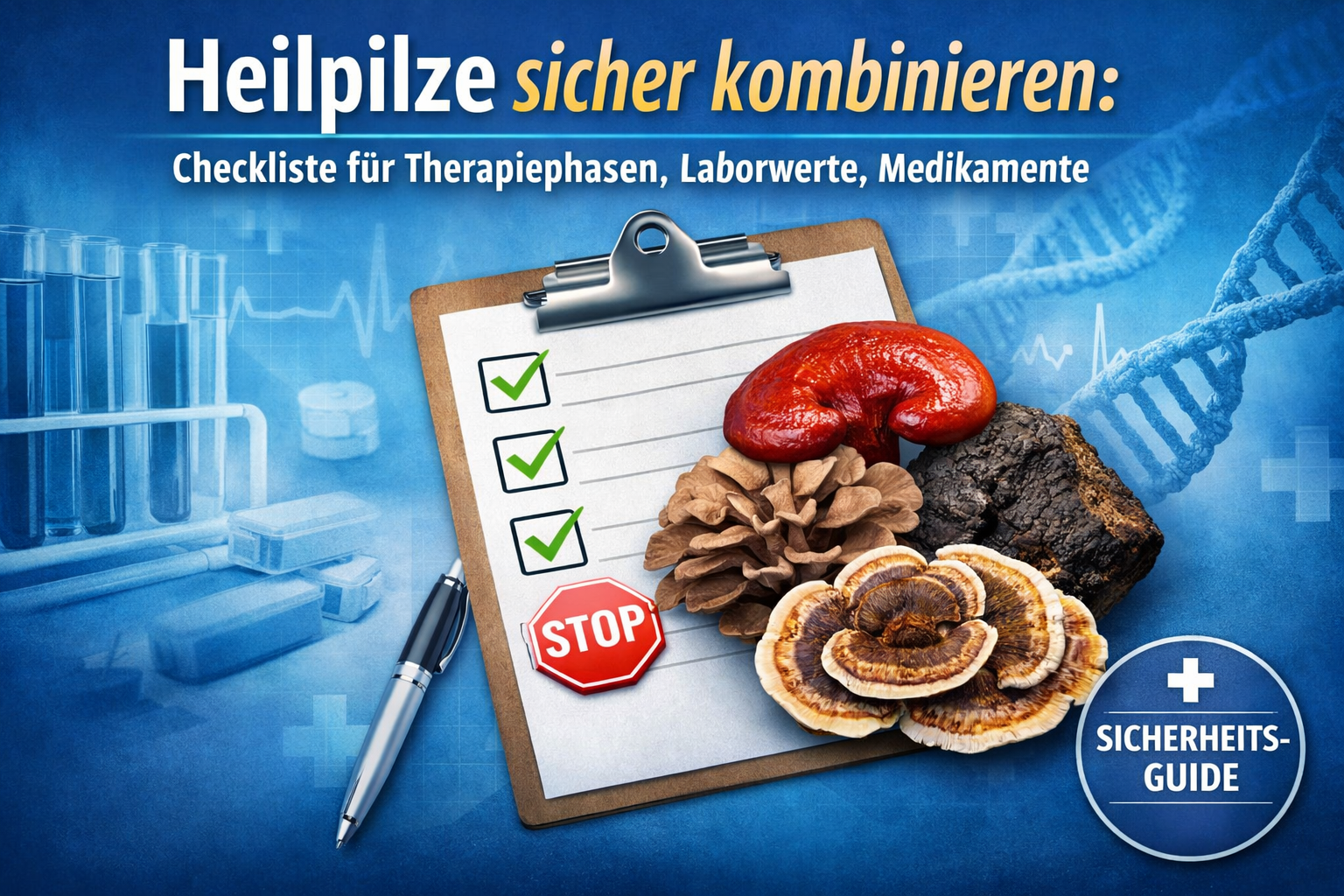
Checklist for therapy phases, laboratory values, medication
Medicinal mushrooms (e.g. Reishi, Maitake, Trametes/Coriolus, Chaga) are often used in oncology as accompanying measure - usually with the aim of, Support symptoms (e.g. appetite, sleep, exhaustion, general well-being). At the same time Cancer therapies, Blood values and Medication are involved, „harmless“ quickly becomes „complicated“.
This checklist helps you (and your treatment team) to assess risks in a structured way - without any promises of a cure.
1. the 3 basic rules in advance
Rule 1: Disclose everything.
Name in the oncology team each Product: type of mushroom, brand, extract/powder, dose, start date.
Rule 2: 1 change = 1 variable.
Never start several new preparations at the same time. This way, side effects/interactions can be assigned.
Rule 3: Pause in case of uncertainty.
Especially around surgery, with unstable blood values, infections, new medication.
2. therapy phase check: when is special caution advisable?
2.1 Before surgery / invasive procedures (biopsy, port, dental surgery)
Discontinue 10 days before the procedure, if a product is potentially blood-thinning or if you are taking blood thinners. (This „10-day rule“ is recommended for many supplements/botanicals perioperatively).
Restart only after release (wound healing, hemostasis, no secondary bleeding).
Practical: If you are not sure whether „your“ fungus is relevant to bleeding → treat as relevant to bleeding and pause.
2.2 During chemotherapy
Proceed conservatively if the blood count fluctuates greatly (see laboratory stop rules below).
Extra caution with signs of infection/fever: rather pause until clarified.
Critically check product quality (heavy metals/impurities) - Chemo is not a phase for „something from the internet“.
2.3 During irradiation
Mostly similar to chemo: stable start, Do not experiment with skin reactions, infections or severe inflammation.
2.4 Immunotherapy (checkpoint inhibitors) / strong immunomodulation
Any immunomodulating accompaniment in advance - especially if immune-mediated side effects have already occurred (dermatitis, colitis, hepatitis, pneumonitis, etc.).
The following applies here in particular: do not escalate, when the immune system is „under power“ anyway.
2.5 Targeted therapy / oral cancer drugs
Interactions via liver enzymes/transporters are theoretically possible - particularly sensitive with oral therapies (TKIs etc.).
There is a general warning against supplement interactions via metabolic pathways (e.g. CYP systems).
2.6 After therapy / maintenance / survivorship
Often the safest phase, to start low doses (if blood values are stable and medication is manageable).
3. laboratory value check: Which values are relevant for „mushroom break“?
3.1 Blood count (CBC)
Stop/pause orientation (conservative):
Platelets low (risk of bleeding) → pause until stable.
Neutrophils/leukocytes significantly low (risk of infection) → pause until stable.
Unclear signs of bleeding (hematomas, nosebleeds, blood in the stool) → clarify immediately.
Why so strict? Because during chemo often low blood values and supplements that could promote bleeding/infection are particularly unfavorable.
3.2 Coagulation
INR/Quick unstable or high → No experiments, especially not together with potentially bleeding-relevant fungi.
3.3 Liver values (AST/ALT, GGT, bilirubin)
New or increasing liver values → take a break and seek medical advice.
Reishi is used with Liver injury as a possible side effect.
3.4 Kidney values (creatinine/eGFR)
Reduced kidney function → Check Chaga particularly critically (see medication/risk check below).
In the case of chaga, the risk of bleeding with blood thinners is mentioned, among other things.
4. medication check: the most common „risk combinations“
4.1 Blood thinners / anticoagulants
Examples: Warfarin, DOACs, heparin, ASS/clopidogrel, NSAIDs
High caution / mostly break, because the risk of bleeding may increase.
Specific information:
- Reishi + blood thinnerIncreased risk of bleeding possible.
- Maitake + warfarinIncreased risk of bleeding possible.
- Chaga + warfarinPossible increased risk of bleeding.
4.2 Diabetes medication / insulin
Check hypoglycemia risk, especially with maitake: maitake can lower blood sugar; combination can be problematic.
4.3 Immunosuppressants (e.g. after transplantation, for autoimmune therapies)
Avoid Reishi or only after strict medical clearanceReishi may be „not safe“ for immunosuppression.
4.4 Tumor markers / laboratory diagnostics
Caution with reishi spore powder: can CA72-4 and interfere with test results/treatment.
4.5 Pregnancy/lactation period
Coriolus/Trametes is used for Consultation as safety is unclear.
5) Mushroom-specific short checklist (practical)
Reishi (Ganoderma lucidum)
Risk flags:
Blood thinners (bleeding)
Immunosuppressants (not sure)
Abnormal liver values / liver disease (liver injury possible)
CA72-4 Monitoring (spore powder can influence value)
Maitake (Grifola frondosa)
Risk flags:
Warfarin/blood thinner (bleeding)
Diabetes medication (hypoglycemia)
Chaga (Inonotus obliquus)
Risk flags:
Warfarin/blood thinner (bleeding)
Kidney problems → particularly conservative (clarify with a doctor)
Trametes/Coriolus (Turkey Tail, PSK/PSP)
Notes:
- Often used as an extract as accompanying discussed; side effects may include dark stools/nail discoloration.
- For „Yun zhi (Coriolus versicolor)“, the following is shown in an interaction overview no effect on CYP3A4 (this does not mean „no interactions“, but it is a reassuring point for oral therapies).
6) „Stop rules“: Pause immediately and clarify if ...
- New bleeding, severe hematomas, tarry stools/blood in the stool
- Fever/infection signs under therapy
- Significant new skin rashes, shortness of breath, severe diarrhea (especially under immunotherapy)
- sharply rising liver values or signs of jaundice
- new drugs are used (especially blood thinners, steroids, immunosuppressants)
7) Quality check: So that „medicinal mushroom“ does not become a risk
- Clearly declared mushroom species + part used (fruiting body/mycelium)
- Extract standardization (e.g. beta-glucans) traceable
- Independent laboratory testing (heavy metals, microbiology)
- No „megadosing“ - rather start low, observe, document
8) Documentation template
Start date:
Product/Brand:
Mushroom & Shape: (powder/hot water extract/spore etc.)
Dose:
Target: (e.g. sleep, fatigue, appetite)
Parallel medication:
Laboratory values before the start: Blood count, liver, kidney, coagulation
Check after 7-14 days: Effect/side effects/laboratory
9) Frequency therapy
Some patients also use Frequency therapy to support well-being and regulatory processes - especially during stressful phases of therapy. The same applies here: always complementary, never as a substitute for standard oncological therapies, and consult the treatment team in case of uncertainty.
Disclaimer
This article is for information purposes only and replaces none medical advice, diagnosis or treatment. Medicinal mushrooms can have side effects and interact with medication. Coordination with the oncology team is necessary, particularly during chemotherapy, immunotherapy or target therapies and in connection with operations.
Frequency therapy is not recognized by conventional medicine and cannot replace treatment by doctors or alternative practitioners.
Author: NLS Informationsmedizin GmbH, Herbert Eder