





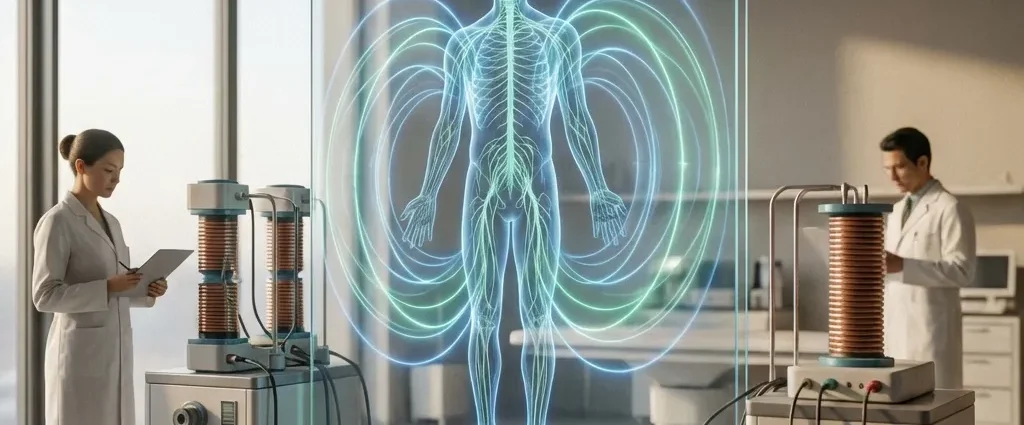
TLDR; The article scientifically classifies frequency therapy 2026 and clearly separates evidence-based bioelectrical procedures from unproven promises of healing. Clinically recognized methods include pulsed electromagnetic fields and non-invasive vagus nerve stimulation, albeit with limited effects depending on the indication. Many popular concepts such as Solfeggio frequencies or universal healing frequencies have not been scientifically proven and should be critically evaluated. Future potential lies in combination therapies, personalized approaches and closed-loop systems, whereby safety, ethics and realistic expectations remain central. In practice, frequency therapy can complement but not replace medication, and reputable providers work in a transparent, evidence-based and indication-specific manner.
Many people have been interested in the scientific studies on frequency therapy 2026 for years. Some hope for new ways to treat chronic complaints. Others are looking for scientific clarity. This is exactly where this article comes in.
In 2026, the scientific study situation on frequency therapy is more differentiated than ever before. There are well-studied bioelectrical procedures with clinical recognition. At the same time, there are methods for which there is still no reliable evidence. This distinction is crucial for therapists, alternative practitioners and patients.
This article provides you with an understandable, honest and up-to-date classification. We take a look at which forms of frequency therapy have been scientifically investigated today. We clarify where there is clinical evidence and where there is not. You will also find out how research in 2026 will deal with topics such as personalization, neurostimulation and combination therapies.
The focus is on clarity rather than promises. On classification instead of marketing. And on practical information that helps you make informed decisions. The scientific study situation on frequency therapy 2026 is not a black-and-white issue. It requires differentiation, understanding and responsibility.
What does frequency therapy mean from a scientific point of view?
The term frequency therapy is used very broadly in everyday life. From a scientific point of view, this is a problem. There is no uniform definition in studies. Instead, very different procedures are summarized under this term.
From a scientific perspective, the focus is not on frequency alone, but on the entire stimulation protocol. This includes signal form, intensity, duration, application site and biological target structure. Only the interaction of these factors allows a comprehensible hypothesis of effect. An isolated consideration of individual Hertz numbers is therefore not meaningful.
In research, the terms bioelectrical therapy, electromagnetic stimulation or neurostimulation are more commonly used. This refers to procedures in which electrical or magnetic fields are used in a targeted manner to influence neuronal activity, cell communication or tissue regeneration.
A key criterion is reproducibility. Scientifically relevant frequency methods must show similar effects under the same conditions. This is precisely where many popular concepts fail. Current frequency therapy research therefore makes a clear distinction between evidence-based methods, experimental approaches and unproven methods.
The following overview shows this classification in simplified form.
| Procedure | Area of application | Evidence status 2026 |
|---|---|---|
| rTMS / tACS | Depression, pain | high |
| PEMF | Osteoarthritis, pain | inconsistent |
| Vagus nerve stimulation | Migraine | increasingly |
| Bioresonance | unspecific | none |
This differentiation is the basis for any serious discussion about clinical evidence bioelectrical therapy.
Evidence-based frequency procedures in clinical medicine
Some frequency-based procedures are now an integral part of conventional medicine. These primarily include transcranial magnetic stimulation and related electrical procedures such as tDCS or tACS.
Repetitive transcranial magnetic stimulation, or rTMS for short, has been used for years to treat therapy-resistant depression. There are also evidence-based applications for chronic neuropathic pain, migraines, post-traumatic stress disorder and obsessive-compulsive disorder.
According to systematic reviews in the Cochrane Library, response rates for depression are around 50 to 60 percent. Remission rates are around 30 to 40 percent. These figures come from randomized controlled trials with standardized treatment protocols and clearly defined inclusion criteria (Cochrane Library).
The high methodological quality is particularly relevant. Placebo controls, sham stimulation and blinded evaluation ensure reliable results. It is precisely these standards that are lacking in many non-clinical frequency applications.
In practice, it is clear that frequency therapy can be highly effective if it is used precisely, according to indication and in line with guidelines. Clinical medicine does not use frequencies as a promise, but as a tool. Further details can be found in the article Frequency therapy for chronic pain - mechanisms of action & applications.
Pulsed Electromagnetic Field Therapy: Between hope and reality
Pulsed Electromagnetic Field Therapy, or PEMF for short, occupies an intermediate position. It has been researched for decades, particularly in the fields of orthopaedics, rehabilitation and pain therapy.
Studies are investigating PEMF for osteoarthritis, back pain, delayed bone healing, wound healing and osteoporosis. However, the results are heterogeneous. Differences in frequency range, intensity and treatment duration make comparison difficult.
Meta-analyses show that PEMF can have moderate effects on pain reduction in knee osteoarthritis, especially in the early stages of the disease. In chronic generalized pain syndromes such as fibromyalgia, the benefit remains unclear.
Reviews in the Pain Physician Journal come to the conclusion that the evidence is highly indication-dependent. Evidence exists for certain orthopaedic applications, but not for others (Pain Physician Journal).
For therapists, this means that PEMF can be useful if it is used in a targeted, complementary and realistic way. It does not replace causal therapy, but can be part of a multimodal concept.
Non-invasive vagus nerve stimulation as a special form
One particularly exciting area is non-invasive vagus nerve stimulation. It uses electrical impulses to activate the vagus nerve via areas of skin on the neck or ear.
The vagus nerve plays a central role in the autonomic nervous system. It influences inflammatory processes, pain processing, heart rate and emotional regulation. It is precisely this broad effect that makes it therapeutically interesting.
Studies show positive effects on migraines and cluster headaches. Randomized controlled studies report a reduction in attack frequency of around 30 to 40 percent and a lower intensity of pain episodes.
Non-invasive procedures are also being researched for depression, epilepsy and long-COVID. The results are still preliminary, but promising.
Specialist journals such as The Lancet Neurology classify this method as a clinically relevant bioelectrical therapy. The side effects are considered mild and reversible (The Lancet Neurology).
Differentiation from non-evidence-based frequency therapy
A delicate but necessary section. Many popular forms of frequency therapy are not scientifically proven. These include bioresonance, radionics, quantum healing or so-called healing frequencies.
These methods often work with non-specific measurements, individual frequency lists or metaphysical explanatory models. In scientific medicine, they do not meet the criteria for proof of efficacy.
The medical consensus is clear. There are no reproducible randomized controlled trials. There is no plausible biophysical assumption of effect. Corresponding statements can also be found in the opinions of the Medical Service (Medical service).
Transparency is crucial in practice. Patients need to know whether a method is scientifically tested, experimental or purely experience-based. This is the only way to make informed decisions.
The role of plasma technology and radio frequency in practice
Plasma devices and high-frequency therapy are gaining increasing attention in the complementary scene. They are based on ionized gases or high-frequency electrical fields.
Plasma has been well studied physically, for example in surface sterilization or wound treatment. In medicine, there are initial applications in dermatology and dentistry.
However, there is a lack of robust clinical studies on systemic therapeutic effects. Devices differ greatly in frequency range, power and application, which makes comparability difficult.
Users report subjective effects, but these are not scientifically validated. Standardization is crucial for the clinical evidence of bioelectrical therapy, and this is precisely where there is a need to catch up.
A structured comparison of the systems currently available helps with classification. You can find a practical overview in the article Comparison of plasma devices 2026: RPZ 16 vs. M.O.P.A..
Combination therapies as a model for the future
A clear trend in recent years is the combination of frequency methods with other forms of therapy. The combination of neurostimulation and psychotherapy has been particularly well researched.
Studies show that electrical or magnetic stimulation can increase neuronal plasticity. If this phase is used specifically with psychotherapeutic interventions, treatment results improve.
Multimodal concepts are also becoming increasingly important in pain therapy. Frequency-based methods are combined with exercise therapy, drug treatment and behavioral therapy.
These approaches reflect a modern understanding of illness. Chronic illnesses rarely have just one cause. Frequency therapy is a building block, not the sole solution.
Personalization and closed-loop systems in the scientific study situation Frequency therapy 2026
Another research focus is personalization. Instead of fixed frequencies, the focus is on individual biological patterns.
Closed-loop systems measure EEG, EMG or other biosignals in real time. The stimulation adapts dynamically to the current state of the nervous system.
Initial studies have been carried out in Parkinson's disease, epilepsy and chronic pain. The results show that adaptive systems can be more effective and better tolerated than rigid protocols.
The potential for 2026 is enormous. However, widespread clinical application is still in its infancy and requires complex technical and ethical framework conditions.
Safety, ethics and responsibility in the scientific study situation Frequency therapy 2026
The more frequency procedures interfere with the body, the more important safety issues become. Evidence-based procedures are subject to clear regulatory requirements.
These include approval procedures, quality controls and reporting obligations for side effects. These structures protect patients and users.
Such standards are often lacking in complementary practice. This increases the risk of unrealistic expectations or improper application.
For therapists, this means responsibility. Education, transparent communication about the evidence status and careful documentation are essential.
Frequently asked questions about the scientific study situation Frequency Therapy 2026
Is frequency therapy scientifically recognized?
It depends on the procedure. Neurostimulation such as rTMS or vagus nerve stimulation is scientifically recognized. Other methods such as bioresonance are not.
Does frequency therapy help with autoimmune diseases?
To date, there is no reliable clinical evidence for autoimmune diseases. Research is mainly carried out in the experimental and preclinical field.
Have solfeggio frequencies been scientifically investigated?
No. There are no clinical studies with a recognized study design or plausible mechanisms of action for Solfeggio frequencies.
Can frequency therapy replace medication?
Evidence-based methods can supplement, but not replace, drug therapy. Medical supervision is essential.
How do I recognize reputable providers?
Reputable providers clearly state the evidence status, make no promises of a cure and refer transparently to studies or the lack thereof.
The essentials for your practice in the scientific study situation Frequency therapy 2026
The scientific study situation for frequency therapy 2026 is clearer than its reputation. There are highly effective bioelectrical therapies with clinical evidence. There are experimental procedures with an open outcome. And there are methods without a scientific basis.
For therapists and interested parties, the opportunity lies in differentiation. Those who understand which frequency therapy research is currently relevant and which is not will gain confidence and professional competence.
Use scientific data as a guide. Remain open to new developments. And always focus on the person, not the device.
Because real effectiveness is created where knowledge, experience and responsibility come together.

Comments are closed, but trackbacks and pingbacks are open.